Category: Politics

Decentralized Governance: Blockchain’s Impact
Decentralized governance represents a fundamental shift in how decisions are made and power is distributed in organizations, communities, and even entire networks. Unlike traditional systems that rely on centralized authorities such as boards of directors, governments, or executives, decentralized governance disperses authority across a network of participants. Blockchain technology serves as the foundational infrastructure enabling… Read More
Women in Politics: Breaking Glass Ceilings
The glass ceiling in politics refers to the unseen barriers that prevent women from ascending to the highest levels of power despite their capabilities and aspirations. These obstacles stem from entrenched biases, structural inequalities, and cultural norms that have long favored men in leadership roles. Yet women continue to push forward, proving that determination combined… Read More
Privacy Laws: Balancing Security and Freedom
Privacy stands as one of the fundamental pillars of human dignity and liberty in modern societies. It encompasses the right to control personal information, maintain confidentiality in communications, and shield one’s life from unwarranted intrusion by governments, corporations, or other individuals. Yet in an era marked by sophisticated surveillance technologies, global terrorism threats, cybercrime, and… Read More
Universal Basic Income: Global Experiments
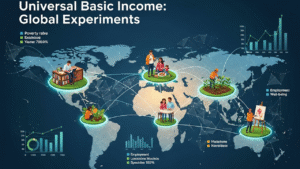
Universal Basic Income (UBI) is a policy proposal under which every adult citizen receives a regular, unconditional cash payment from the government or another public authority, without means testing or work requirements. The payments are intended to cover basic needs and provide a floor of economic security. Unlike traditional welfare programs, UBI does not phase… Read More
Geopolitical Shifts: New Power Blocs in 2025
The year 2025 marked a pivotal acceleration in the reconfiguration of global power structures. Long-standing assumptions about a unipolar or bipolar world order gave way to a more fragmented, multipolar reality. Traditional alliances faced strains from economic pressures, leadership changes, and persistent conflicts, while emerging groupings gained momentum through expansion and strategic coordination. At the… Read More
Youth Voters: Shaping Global Politics
Youth voters, typically defined as those aged 18 to 35, represent a formidable and growing force in democracies worldwide. As populations in many regions skew younger, particularly in the Global South, this demographic holds the potential to redefine political landscapes. In an era marked by economic uncertainty, climate urgency, and digital connectivity, young people are… Read More
Social Media’s Role in 2025 Elections
In 2025, elections unfolded across dozens of countries, from snap federal votes in Germany to national contests in Canada and Australia, off-year races in the United States, and a contentious presidential rerun in Romania. These polls occurred amid a rapidly evolving digital landscape where social media platforms had become primary arenas for political discourse. No… Read More
Climate Politics: Meeting 2030 Goals?
The Paris Agreement of 2015 established a framework for nations to limit global temperature rise to well below two degrees Celsius above pre-industrial levels, while pursuing efforts to cap it at 1.5 degrees Celsius. Central to this effort are the nationally determined contributions, or NDCs, through which countries outline their plans to curb greenhouse gas… Read More
AI in Political Campaigns: Ethical Concerns
Artificial intelligence has rapidly integrated into the fabric of modern political campaigns, promising unprecedented efficiency in voter outreach, message tailoring, and strategic decision-making. Campaigns now deploy AI to analyze vast datasets, generate personalized advertisements, create chatbots for direct voter interaction, and even produce synthetic media such as images and audio clips. While these tools can… Read More
What Political Ads Don’t Want You to Know
Political advertisements have become a constant fixture of modern democracy. During election seasons they flood television screens, social media feeds, radio waves, and mailboxes with polished messages that promise solutions to every problem. Candidates appear as heroic figures surrounded by cheering crowds or concerned families while opponents are cast as threats to everything voters hold… Read More
How Satirical News Shapes Public Opinion
Satirical news has become a powerful force in modern media landscapes, blending humor, exaggeration, and critique to comment on current events and political figures. Unlike traditional journalism, which strives for objectivity and factual reporting, satirical news programs and outlets deliberately twist reality for comedic effect while often embedding pointed social or political commentary. Shows like… Read More
The Rise of Local Politics in a Hyper-Connected World
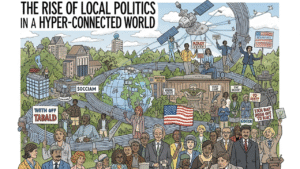
In an age defined by instant global communication and borderless flows of information, the political landscape has undergone a striking transformation. While digital technologies have linked distant corners of the planet like never before, they have also catalyzed a powerful resurgence of local politics. Citizens, once seemingly powerless against distant national capitals or international bodies,… Read More
What School Curriculums Get Wrong About Politics
School curriculums around the world dedicate significant time to politics under headings such as civics, government, or social studies. Students learn about constitutions, elections, branches of government, and major historical events. In theory, this preparation equips young people to become informed citizens. In practice, the approach often leaves graduates with a distorted, incomplete, or actively… Read More
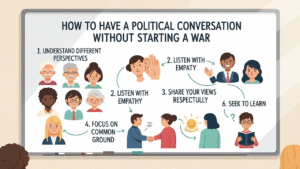
How to Have a Political Conversation Without Starting a War
Political conversations have always been part of human society, but in recent decades they have grown more charged than ever. Social media amplifies every disagreement, news cycles reward outrage, and cultural shifts have turned many topics into identity markers rather than ideas open for debate. The result is that a simple dinner-table exchange about taxes,… Read More
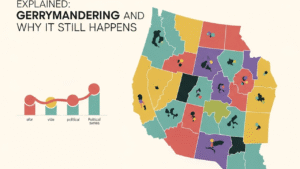
Explained: Gerrymandering and Why It Still Happens
Gerrymandering is the practice of drawing electoral district boundaries in a way that gives an unfair advantage to one political party, candidate, or demographic group. The goal is simple yet corrosive to democracy. By reshaping maps, those in power can turn a minority of votes into a majority of seats or neutralize opposition strongholds without… Read More
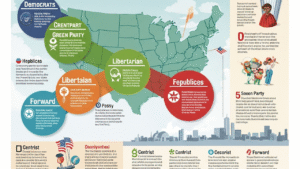
What If the U.S. Had More Than Two Major Parties?
The United States has operated under a two-party system for most of its history. Democrats and Republicans have dominated national politics since the mid-19th century. This arrangement shapes every election, every law passed by Congress, and every presidential administration. It influences how Americans think about issues from taxes to immigration to foreign policy. Yet this… Read More
The Role of Influencers in Modern Elections
In the landscape of contemporary politics, social media influencers have emerged as pivotal figures who shape voter perceptions, drive engagement, and sometimes sway electoral outcomes. Unlike traditional campaign surrogates such as celebrities or party officials, influencers operate through platforms like TikTok, Instagram, YouTube, and X, where they cultivate direct, personal connections with followers. These content… Read More
How Political Scandals Are Evolving in the Digital Age
Political scandals have always been a feature of democratic life, exposing corruption, hypocrisy, or ethical lapses among those in power. From the Teapot Dome affair in the 1920s to the Watergate break-in in the 1970s, these events traditionally unfolded through investigative journalism, congressional hearings, and slow-moving leaks to established newspapers. In the digital age, however,… Read More
The Future of Voting: Online Ballots and Biometric Security
Democracy thrives on participation, yet traditional voting methods have long struggled with accessibility, efficiency, and public trust. Long lines at polling stations, postal delays, and concerns over fraud have prompted nations to explore alternatives. As technology advances, online ballots combined with biometric security emerge as a promising evolution. These systems allow voters to cast ballots… Read More
Why Young People Don’t Trust the Two-Party System
The two-party system in the United States has long dominated American politics, with the Democratic and Republican parties shaping elections, policy debates, and national discourse for over a century and a half. Yet for many young Americans, particularly those in Generation Z and the millennial cohort, this system inspires little confidence and even less loyalty.… Read More
The Rise of Citizen Journalism: Can It Replace the News?
Citizen journalism has emerged as one of the most transformative forces in modern media. Ordinary individuals, equipped with nothing more than smartphones and internet access, now capture, report, and distribute news events in real time. This shift challenges the long-standing monopoly of professional news organizations. From viral videos of protests to eyewitness accounts of disasters,… Read More