

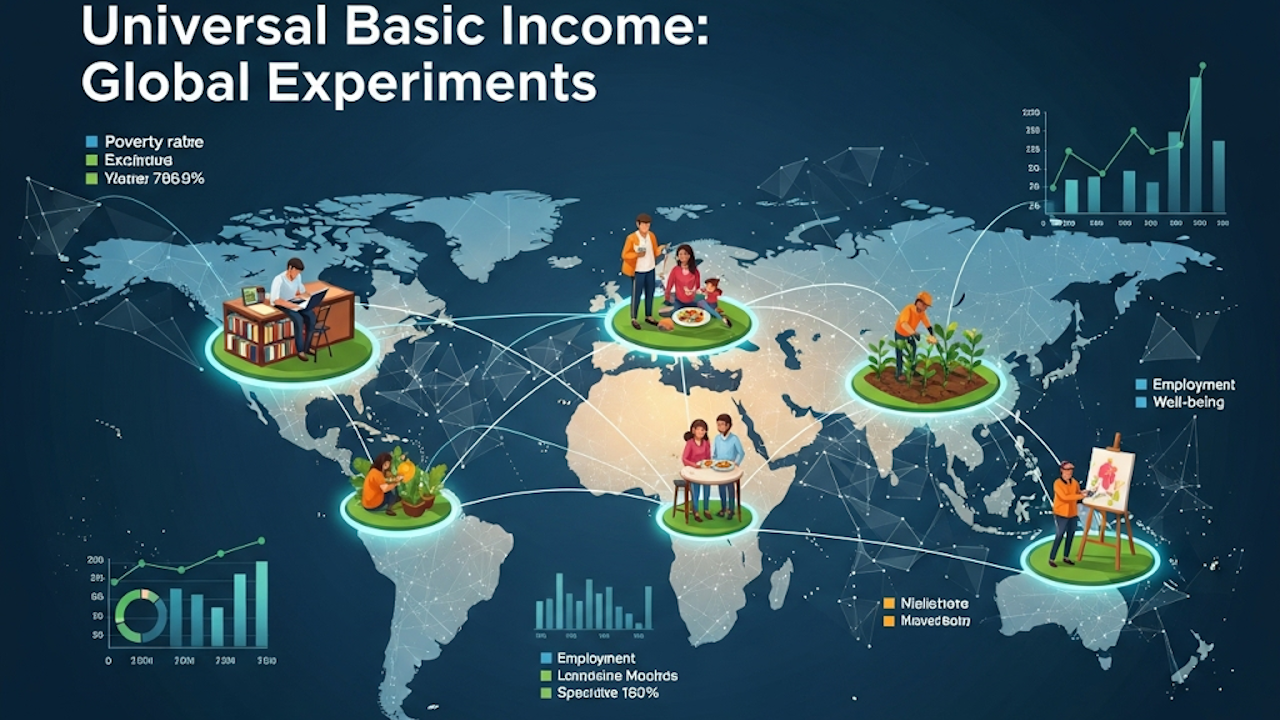
Universal Basic Income (UBI) is a policy proposal under which every adult citizen receives a regular, unconditional cash payment from the government or another public authority, without means testing or work requirements. The payments are intended to cover basic needs and provide a floor of economic security. Unlike traditional welfare programs, UBI does not phase out as earnings rise and does not impose behavioral conditions. Advocates highlight its potential to alleviate poverty, reduce administrative bureaucracy, support workers displaced by automation and artificial intelligence, and improve overall well-being by freeing people from financial precarity. Opponents raise concerns about enormous fiscal costs, possible reductions in labor supply, inflationary pressures, and the risk of dependency.
The modern debate over UBI gained momentum in the late 20th century and intensified after the 2008 financial crisis and during the COVID-19 pandemic, when many governments distributed one-time cash transfers. To evaluate these claims empirically, dozens of experiments have been launched worldwide since the 1960s. These range from small randomized controlled trials (RCTs) lasting a few years to larger-scale programs approaching national implementation. While no country has adopted a pure, universal, and permanent UBI at the national level as of 2026, the accumulated evidence from pilots offers insights into effects on employment, health, entrepreneurship, and poverty. This article reviews major global experiments, organized by region, and synthesizes their lessons.
Early Experiments in North America
The first rigorous tests of unconditional cash transfers occurred in the United States during the 1960s and 1970s through Negative Income Tax (NIT) experiments. These were not identical to modern UBI proposals but shared core features: guaranteed minimum income with a gradual phase-out as earnings increased. The New Jersey Graduated Work Incentive Experiment (1968-1972) involved nearly 1,000 low-income two-parent households receiving payments ranging from 50 to 125 percent of the poverty line. Researchers observed a moderate reduction in work effort, with women reducing hours by about 17 percent and men by 7 percent. However, the funds were not wasted; families increased school attendance among children, and there were no major gains or losses in health or home ownership.
Similar NIT trials followed in rural Iowa and North Carolina (1970-1972), Seattle and Denver (1970-1980), and Gary, Indiana (1971-1974). Collectively, these studies, involving thousands of participants, found modest labor supply reductions, particularly among secondary earners, but also positive effects on child schooling and family stability in some cases. The longest-running North American experiment was Canada’s Mincome project in Dauphin, Manitoba (1974-1979). Residents received a guaranteed annual income, and the results showed a significant drop in hospitalization rates, especially for mental health issues. Only new mothers and teenagers reduced work hours substantially, with the latter using the time to complete high school at higher rates.
More recent North American activity has centered on the United States, where over 122 guaranteed income pilots operated between 2017 and 2025 across 33 states and the District of Columbia. These distributed roughly $481 million to more than 40,000 recipients, with average monthly payments around $616 and durations averaging 18 months. Many targeted low-income or specific demographic groups rather than being fully universal. The Stockton Economic Empowerment Demonstration (SEED) in Stockton, California (2019 onward) gave 125 residents $500 per month. Participants primarily spent the funds on groceries, bills, and essentials. Full-time employment rose, and psychological well-being improved, with no evidence of reduced work incentives during the short pilot.
Larger U.S. efforts include pilots in Los Angeles, where families received $1,000 monthly and reported transformative improvements in financial stability and health. A dashboard tracking more than 30 evaluated pilots shows that the largest share of spending went to retail, services, housing, and food. Across these programs, employment effects have varied. Smaller randomized trials often showed slight increases in employment rates, but the four largest pilots (each with at least 500 participants and covering over half of all treatment-group individuals) recorded an average decline of 3.2 percentage points. Overall, the mean effect across 30 randomized pilots with published data was a modest 0.8 percentage-point increase, with no pilots showing catastrophic workforce withdrawal.
Canada revived interest with its Ontario Basic Income Pilot (2017-2018), which was canceled before full results but provided payments to low-income adults aged 18-64. Tribal profit-sharing programs, such as those from the Eastern Band of Cherokee Indians in North Carolina, have delivered semi-annual unconditional payments to members, leading to reduced behavioral problems in children and improved family dynamics in longitudinal studies.
European Experiments
Europe has hosted several high-profile pilots emphasizing well-being and labor market flexibility. Finland’s 2017-2018 experiment remains one of the most cited. The government randomly selected 2,000 unemployed citizens aged 25-58 and provided them with €560 (about $635) per month, tax-free, for two years, while a control group received standard unemployment benefits. Preliminary and final results showed no significant negative impact on employment; in fact, recipients worked slightly more days on average than the control group. Self-reported well-being, happiness, and health improved markedly, with lower stress and greater trust in institutions. The modest employment gains and strong non-economic benefits suggested that removing bureaucratic hurdles from conditional benefits could enhance life satisfaction without discouraging work.
In Germany, a three-year pilot launched in 2020 provided €1,200 per month to 122 participants, compared against a control group of 1,580. Final results, released after data analysis, confirmed positive effects on mental health, sense of autonomy, and social participation, with no evidence of reduced labor supply among recipients. Other European efforts include the Netherlands’ municipal pilots in the 2010s, which tested variations of basic income for welfare recipients, and Spain’s B-MINCOME project in Barcelona (2017-2019), which combined cash transfers with active labor policies and found improvements in poverty reduction and community engagement.
The Welsh Government launched a pilot in 2022 for young people leaving care, offering £1,600 per month (net £1,280 after tax) with no conditions. Early monitoring indicated enhanced financial security and mental health. Catalonia, in Spain, began a substantial pilot in 2025 targeting 5,000 residents with €906 monthly for adults and €400 for children. Evaluation is scheduled for 2026 and focuses on poverty, employment flexibility, and health outcomes. These European trials consistently report gains in subjective well-being and minimal or positive labor market effects, though scalability to national levels remains untested due to high projected costs.
African and Asian Initiatives
Africa has produced some of the most ambitious and long-running experiments, often in rural, low-income settings where cash transfers can have outsized impacts. Namibia conducted a two-year pilot (2008-2009) in the Otjivero-Omitara settlement, giving roughly 1,000 residents under age 60 about $7 monthly. Poverty fell sharply, child malnutrition decreased, and economic activity increased through small businesses. Follow-up payments continued until 2012. Uganda ran a 2017 pilot in a village providing modest monthly sums to households, resulting in 57 percent growth in business assets, 17 percent more work hours, and 38 percent higher earnings as residents launched enterprises.
The world’s largest and longest UBI-style experiment is underway in Kenya, led by the nonprofit GiveDirectly since 2017-2018. Over 20,000 recipients in 195 rural villages receive $22.50 monthly. The design includes three treatment arms: long-term UBI (12 years), short-term UBI (2 years), and a one-time lump sum of $500, plus control villages. Early findings after two years (covering 2018-2020) revealed no reduction in work hours or idleness. Recipients shifted from agricultural wage labor to self-employment and entrepreneurship. The lump-sum group created the most new businesses and boosted household income by 50 percent relative to controls. Long-term UBI encouraged greater savings and future-oriented investments. Food security and mental health improved, with short-term recipients showing the largest drop in depression. No increases in alcohol consumption or other negative behaviors occurred. Surveys at seven and twelve years are planned to assess sustained effects.
In Asia, India conducted UNICEF-backed pilots in 2011 in Madhya Pradesh, providing 200 rupees monthly to adults and 100 rupees to children for about 6,000 people. Outcomes included better nutrition, school attendance, and economic activity, with women reporting greater empowerment. Iran stands out as the closest real-world example of a national-scale program. Since 2010, the government has provided unconditional cash transfers to all citizens, replacing fuel and food subsidies. Households receive the equivalent of roughly 29 percent of income on average. Studies indicate poverty reduction and increased labor force participation, particularly among women, though inflation and fiscal sustainability have posed challenges. South Korea has experimented with provincial programs, such as Gyeonggi Province’s youth allowances and rural basic income initiatives, showing population retention benefits in declining areas.
Other Notable Programs and Synthesis of Results
Alaska’s Permanent Fund Dividend, funded by oil revenues, provides all residents an annual unconditional payment (typically $1,000-$2,000). Though not monthly, it demonstrates long-term feasibility of universal cash distributions without evident work disincentives. Brazil has explored similar cash transfer models through programs like Bolsa Familia, though these retain some conditions.
Across hundreds of experiments, several patterns emerge. Employment effects are generally neutral or modestly positive when measured by quality of work rather than raw hours. Larger, more credible studies show small reductions in some contexts, consistent with standard economic models of income elasticity around -0.18, yet overall labor supply rarely collapses. Health and mental well-being consistently improve: recipients report less stress, better physical health, and reduced depression. Children benefit through higher school attendance, lower obesity rates in some trials, and improved behavioral outcomes. Entrepreneurship rises as people invest in small businesses or training. Spending focuses overwhelmingly on essentials such as food, housing, and utilities, with little evidence of waste on luxuries or vice. Food insecurity drops, and community-level economic multipliers appear in cash-rich villages.
Critics note that most pilots are short-term, small-scale, and often implemented during economic expansions or post-COVID recovery, limiting generalizability to a permanent nationwide program. Attrition rates are high in some studies, and funding has sometimes come from private donors rather than sustainable public budgets. Iran’s national experience highlights fiscal trade-offs, while Kenya’s ongoing trial suggests that longer horizons amplify investment effects over immediate consumption.
Challenges and Future Prospects
Scaling UBI globally faces formidable hurdles. Full implementation could cost trillions annually in large economies, requiring tax increases, reallocation of existing welfare budgets, or new revenue sources such as carbon taxes or wealth levies. Political feasibility varies: pilots enjoy broad support for their experimental nature, but permanent adoption encounters resistance over perceived fairness and work ethic concerns. Inflation risks arise if supply does not keep pace with increased demand, though evidence from pilots indicates modest price effects localized to certain goods.
As of 2026, interest persists amid rapid technological change. Proposals linking UBI to artificial intelligence displacement have surfaced in legislative discussions, and additional pilots continue in places such as the Marshall Islands and select U.S. cities. The cumulative data from more than 160 experiments worldwide suggests that unconditional cash transfers deliver tangible improvements in human welfare without the dire labor market collapse feared by skeptics. Yet they do not constitute a universal panacea. Future policy design must balance generosity with fiscal realism, perhaps through hybrid models that complement rather than replace targeted services.
In conclusion, global UBI experiments have moved the conversation from abstract theory to evidence-based assessment. They affirm that providing people with basic financial security enhances dignity, health, and opportunity in diverse cultural and economic contexts. Whether these lessons translate into widespread adoption will depend on political will, economic conditions, and continued rigorous evaluation. The next decade of trials and policy debates will determine if UBI evolves from experimental curiosity to mainstream tool for 21st-century challenges.