

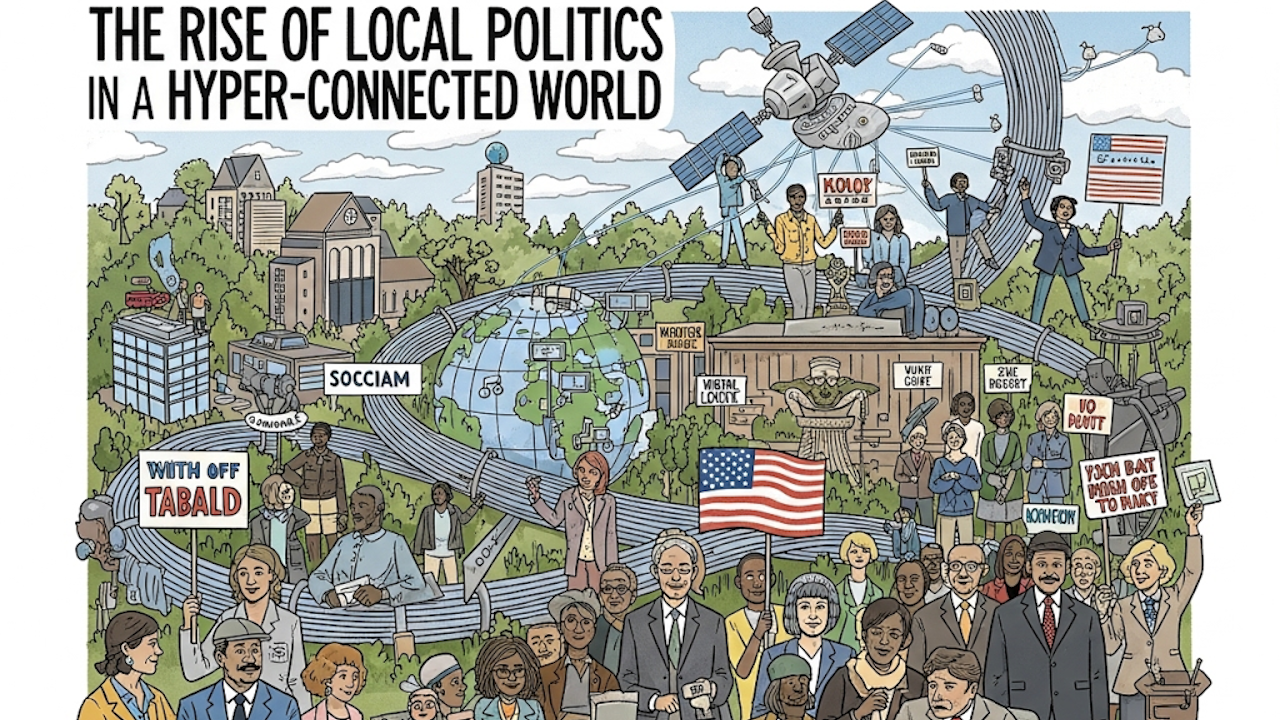
In an age defined by instant global communication and borderless flows of information, the political landscape has undergone a striking transformation. While digital technologies have linked distant corners of the planet like never before, they have also catalyzed a powerful resurgence of local politics. Citizens, once seemingly powerless against distant national capitals or international bodies, are now channeling their energy into city councils, neighborhood assemblies, and regional initiatives. This shift represents more than a fleeting trend. It signals a fundamental reorientation of power in response to the very forces of hyper connectivity that many predicted would render local concerns obsolete.
Hyper connectivity describes the dense web of digital infrastructure that binds individuals, communities, and institutions. Smartphones, high speed broadband, social media networks, and real time data streams have compressed time and space. A protest in one city can inspire solidarity actions thousands of miles away within hours. Global news cycles dominate attention, yet this same infrastructure has sharpened focus on the streets outside people’s doors. The paradox is clear: the more connected the world becomes, the more urgently people seek control over the spaces they inhabit daily. Local politics has risen precisely because hyper connectivity exposes the limits of centralized authority while equipping ordinary citizens with tools to act at the scale they can influence most directly.
The roots of this resurgence trace back to growing disillusionment with national and global institutions. Decades of globalization promised prosperity and efficiency, but delivered uneven results. Trade agreements lifted millions from poverty in some regions while hollowing out manufacturing towns in others. International organizations tackled grand challenges such as climate accords or pandemic response, yet implementation often faltered at the ground level. Voters noticed. Trust in national legislatures and supranational entities declined steadily across many democracies. In this vacuum, local governments emerged as more responsive alternatives. A mayor can approve a new bus route or fund a community center with visible speed. A school board can debate curriculum changes that affect families immediately. These outcomes feel real and accountable in ways that abstract policy debates in distant halls rarely do.
Social media platforms have accelerated this dynamic. Once viewed as engines of globalization, they now serve as powerful amplifiers for hyper local voices. Residents share videos of flooded streets or uncollected trash, tagging officials and sparking public pressure campaigns. Neighborhood groups organize via group chats and live streams, turning casual complaints into organized advocacy. Algorithms, while often criticized for promoting division, also surface content tied to geographic proximity. When a local park faces closure or a zoning variance threatens historic buildings, posts circulate rapidly within the affected community. This immediacy contrasts with the slower pace of traditional media and creates a feedback loop that elevates local issues to the forefront of public consciousness.
Technological innovation has further lowered barriers to local political participation. Participatory budgeting programs, once rare experiments, now appear in hundreds of municipalities worldwide. Residents propose and vote on spending priorities through user friendly apps and online portals. In some cities, digital dashboards track every public works project in real time, allowing citizens to monitor progress and demand corrections. Mobile reporting tools let anyone photograph a pothole or graffiti and submit it directly to city maintenance crews with GPS coordinates. These systems reduce the friction of civic engagement. No longer must residents attend lengthy evening meetings after a full workday. They can participate from their phones during a commute or lunch break. The result is broader involvement, particularly among younger demographics who grew up with digital tools as second nature.
Economic and cultural shifts have reinforced the trend. The rise of remote work, accelerated by the global pandemic of the early 2020s, allowed many professionals to relocate or remain in smaller communities rather than clustering in expensive megacities. These individuals brought higher expectations and resources to their new locales, demanding better schools, safer streets, and sustainable development. At the same time, globalization’s cultural dislocations have prompted a defensive embrace of local identity. Debates over immigration, language, or land use play out most intensely at the community level, where the impacts are immediate and personal. Local politicians respond by crafting policies attuned to these realities, whether through targeted integration programs or restrictions on short term rentals that strain housing markets.
Environmental urgency provides another compelling illustration. Climate change is undeniably planetary in scope, yet cities and towns have taken the lead in crafting actionable responses. Municipalities worldwide have adopted ambitious emissions reduction targets, often exceeding those of their national governments. Urban forestry projects, electric vehicle charging networks, and localized renewable energy microgrids demonstrate how hyper local decisions aggregate into meaningful progress. Networks of mayors exchange best practices through online forums and virtual summits, creating a decentralized laboratory of innovation. A successful bike lane expansion in one European city inspires similar pilots in Latin American capitals. This bottom up approach proves more adaptable than top down mandates, adjusting swiftly to local topography, culture, and economic conditions.
Case studies from various regions highlight the pattern. In the United States, local politics gained prominence as cities experimented with progressive reforms on policing, housing, and minimum wages. Initiatives in places like Seattle or Austin influenced statewide conversations and sometimes national platforms. School board races, once sleepy affairs, became flashpoints for debates over education and parental rights, drawing record turnout fueled by parent groups coordinating online. In Europe, citizen led movements captured city halls in cities such as Barcelona, where grassroots platforms used digital organizing to challenge established parties. Regional assemblies in devolved nations like Scotland and Wales asserted greater autonomy over health and education policy. In parts of Latin America and Africa, mobile technology enabled rural communities to monitor local elections and public spending, reducing corruption through real time transparency.
Even in the Global South, where national institutions sometimes struggle with capacity, hyper connectivity has empowered local actors. Farmers cooperatives in India use smartphone apps to negotiate with local authorities over water rights or crop subsidies. Community radio stations stream live council meetings, allowing listeners to call in with questions. These examples show that local politics is not a luxury of wealthy democracies but a universal response to the need for accountable governance in an interconnected era.
Yet the ascent of local politics carries risks that merit careful scrutiny. Fragmentation poses one challenge. When cities and regions adopt conflicting regulations on issues ranging from public health to environmental standards, coordination becomes difficult. Businesses may face a maze of rules when operating across jurisdictions, and mobile populations encounter inconsistent services. Localism can also foster insularity. NIMBY attitudes, or resistance to developments perceived as undesirable in one’s own backyard, have stalled affordable housing projects and infrastructure upgrades in many prosperous areas. Short term electoral pressures may discourage bold but unpopular decisions needed for long term sustainability.
Hyper connectivity itself introduces vulnerabilities. Online echo chambers can intensify local divisions, as residents encounter only reinforcing viewpoints. Misinformation spreads with alarming speed, sometimes derailing constructive debate over school funding or land use. Digital divides persist, leaving lower income or elderly residents underrepresented despite the proliferation of tools. Moreover, local governments often lack the resources or expertise of national bodies, leading to uneven policy quality. A small town may struggle to implement complex climate adaptation plans without external support.
These drawbacks do not negate the overall momentum. Evidence from voter surveys and civic engagement studies consistently shows rising interest in local contests compared with national ones in many countries. Turnout in municipal elections has climbed in several nations, driven by the perception that local votes matter more tangibly. Successful local experiments frequently scale upward. Pilot programs for universal basic income in select cities have informed national policy discussions. Community driven policing reforms have shaped legislative agendas at higher levels. This iterative process strengthens democratic resilience by testing ideas in controlled environments before broader adoption.
Looking forward, the interplay between local politics and hyper connectivity seems poised to deepen. Artificial intelligence tools could soon assist local planners in modeling traffic patterns or predicting flood risks with granular accuracy. Virtual reality town halls may allow broader participation from residents unable to attend in person. International alliances of cities could evolve into influential blocs, advocating collectively on trade, migration, or technology standards while retaining their focus on ground level delivery. The key will be balancing autonomy with collaboration. Local leaders must harness digital tools without succumbing to their polarizing tendencies, ensuring inclusive processes that represent all segments of the community.
In essence, the rise of local politics reflects a mature adaptation to hyper connectivity rather than a rejection of it. The same networks that broadcast global crises also illuminate the power of proximity. People have rediscovered that meaningful change often begins where they live, work, and raise families. By investing in local institutions and leveraging technology to enhance transparency and participation, societies can address the limitations of centralized systems while retaining the benefits of global awareness. This rebalancing holds promise for revitalizing democracy at its most elemental level. As communities gain confidence in their own capacity to solve problems, they contribute to a more responsive and innovative world overall. The hyper connected era need not dissolve local bonds. Instead, it can strengthen them, creating a political order that is simultaneously global in reach and rooted in place.