

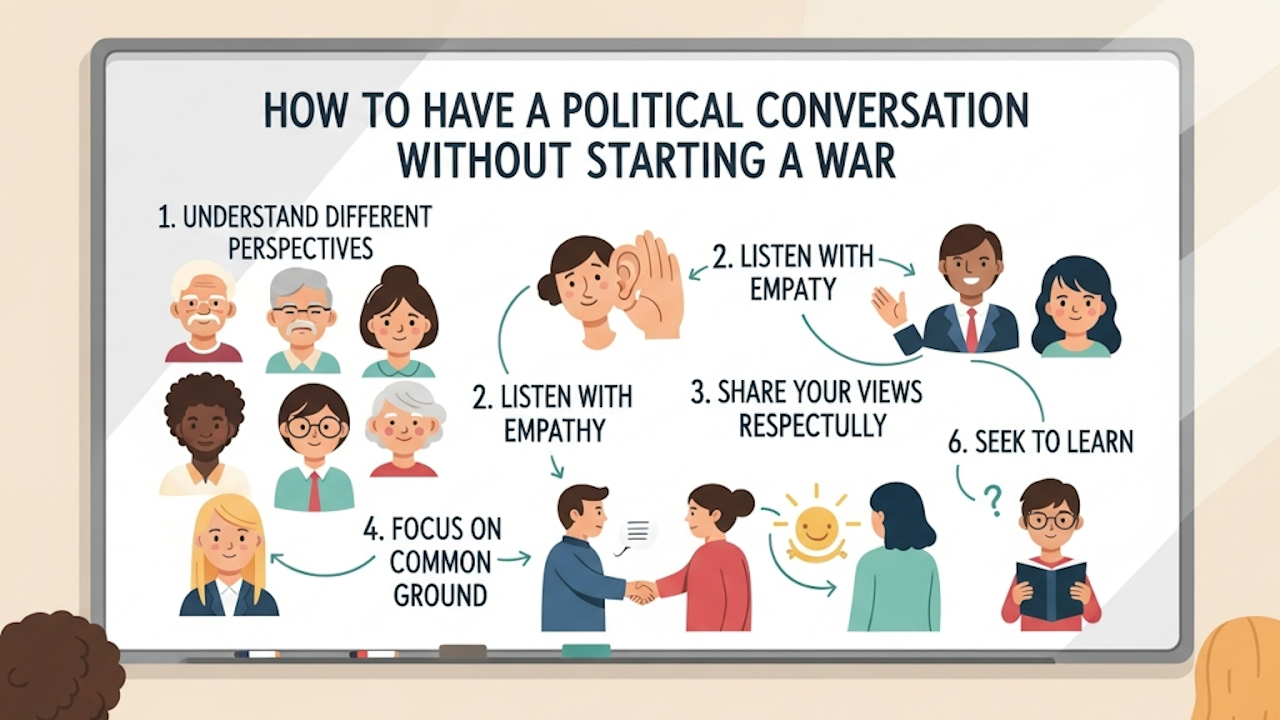
Political conversations have always been part of human society, but in recent decades they have grown more charged than ever. Social media amplifies every disagreement, news cycles reward outrage, and cultural shifts have turned many topics into identity markers rather than ideas open for debate. The result is that a simple dinner-table exchange about taxes, immigration, foreign policy, or climate strategy can escalate into accusations, raised voices, and damaged relationships. Yet avoiding these talks entirely is not a solution. Democracy depends on citizens who can disagree productively. Personal growth requires testing our own assumptions against the views of others. The alternative to shouting matches is not silence but skill. This article lays out a practical, step-by-step framework for conducting political conversations that stay civil, reveal truth, and sometimes even change minds without burning bridges.
The first requirement is clarity about the goal. Most people enter political discussions intending to win. That mindset turns every exchange into a contest with winners and losers. A better objective is mutual understanding. You do not need to convert the other person. You only need to leave the conversation knowing more about why they believe what they believe and having given them the same opportunity to understand you. When the aim shifts from victory to comprehension, the emotional stakes drop immediately. This reframing is not weakness; it is strategic. People defend positions more fiercely when they feel attacked. When they feel heard, defenses relax and curiosity can emerge.
Preparation begins long before the first word is spoken. Examine your own emotional state. If you are already angry about a recent headline or personal grievance, postpone the conversation. Fatigue, hunger, or stress also sabotage good dialogue. Choose a setting that supports calm exchange: a quiet walk, a living room without screens, or a coffee shop rather than a bar where alcohol lowers inhibitions. Timing matters. Avoid launching into policy debates right after someone has endured a long workday or during family holidays when emotions already run high. A brief check-in helps: “Is now a good time to talk about the election results, or would you rather wait?” Respect for the other person’s readiness signals that the discussion is not an ambush.
Once the conversation starts, the single most powerful tool is listening. This is not the passive silence people often mistake for listening. Active listening requires three deliberate actions. First, give the speaker your full attention. Put away phones, maintain eye contact, and nod occasionally to show you are tracking. Second, reflect back what you heard in your own words: “So if I understand you correctly, you believe that raising the minimum wage would hurt small businesses because labor costs would force them to cut hours. Is that right?” This step forces you to process the argument accurately and gives the speaker a chance to correct any misinterpretation. Third, ask follow-up questions that explore the reasoning rather than challenge it immediately: “What experiences led you to that view?” or “How do you think that policy would play out over the next five years?” Genuine questions signal respect and often uncover the values or evidence behind the position.
Language choices determine whether a conversation builds or destroys trust. Avoid statements that begin with “You people always…” or “Your side is destroying the country.” These generalizations lump the individual into a despised group and trigger defensiveness. Instead, speak from personal experience using “I” statements: “I worry that rapid changes in immigration policy strain local services because I saw it happen in my hometown.” This keeps the focus on your perspective rather than an attack on theirs. Steer clear of loaded labels such as “radical,” “extremist,” “fascist,” or “communist” unless the person has explicitly embraced those terms. Even then, it is wiser to describe specific policies rather than apply ideological tags. Precision in language shows intellectual honesty and reduces the chance that the other person will hear an insult where none was intended.
Finding common ground is not a tactic to manipulate agreement; it is a way to remind both parties that they share the same reality. Almost every political disagreement rests on shared human concerns: safety, fairness, prosperity, freedom. Begin by naming those overlaps aloud. “We both want lower crime rates and better schools for our kids. We just disagree on the best path to get there.” Once that foundation is established, differences become easier to explore without the sense that one worldview must annihilate the other. Research in psychology consistently shows that people are more willing to consider new information when they feel their core values are acknowledged first.
Questions are more persuasive than assertions. A well-timed question invites the other person to articulate their own logic, which often reveals inconsistencies they had not noticed. Instead of declaring, “Universal healthcare would bankrupt the country,” try, “I’ve read that countries with single-payer systems face long wait times for elective procedures. Have you seen data that suggests otherwise?” The question format keeps the exchange exploratory rather than combative. It also models intellectual humility. You are admitting that your knowledge is limited and that you are open to correction. That posture is contagious. When one participant shows willingness to learn, the other is more likely to reciprocate.
Emotional regulation is essential when disagreement surfaces. Discomfort is inevitable in any serious political talk. The brain’s threat-detection system treats ideological challenges as physical danger, releasing adrenaline and narrowing focus to fight-or-flight responses. Recognize the physical signs: faster heartbeat, tighter chest, rising voice. When you notice them, pause. Take a slow breath. Remind yourself that the person across from you is not an enemy but a fellow citizen trying to make sense of a complicated world. If the temperature rises, name it neutrally: “I can feel myself getting defensive here. Let me take a moment to collect my thoughts.” This transparency humanizes the exchange and often de-escalates tension.
Certain topics carry extra emotional weight because they touch on identity, trauma, or moral convictions. Immigration, race, gender, religion, and abortion are frequent flashpoints. In these cases, extra caution is warranted. Begin by clarifying definitions. People often argue past each other because they use the same words to mean different things. “When you say ‘open borders,’ do you mean completely unregulated entry or simply more generous legal immigration pathways?” Clarifying terms prevents straw-man arguments. Acknowledge the moral dimension without conceding the policy debate: “I understand that you see this issue as a matter of basic human dignity, and I share that concern even though I reach a different conclusion on enforcement.” Validation of feelings does not require agreement on solutions, but it keeps the conversation respectful.
Evidence and sources deserve careful handling. In an era of algorithmic echo chambers, people arrive armed with conflicting facts. Rather than dismissing the other person’s data as fake, ask how they evaluated it: “What made that study persuasive to you?” Share your own sources without demanding immediate conversion: “I found this report from a nonpartisan think tank that reached a different conclusion. Would you be interested in looking at it later?” The goal is not to score points but to establish a shared standard for what counts as reliable information. Over time, repeated exposure to rigorous sources from multiple perspectives can shift opinions more effectively than any single argument.
Knowing when to stop is as important as knowing how to begin. Not every conversation needs a resolution. Some differences are irreconcilable in one sitting. When fatigue sets in or positions harden, propose a graceful exit: “I appreciate you sharing your perspective. I still disagree on the best approach, but I understand your reasoning better now. Maybe we can revisit this another time.” If the discussion turns personal or disrespectful, end it firmly: “I’m happy to talk about the policy, but I’m not willing to continue if we start attacking each other’s character.” Setting boundaries protects the relationship and models healthy limits.
Real-world examples illustrate the difference between destructive and constructive approaches. Consider two friends debating gun control. In the destructive version, one says, “Only idiots think more guns equal more safety. The data is clear.” The other retorts, “You want to leave law-abiding citizens defenseless against criminals.” Tempers flare, and the friendship cools. In the constructive version, the first friend asks, “What do you see as the main driver of gun violence in our country?” The second explains concerns about mental health, family breakdown, and enforcement gaps. The first then shares data on mass shootings and accidental deaths, framing it as “Here’s what worries me most.” Both leave with a clearer picture of the trade-offs involved: public safety versus individual rights. No minds changed on the spot, yet respect remains intact.
Another example involves workplace talk about affirmative action. A colleague argues that merit alone should decide hiring. Another counters that historical disadvantages require corrective measures. A skilled participant might respond, “I agree that past discrimination created unequal starting points. Where I get stuck is whether current policies are the fairest way to address that today. Have you looked at studies on mismatch effects in university admissions?” The question opens a door rather than slamming one shut.
These techniques work because they treat the other person as a rational agent capable of good-faith reasoning. That assumption is not always true. Some individuals argue in bad faith, seeking only to provoke or dominate. In those rare cases, the wisest response is disengagement. You cannot reason someone out of a position they did not reason themselves into. Protecting your time and energy is not surrender; it is self-preservation.
The broader benefits of mastering civil political conversation extend far beyond individual relationships. Societies that lose the ability to disagree without hatred fracture into tribes that view one another as existential threats. History shows that such polarization precedes instability. Conversely, cultures that preserve norms of respectful debate adapt more successfully to new challenges. Citizens who practice these skills become better voters, more thoughtful leaders, and stronger community members. They model for children that disagreement is not dangerous but necessary for progress.
Parents can teach these habits early. Family dinners provide natural laboratories. Instead of shutting down a teenager’s provocative opinion, ask, “What led you to that conclusion?” Encourage evidence gathering and logical testing. Over years, young people internalize that political ideas are tools for understanding reality, not weapons for tribal warfare.
Institutions also play a role. Schools, universities, and workplaces should reward intellectual courage over ideological conformity. Debate clubs, structured dialogues, and cross-partisan reading groups create low-stakes practice fields. Media outlets that prioritize nuance over outrage contribute by giving audiences exposure to competing arguments presented fairly. None of these changes happen automatically. They require deliberate effort from individuals who decide that truth matters more than comfort or applause.
Critics sometimes argue that calls for civility suppress necessary confrontation. They claim that some ideas are so dangerous they must be shouted down. This view confuses passion with rudeness. Strong convictions can be expressed forcefully without personal attacks. History’s most effective reformers, from Martin Luther King Jr. to Mahatma Gandhi, combined moral clarity with disciplined nonviolence and respect for opponents as persons. Their example shows that ethical urgency and conversational skill are compatible.
Technology complicates the picture. Online platforms strip away tone of voice, facial expressions, and immediate feedback. Misunderstandings multiply. When engaging digitally, the same rules apply but with stricter discipline. Read the entire post before replying. Wait twenty-four hours before responding to emotionally charged material. Use private messages rather than public threads when possible. And remember that the person behind the avatar is a human being with hopes, fears, and a need for dignity.
Ultimately, the ability to discuss politics without starting a war rests on a simple philosophical commitment: other people are not stupid or evil merely because they reached different conclusions from the available evidence. They operate with different information, different life experiences, different priorities. Truth-seeking requires curiosity about those differences. It demands the humility to admit that your own worldview might contain blind spots. It asks you to value long-term relationships over short-term rhetorical victories.
None of this is easy. It requires practice, self-control, and a willingness to tolerate temporary discomfort. Yet the reward is substantial. Conversations conducted in this spirit expand knowledge, strengthen social bonds, and keep democratic norms alive. They transform potential enemies into conversation partners and, on good days, into friends who disagree. In a world that often feels determined to divide us, choosing civility is an act of quiet rebellion and genuine patriotism.
Start small. Pick one upcoming political discussion and apply a single technique from this article: active listening, an “I” statement, or a clarifying question. Notice what changes. Over time, these habits compound. You will find yourself less anxious before difficult talks, more confident in your ability to navigate disagreement, and more hopeful about the possibility of shared understanding. Political conversation does not have to be warfare. With intention and skill, it can become one of the highest forms of human connection: the joint pursuit of truth in a world that rarely hands it over easily.