

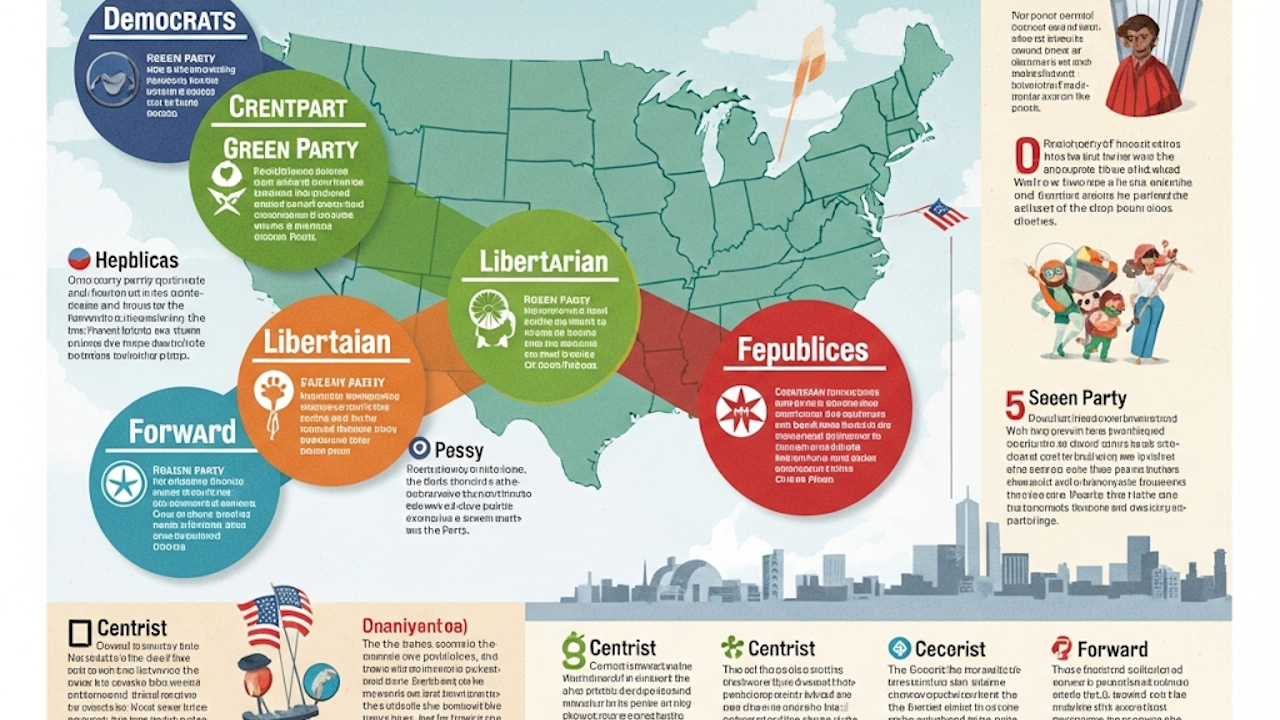
The United States has operated under a two-party system for most of its history. Democrats and Republicans have dominated national politics since the mid-19th century. This arrangement shapes every election, every law passed by Congress, and every presidential administration. It influences how Americans think about issues from taxes to immigration to foreign policy. Yet this dominance is not inevitable. It stems from specific rules such as single-member districts and winner-take-all elections. What if those rules changed? What if the country developed a stable system with three, four, or even five major parties competing on equal footing?
Such a shift would transform American democracy. It could produce more responsive government or deeper gridlock. It might reduce the intense polarization that defines politics today or introduce new forms of division. To explore this counterfactual, we must examine why the two-party system persists, how a multi-party alternative might arise, what the parties could look like, and the likely consequences for governance, elections, policy, and society.
The Roots of the Two-Party System
Political scientists often cite Duverger’s Law to explain the persistence of two parties. In electoral systems that award seats to the candidate with the most votes in each district, smaller parties struggle to win representation. Voters learn to support one of the two viable options rather than waste votes on a third choice. This dynamic has held in the United States since the early republic. The Federalists and Democratic-Republicans gave way to Democrats and Whigs, then Democrats and Republicans after the Civil War.
Third parties have occasionally risen but never endured at the national level. Theodore Roosevelt’s Progressive Party in 1912 split the Republican vote and helped elect Woodrow Wilson. George Wallace’s American Independent Party in 1968 captured Southern discontent but faded. Ross Perot’s Reform Party in 1992 won nearly 19 percent of the popular vote yet secured no electoral votes and dissolved soon after. More recent efforts by the Green Party, Libertarian Party, and others have remained marginal. Structural barriers such as ballot access laws, campaign finance rules favoring the two major parties, and the Electoral College reinforce this pattern.
Public frustration with the duopoly runs high. Polls consistently show that a majority of Americans wish for more options. Yet the system endures because it delivers clear choices and stable majorities. A multi-party system would require fundamental changes to break this cycle.
How a Multi-Party System Could Emerge
Several pathways exist. The most direct involves electoral reform. Many democracies use proportional representation, where parties receive seats in parliament roughly in proportion to their share of the vote. If the United States adopted multi-member districts or national party-list voting for the House of Representatives, smaller parties could gain traction immediately. Ranked-choice voting, already used in some states and cities, reduces the spoiler effect and encourages voters to rank preferences honestly. Alaska and Maine have experimented with it, producing outcomes that sometimes favor independents or third-party candidates.
Other catalysts could include cultural and technological shifts. The rise of social media has fragmented media consumption and allowed niche movements to organize nationally without traditional party infrastructure. Economic crises or social upheavals might splinter existing coalitions. For instance, the growing divide between moderate and progressive Democrats or between traditional conservatives and populist nationalists could produce breakaway groups that evolve into permanent parties.
Campaign finance reform might accelerate the process. Public funding for parties that reach a certain vote threshold, combined with stricter limits on donations from corporations and wealthy individuals, could level the playing field. Demographic changes also matter. A more diverse electorate with varied priorities on climate, immigration, and economic inequality might demand parties tailored to specific concerns rather than broad-tent coalitions.
Assume, for this scenario, that by the 2030s or 2040s these reforms take hold. Congress passes legislation creating multi-member districts for the House and adopts ranked-choice voting nationwide. The Senate, harder to reform because of equal state representation, follows more slowly but begins to reflect new alignments. Presidential elections shift toward a national popular vote or ranked-choice system to avoid third-party spoilers. Under these conditions, a genuine multi-party landscape takes shape.
The Shape of a Multi-Party America
In this hypothetical future, the United States might sustain four or five viable national parties, each with distinct platforms and regional strongholds. The exact lineup would reflect current cleavages but evolve over time. Here is one plausible configuration:
A Conservative Party, heir to traditional Republican values, would emphasize limited government, free markets, strong national defense, and traditional social norms. It would draw support from suburban and rural voters in the Midwest and South who favor fiscal restraint without the cultural nationalism of recent Republican factions.
A Nationalist-Populist Party would appeal to working-class voters concerned about trade, immigration, and cultural change. It might advocate tariffs, stricter border controls, and government intervention to protect domestic industries. This party could dominate in industrial regions and parts of the rural heartland, echoing elements of the Trump-era Republican coalition but operating independently.
A Progressive Party would champion expansive social programs, aggressive climate action, wealth redistribution, and criminal justice reform. It would attract urban voters, young people, and minorities in coastal cities and university towns. Positions on issues such as universal healthcare and student debt relief would set it apart.
A Libertarian Party would focus on individual liberty, deregulation, non-interventionist foreign policy, and civil liberties. It might gain traction among tech entrepreneurs, rural Westerners, and younger voters skeptical of both big government and corporate power. Though small, it could serve as a kingmaker in close contests.
A Centrist or Moderate Party might emerge as a pragmatic alternative, appealing to suburban swing voters who dislike extremes on both sides. It would prioritize compromise on fiscal policy, infrastructure, and education while avoiding ideological purity tests. In a fragmented system, this party could play a pivotal role in coalitions.
Regional variations would add complexity. Environmentalists might form a stronger Green Party in the Pacific Northwest. A Social Democratic Party could appeal in the Northeast. Over time, parties might merge, split, or realign in response to new issues such as artificial intelligence regulation or global pandemics.
These parties would not operate in isolation. Coalitions would become routine. No single party might command a majority in the House, forcing negotiations for the speakership and committee chairs. Presidential candidates would likely need endorsements or alliances to reach the 50 percent threshold under ranked-choice voting.
Governance and Policy Outcomes
A multi-party Congress would function differently from today’s. Legislation would require broader consensus. A climate bill, for example, might combine progressive carbon taxes with nationalist incentives for domestic clean energy manufacturing. This bargaining could produce more durable laws less vulnerable to reversal after elections. On the other hand, coalition governments might prove unstable. European examples such as Italy’s frequent cabinet collapses illustrate the risk of paralysis when parties quarrel over minor issues.
The separation of powers unique to the American system would complicate matters further. A president from one party facing a fragmented Congress might struggle to pass an agenda. Gridlock could increase on some fronts while decreasing on others. Budget negotiations, already contentious, might involve horse-trading among multiple factions. Yet smaller parties could force attention to neglected issues. A Libertarian bloc might block expansive surveillance measures, while a Green Party could demand stronger environmental protections in exchange for supporting infrastructure spending.
Voter turnout could rise. When citizens feel their views are genuinely represented, they participate more. Studies from proportional-representation countries show higher engagement, especially among younger and minority voters. Campaigns would focus less on negative attacks against a single opponent and more on positive differentiation. Television ads and debates would feature a wider range of voices.
Elections would become more fluid. In the House, a party winning 15 percent nationally could secure a comparable share of seats. The Senate, with its staggered terms and state-based elections, might evolve more slowly but could still accommodate independents and third-party candidates in states with receptive electorates. Presidential races would require candidates to court multiple constituencies. A Nationalist candidate might ally with Conservatives on defense but compete with Progressives on trade.
Foreign policy would reflect this diversity. A unified stance on China or Ukraine might prove elusive. One administration could pursue aggressive tariffs and alliances with populist governments abroad, while the next emphasizes multilateral institutions and climate diplomacy. Military spending might face scrutiny from Libertarian and Progressive factions, potentially leading to leaner budgets or redirected priorities toward domestic needs.
Economic and Social Consequences
Economically, outcomes would vary with coalition composition. A Conservative-Nationalist alliance might favor protectionism and tax cuts for corporations. A Progressive-Centrist partnership could expand social safety nets and invest heavily in green infrastructure. Overall growth rates might fluctuate more than under two-party stability, but targeted policies could address inequality more effectively. For instance, a Libertarian-Progressive deal might deregulate small businesses while funding universal basic income experiments.
Social issues would fragment along new lines. Abortion policy might see state-level experimentation with federal guidelines negotiated by multiple parties rather than binary battles. Gun control could involve compromises such as enhanced background checks paired with expanded concealed-carry rights. Immigration reform might balance border security with pathways to citizenship, satisfying Nationalist and Progressive demands simultaneously.
Cultural polarization might not disappear but could diffuse. Instead of two monolithic blocs viewing each other as existential threats, Americans might align along multiple axes: economic, cultural, environmental. This multidimensional competition could reduce the sense that every election is a zero-sum war.
Challenges and Risks
A multi-party system carries clear drawbacks. Extremist parties could gain footholds if thresholds for representation remain low. In Israel and some European nations, small radical groups have exerted outsized influence through coalitions. The United States’ large size and federal structure might encourage regional parties that prioritize local interests over national unity. Corruption risks could rise as parties trade favors for support.
Public confusion might increase. Voters accustomed to binary choices would face more complex ballots and coalition arithmetic. Media coverage would need to expand beyond horse-race narratives between two sides. Campaign costs could spread more evenly but still favor well-organized groups.
The transition itself would prove turbulent. Entrenched interests in the two major parties would resist reforms fiercely. Legal challenges to changes in voting systems would reach the Supreme Court. Early multi-party elections might produce chaotic results, eroding public confidence before the system stabilizes.
Global Comparisons and Lessons
Other democracies offer glimpses of what a multi-party United States might resemble. Germany’s Bundestag features six parties that routinely form coalitions, delivering stable yet responsive governance on issues from energy to migration. The Netherlands maintains a dozen parties in parliament, fostering negotiation but occasionally requiring months to form governments. Canada’s system, though first-past-the-post, often features three or four competitive parties and produces minority governments that pass centrist legislation.
India, the world’s largest democracy, sustains a multi-party landscape with national and regional players. It demonstrates both the vibrancy of diverse representation and the dangers of fragmentation when coalitions collapse. These examples suggest that multi-party systems succeed when institutions encourage cooperation and when political culture values compromise.
In the American context, the federal system would mitigate some risks. States could serve as laboratories, testing ranked-choice voting or proportional methods before national adoption. The Constitution’s flexibility, demonstrated by past amendments and reforms, provides a framework for adaptation.
A More Representative Future?
A United States with more than two major parties would not magically solve polarization or deliver perfect governance. It would, however, align representation more closely with the diversity of American opinion. Voters would no longer feel forced into lesser-evil choices. Policies could reflect nuanced compromises rather than pendulum swings between extremes.
Yet stability matters. The two-party system has provided continuity through wars, depressions, and social upheavals. Replacing it demands careful design to preserve the strengths of checks and balances while addressing its flaws.
Ultimately, the question is not whether a multi-party system is inherently superior. It is whether Americans value broader choice enough to accept the trade-offs. If current trends toward dissatisfaction continue, pressure for reform will grow. Electoral experiments in states and cities offer testing grounds. The outcome depends on whether citizens and leaders prioritize institutional change over short-term partisan advantage.
In this imagined future, American politics would feel less like a binary tug-of-war and more like a complex negotiation among competing visions. Democracy would remain messy, but it might become more dynamic and inclusive. The experiment would test whether a nation founded on compromise can rediscover that principle in an era of greater choice.