

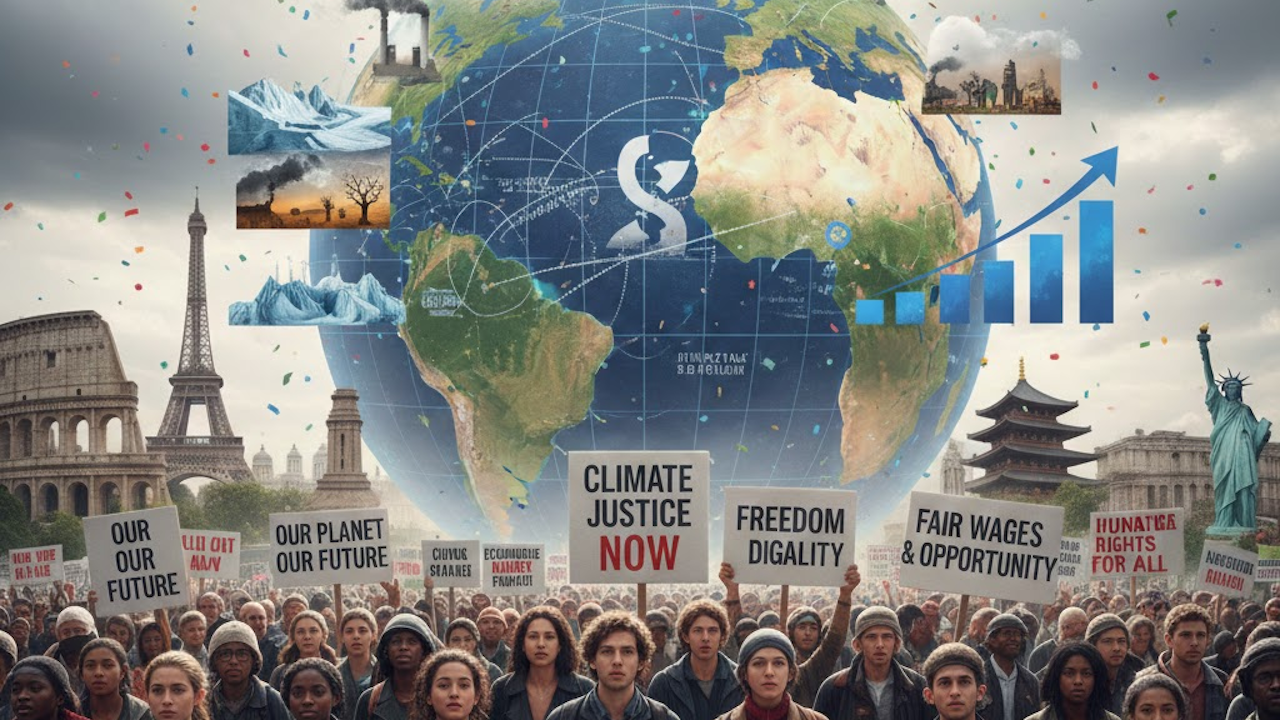
Global protests have become one of the most visible features of contemporary political and social life. From city squares in Europe to streets in Latin America, from university campuses in North America to town centers in Africa and Asia, people continue to gather in large numbers to demand change. Although each protest emerges from a specific local context, many are driven by a shared set of causes that unite people across borders. These causes reflect common pressures produced by economic inequality, political exclusion, social injustice, environmental crisis, and the erosion of trust in institutions.
One of the most powerful forces behind global протест movements is economic inequality. In many societies, the gap between the wealthy and the poor has widened dramatically over recent decades. Rising living costs, stagnant wages, and insecure employment have created a sense that economic systems no longer serve the majority. Protests over fuel prices, housing shortages, and austerity measures reveal a shared frustration with economic models that concentrate wealth while leaving large segments of the population vulnerable. Whether in France, Chile, or Nigeria, demonstrators often express the same demand: a fairer distribution of resources and greater protection for ordinary workers.
Closely linked to economic grievances is the issue of corruption and political accountability. In many countries, people believe that elites use public office for private gain while ignoring the needs of citizens. Scandals involving bribery, misuse of public funds, and favoritism have fueled mass protests that call for transparency and reform. These movements are not only about removing specific leaders but about transforming political systems that allow corruption to flourish. The desire for clean government unites protesters who may differ in culture, religion, or ideology but share a common belief that public power should serve the public good.
Another unifying cause is the demand for democratic rights and political inclusion. Around the world, people protest restrictions on free speech, limits on voting, and the suppression of opposition voices. In authoritarian contexts, demonstrations often seek basic freedoms such as the right to assemble and express dissent without fear of punishment. In more established democracies, protests may focus on electoral reform, representation of minorities, or the influence of money in politics. Despite different political systems, the core aspiration remains the same: meaningful participation in decisions that shape collective life.
Social justice movements also play a central role in global protest culture. Issues of race, gender, ethnicity, and sexuality have mobilized millions who demand equal treatment and an end to discrimination. Protests against police violence, gender based violence, and systemic racism reveal how deeply personal experiences can become political catalysts. These movements often spread rapidly across borders through social media, creating transnational networks of solidarity. A protest that begins in one city can inspire similar actions elsewhere, reinforcing the sense that struggles for dignity and equality are shared human concerns.
Environmental activism represents another major force uniting people worldwide. Climate change, pollution, and the destruction of ecosystems threaten communities across continents, even if the immediate impacts differ. Young people in particular have taken to the streets to demand stronger action from governments and corporations. Environmental protests often combine scientific warnings with moral arguments about responsibility to future generations. The global nature of ecological problems makes cooperation essential, and protests serve as a way to pressure leaders to act beyond narrow national interests.
The erosion of trust in institutions further contributes to the rise of global protests. Many citizens feel that traditional parties, media organizations, and legal systems no longer represent them. This distrust is amplified by economic crises, health emergencies, and the rapid spread of misinformation. When institutions appear unresponsive or biased, people turn to the streets as a direct means of expression. Protests become a way to reclaim agency in situations where formal channels seem closed or ineffective.
Technology has transformed how these causes unite people across borders. Social media platforms allow images, slogans, and strategies to circulate within minutes. Protesters learn from each other’s successes and failures, adapting tactics to local conditions. Digital networks also help sustain movements over time by coordinating actions and sharing information. At the same time, technology exposes protesters to surveillance and repression, reminding them that the struggle for rights is ongoing.
Despite their diversity, global protests share a common emotional core: a sense of injustice combined with hope for change. People take personal risks to express collective demands because they believe that silence would be worse. While protests do not always achieve immediate victories, they reshape public debate and force societies to confront uncomfortable truths. They remind governments and citizens alike that political authority depends on consent and accountability.
In the end, the causes uniting people worldwide are rooted in universal aspirations for dignity, fairness, and voice. Economic security, honest governance, political freedom, social equality, and environmental protection may take different forms in different places, but they speak to the same human desire for a life of meaning and respect. Global protests are not simply moments of unrest. They are expressions of a shared search for a more just and sustainable world.