

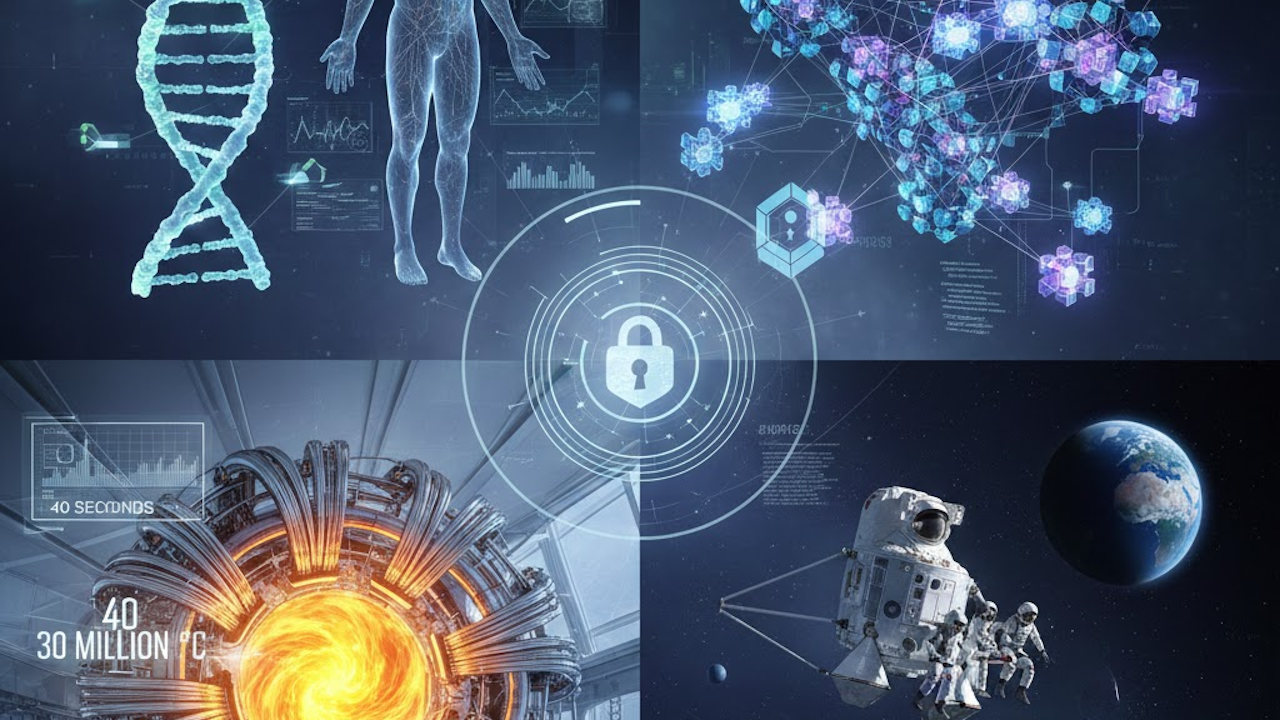
As we move through 2026, the scientific landscape is shifting from theoretical promise to tangible application. This year is defined by a move toward “human-relevant” science, where laboratory breakthroughs in gene editing, quantum infrastructure, and clean energy are finally meeting the rigorous demands of the real world.
From the return of humans to the lunar vicinity to the first practical methods for securing quantum data, the milestones of 2026 are rewriting the rules of what is possible.
The Biological Frontier: Beyond CRISPR
For years, gene editing was synonymous with CRISPR Cas9, a tool that acts like genetic scissors. In 2026, the focus has shifted toward more surgical precision.
Prime and Base Editing
Unlike early techniques that cut both strands of DNA, base editing and prime editing allow scientists to rewrite single “letters” of the genetic code. This year, base editing has entered expanded Phase 2 trials for cardiovascular diseases, specifically targeting the permanent reduction of LDL cholesterol. This represents a pivot from treating symptoms to “one and done” genetic cures for chronic conditions that affect millions.
The Rise of Digital Twins
Clinical trials are undergoing their most significant regulatory shift in twenty years. The United Kingdom and the United States have begun formally integrating “digital twins” into drug development. These are sophisticated AI models of human biology that allow researchers to simulate how a drug might behave in a specific population before a single human volunteer is dosed. This reduces the reliance on animal testing and accelerates the path to market for life saving therapies.
Quantum Computing: The Infrastructure Phase
The “quantum hype” of the early 2020s is being replaced by a focus on “quantum utility.” Scientists are no longer just trying to build more qubits; they are trying to build a quantum internet.
Breaking the No-Cloning Barrier
A major breakthrough occurred in early 2026 when researchers at the University of Waterloo and Kyushu University developed a method to create redundant, encrypted copies of quantum information.
In the quantum world, the “no-cloning theorem” usually prevents the copying of data. By using a “one time use” decryption key system, scientists have found a workaround that allows for quantum cloud storage. This is effectively the birth of a “Quantum Dropbox,” ensuring that if one quantum server fails, the information is not lost forever.
Error Correction and Scalability
Quantum computers are notoriously “noisy,” meaning they are prone to errors from the slightest environmental vibration. In 2026, processors like Google’s Willow have demonstrated exponential error suppression. By organizing qubits into 7×7 lattices, these systems can now correct their own mistakes faster than they make them, moving us closer to fault tolerant machines capable of simulating complex new materials for batteries and superconductors.
Energy: The Fusion Nexus
The quest for the “holy grail” of energy reached a fever pitch this year. While commercial fusion remains a target for the 2030s, 2026 has provided the engineering proof of concept needed to get there.
Stellarator Performance
While most people are familiar with the donut shaped Tokamak reactors, 2026 belongs to the Stellarator. Germany’s Wendelstein 7-X facility achieved a record breaking energy turnover, maintaining stable plasma for over 40 seconds at temperatures of 30 million degrees Celsius.
Stellarators are notoriously difficult to build because of their complex, twisted magnetic coils, but they offer a key advantage: they are naturally stable and can run continuously, unlike the pulsed operation of Tokamaks. This makes them much better suited for providing the “baseload” power required by our increasingly electricity hungry world.
Space Exploration: The Lunar Rehearsal
Space science in 2026 is dominated by two themes: the return of humans to deep space and the hunt for “Earth twins.”
Artemis II: A Historic Journey
The Artemis II mission is the crown jewel of 2026. For the first time since 1972, a crewed spacecraft will travel around the Moon. This 10 day mission serves as the ultimate stress test for the Orion capsule and the Space Launch System (SLS). The crew includes the first woman and the first person of color to leave low Earth orbit, marking a massive cultural and technical milestone for NASA and its international partners.
The Planet Hunters
While astronauts look at the Moon, new telescopes are looking much further. The European Space Agency is preparing the launch of PLATO (PLAnetary Transits and Oscillations of stars). Equipped with 26 cameras, PLATO is designed to monitor 200,000 stars to find rocky, Earth sized planets in habitable zones. Simultaneously, China’s Xuntian space telescope is set to provide wide field views of the universe with a resolution comparable to Hubble but a field of view 300 times larger.
Looking Ahead
The breakthroughs of 2026 demonstrate a maturing of 21st century technology. We are moving away from the era of “black box” AI and experimental gene edits toward a world where these tools are transparent, regulated, and reliable.