

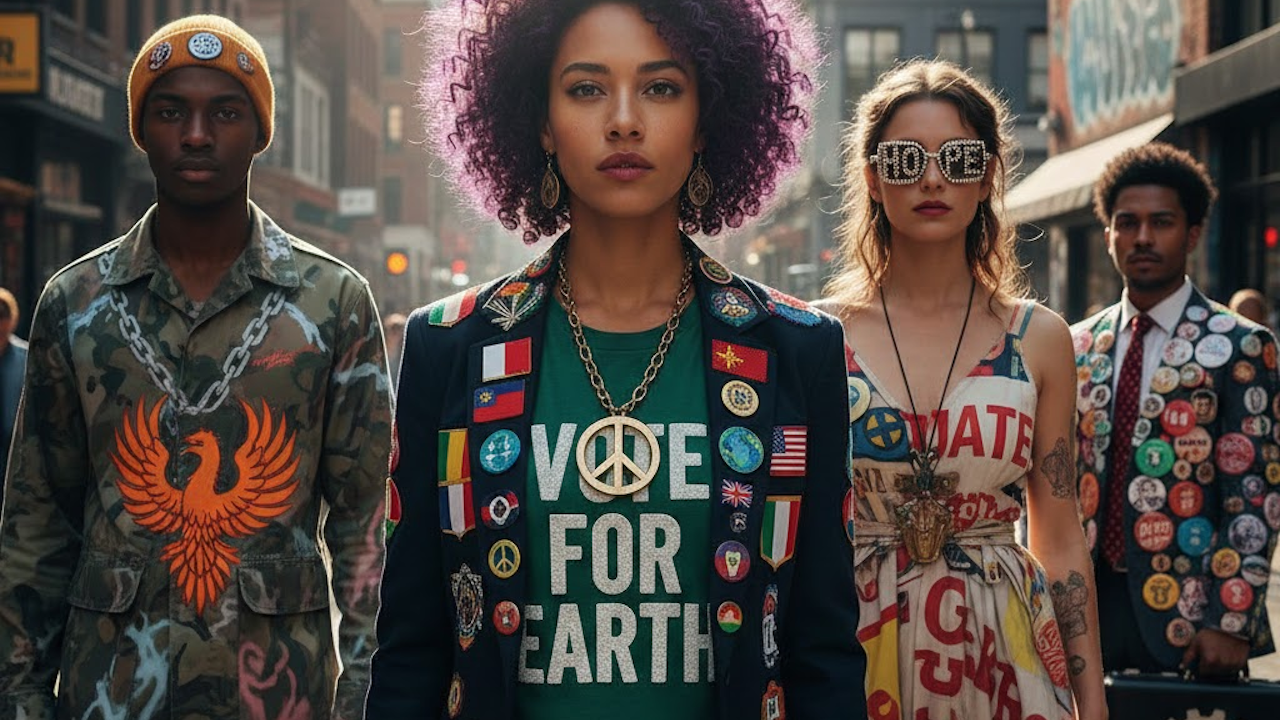
Fashion has long served as more than decoration or personal expression. Throughout history clothing, accessories, and deliberate style choices have functioned as visible declarations of political allegiance, resistance, identity, and power. These symbols communicate ideas faster than speeches and often reach audiences that formal politics cannot. From revolutionary cockades to modern campaign merchandise, political fashion turns the body into a billboard and the wardrobe into a form of public argument.
Historical Foundations of Political Dress
In the late eighteenth century the French Revolution transformed everyday clothing into a political weapon. Revolutionaries rejected the elaborate silks, powdered wigs, and high heels associated with the aristocracy. Instead they adopted the red, white, and blue cockade pinned to hats and coats as a badge of loyalty to the new republic. The sans-culottes, working-class radicals, deliberately wore long trousers rather than the knee breeches of the elite, turning a practical garment into a class statement. These choices were not subtle. Wearing or refusing the cockade could determine whether a person was greeted as a patriot or treated as a suspect.
Across the Atlantic, American revolutionaries used homespun cloth as both economic protest and patriotic signal. By rejecting British imported textiles, colonists made their clothing a daily act of defiance. Later, during the abolitionist movement, free Black Americans and white allies sometimes adopted certain colors or styles to signal solidarity, while enslaved people occasionally used coded patterns in clothing or hair to communicate resistance in ways that escaped immediate detection by overseers.
The nineteenth and early twentieth centuries saw the rise of organized women’s suffrage campaigns that relied heavily on color symbolism. British and American suffragettes adopted purple for dignity, white for purity, and green for hope. Marchers wore these colors in coordinated sashes, dresses, and banners so that even from a distance the political meaning was unmistakable. The deliberate elegance of many suffragette outfits also challenged the stereotype that political women were unfeminine or disorderly. Their fashion was itself a rebuttal.
Twentieth-Century Icons and Uniforms of Ideology
The twentieth century produced some of the most recognizable political garments in modern memory. In China, the Mao suit became both a practical uniform and a powerful equalizing symbol. By dressing leaders and citizens in nearly identical simple jackets and trousers, the Communist Party visually erased traditional markers of hierarchy and projected an image of collective purpose. Similar logic appeared in other revolutionary contexts. Fidel Castro’s olive-green military fatigues and Che Guevara’s beret turned guerrilla practicality into global iconography. The beret in particular migrated far beyond Cuba, becoming a shorthand for leftist militancy worn by activists from the Black Panthers in the United States to student radicals in Europe.
The Black Panther Party in the late 1960s refined political style into a disciplined uniform. Black leather jackets, black berets, dark sunglasses, and natural hairstyles created a cohesive visual identity that projected strength, seriousness, and readiness. The look rejected both mainstream respectability politics and the more colorful aesthetics of some contemporaneous countercultural movements. It announced that these activists intended to be taken seriously as a political force rather than dismissed as fashionable rebels.
On the other side of the ideological spectrum, conservative and nationalist movements have also used clothing as assertion. In the United States the cowboy hat, Western boots, and certain styles of workwear have long carried associations with rugged individualism and traditional values. Military surplus clothing has appeared in both left-wing anti-war protests and right-wing paramilitary aesthetics, demonstrating how the same garments can be reinterpreted according to context.
Contemporary Campaign Merchandise and Protest Wear
In recent decades political fashion has become more commercialized and more fragmented. The red “Make America Great Again” baseball cap popularized by Donald Trump’s campaigns is one of the clearest modern examples of a single garment functioning as an unambiguous political signal. Wearers are immediately identifiable, and the hat itself has become a target of both admiration and hostility. Its bright color and bold lettering make subtlety impossible, which is precisely the point for many supporters who view it as a rejection of elite restraint.
Opposite examples include the pink “pussyhat” that appeared in large numbers at the 2017 Women’s March. Knitted or crocheted in a distinctive shade and topped with cat-ear shapes, the hats created a sea of coordinated color that photographed dramatically and communicated opposition to the incoming administration’s rhetoric on women’s issues. Like the MAGA hat, the pussyhat sacrificed nuance for instant recognizability.
Other contemporary symbols operate with varying degrees of explicitness. The keffiyeh, a traditional Middle Eastern scarf, has been adopted by some Western activists as a sign of solidarity with Palestinian causes. Rainbow accessories and clothing signal support for LGBTQ rights. Certain designer labels have become loosely associated with particular political leanings in elite circles, while thrift-store aesthetics or deliberately anti-fashion choices can signal rejection of consumer capitalism.
Designers themselves have entered the political arena more directly. Vivienne Westwood used her runway collections and personal appearances to promote environmental activism and critique capitalism. Other houses have produced limited-edition pieces tied to specific causes or elections. These interventions blur the line between commerce and conviction, raising questions about authenticity and the commercialization of dissent.
How Style Communicates Power and Resistance
Political fashion works because clothing is unavoidable. Unlike a poster or a speech, garments travel with the body into everyday spaces. A person wearing a contested symbol forces others to notice and often to react. This visibility can build solidarity among supporters who recognize one another instantly in a crowd. It can also provoke confrontation, as when opposing symbols appear in the same public space.
Style choices also allow individuals to calibrate the intensity of their statement. A subtle lapel pin or a particular color combination can signal affiliation to those who know the code while remaining opaque to outsiders. At the other extreme, full coordinated uniforms or highly distinctive accessories leave no room for ambiguity. The decision between subtlety and boldness is itself a political calculation about risk, audience, and desired effect.
Gender, class, and race further complicate these signals. Women in politics have long navigated the expectation that their clothing will be scrutinized more intensely than men’s. Pantsuits, for example, have been used by figures such as Hillary Clinton and Kamala Harris to project authority while still operating within professional norms. Men’s political fashion tends to revolve around ties, flags pins, or outdoor workwear, each carrying its own set of associations. Working-class styles can be romanticized by elites or dismissed as unsophisticated depending on who wears them and in what context.
Controversies and Limits
Political fashion is rarely free of tension. Critics argue that reducing complex issues to logos, colors, or slogans encourages superficial engagement. When a cause becomes a trend, the original meaning can dilute or be co-opted by commercial interests. Brands that rush to produce “woke” or patriotic merchandise risk accusations of inauthenticity. Wearers of contested symbols sometimes face social or professional consequences, illustrating that fashion statements can carry real costs.
There is also the problem of appropriation and shifting meanings. A garment that begins as a sincere expression of solidarity can later be emptied of content or turned into pure fashion. Conversely, items once associated with oppression can be reclaimed. These shifts make political style an unstable language, constantly renegotiated by new wearers and new contexts.
Conclusion
Political fashion symbols and styles endure because they meet a persistent human need to make identity and belief visible. From revolutionary France to contemporary campaign trails, people have used cloth, color, and cut to declare where they stand. These choices can unify, polarize, inspire, or provoke. They can elevate a cause or reduce it to a commodity. What remains constant is the recognition that appearance is never entirely neutral. In the public square the clothes people wear continue to speak, often more loudly and more immediately than the words they say. Understanding those visual statements is essential to understanding the political culture that produces them.