

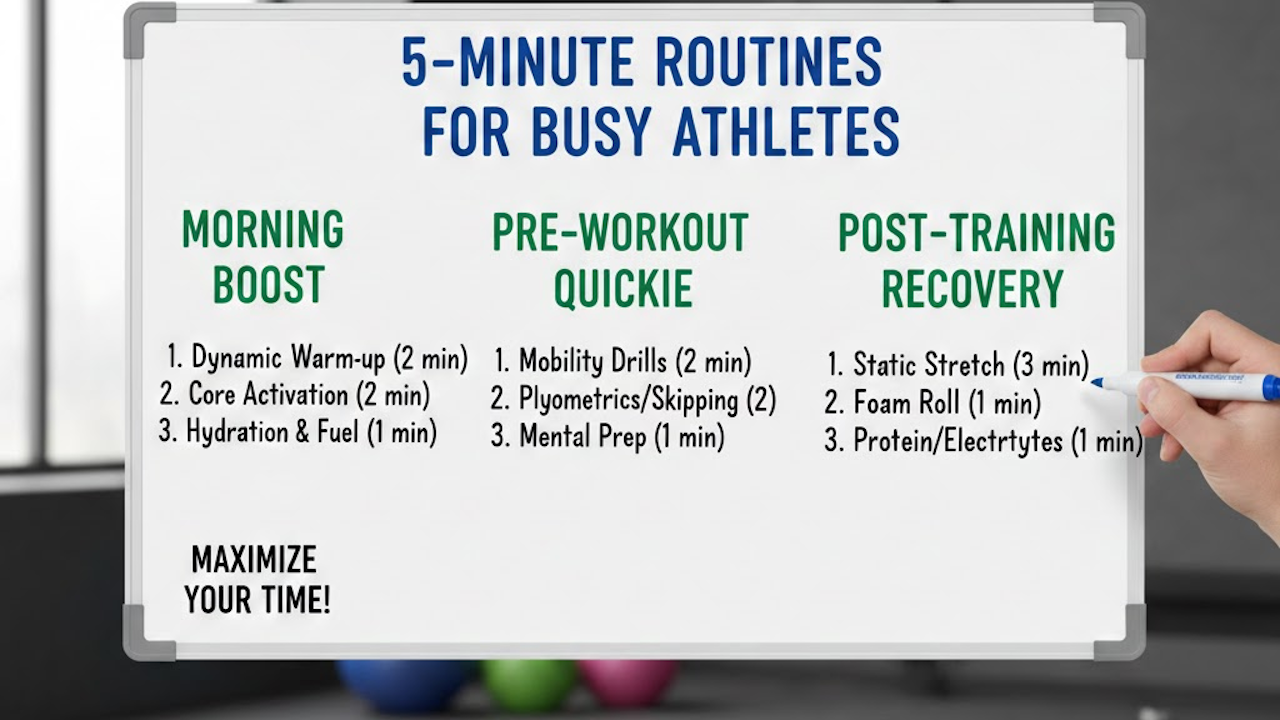
Athletes today face intense demands. Training sessions, competitions, travel, work, family obligations, and recovery all compete for limited time. Many feel they must choose between a full workout or nothing at all. This all-or-nothing mindset leads to skipped sessions, stalled progress, and increased injury risk. The solution lies in consistent micro-routines that take just five minutes. These short, targeted practices deliver outsized benefits when performed regularly. They maintain fitness, enhance performance, prevent injuries, and build mental resilience without requiring gym access or elaborate equipment.
Short routines work because they lower the barrier to action. A five-minute commitment feels manageable even on the busiest days. Once started, athletes often extend the session naturally, but the key is consistency over perfection. Research on habit formation shows that small, repeatable actions compound more effectively than sporadic long workouts. For athletes, these routines preserve training adaptations, support mobility, and accelerate recovery between harder sessions.
This article explores practical five-minute routines across multiple categories. Each includes step-by-step instructions, target benefits, and modifications for different sports or fitness levels. Adapt them to your schedule: do them first thing in the morning, during work breaks, before or after practice, or while waiting for a ride or meeting.
The Science Behind Five-Minute Training
Brief bouts of exercise trigger physiological responses that accumulate. A five-minute dynamic warm-up increases blood flow, raises core temperature, and activates neuromuscular pathways. Short strength circuits stimulate muscle protein synthesis and improve power output. Mobility drills counteract the tightness that comes from repetitive sport movements or prolonged sitting. Recovery-focused routines reduce inflammation markers and improve sleep quality when practiced daily.
Busy athletes benefit particularly because these routines combat the law of diminishing returns in long sessions while minimizing overtraining risk. They also fit into the concept of “greasing the groove,” where frequent, submaximal practice improves motor patterns and strength without fatigue. Consistency in five-minute blocks can yield better long-term results than irregular hour-long efforts.
Morning Activation Routine (Wake-Up and Prime)
Start the day with this routine to awaken the body and set a positive tone. Perform it right after getting out of bed, before coffee or breakfast.
- Cat-Cow to Thoracic Rotation (60 seconds): On all fours, alternate arching and rounding your back. After five cycles, thread one arm under the body and rotate, then switch sides. This mobilizes the spine and opens the shoulders.
- Bodyweight Squat with Reach (60 seconds): Perform deep squats, reaching arms overhead on the way up. Focus on keeping heels down and chest tall. Ten to fifteen controlled reps.
- Push-Up to Downward Dog (60 seconds): From a plank, do a push-up then lift hips into downward dog. Flow through five to eight repetitions. This builds upper body strength and lengthens the posterior chain.
- Single-Leg Balance with Knee Drive (60 seconds): Stand on one leg, drive the opposite knee up while maintaining balance. Alternate legs every ten seconds. Add arm swings for coordination.
- Deep Breathing with March in Place (60 seconds): March briskly while inhaling deeply through the nose for four counts and exhaling through the mouth for six counts.
Benefits: Improves posture, activates glutes and core, boosts energy levels, and prepares joints for the day’s demands. Runners, cyclists, and team sport athletes notice better initial stride or movement quality.
Modifications: Reduce range of motion if recovering from injury. Add a resistance band around the knees during squats for extra glute activation.
Pre-Training Warm-Up Routine
Use this before any session to reduce injury risk and improve performance. It replaces static stretching with movement-based preparation.
- Leg Swings (60 seconds): Stand on one leg and swing the other forward and back, then side to side. Ten swings each direction per leg.
- Arm Circles and Scapular Wall Slides (60 seconds): Make large forward and backward circles with the arms. Then stand against a wall and slide arms up and down while keeping elbows and wrists in contact.
- Inchworm to Push-Up (60 seconds): Hinge at the hips, walk hands out to plank, perform a push-up, and walk feet to hands. Repeat smoothly.
- Lateral Lunges with Rotation (60 seconds): Step sideways into a lunge, rotate torso toward the front leg, then push back to start. Alternate sides.
- High Knees with Butt Kicks (60 seconds): Alternate 20 seconds of each, focusing on quick foot turnover.
Benefits: Increases heart rate gradually, improves range of motion in sport-specific patterns, and primes the nervous system for explosive movements. Ideal for soccer, basketball, tennis, and sprint athletes.
Modifications: Perform against a wall for support if balance is an issue. Shorten ranges for beginners.
Strength and Power Maintenance Routine
Maintain or build strength on days when full gym sessions are impossible. Focus on compound movements using bodyweight or minimal equipment like a backpack or water bottles.
- Air Squats or Jump Squats (60 seconds): Perform as many controlled reps as possible. Jump version for power development.
- Push-Ups or Knee Push-Ups (60 seconds): Standard, diamond, or wide-grip variations. Pause at the bottom for added difficulty.
- Superman Holds and Bird Dogs (60 seconds): Alternate 20-second holds of each. Lie face down for Superman, then on all fours for bird dogs.
- Lunges with Overhead Press (60 seconds): Alternate forward or reverse lunges while pressing imaginary or light weights overhead.
- Plank Variations (60 seconds): Cycle through forearm plank, side planks, and shoulder taps.
Benefits: Preserves muscle mass, maintains power output, and strengthens stabilizing muscles that prevent common athletic injuries. Suitable for strength and power athletes like weightlifters, throwers, or combat sports participants.
Modifications: Slow the tempo for more time under tension. Use a sturdy chair for assisted variations.
Mobility and Injury Prevention Routine
Athletes often lose range of motion due to repetitive stress. This routine targets tight areas common in sports.
- Hip Flexor Stretch with Reach (60 seconds): In a half-kneeling position, drive hips forward and reach overhead. Switch sides after 30 seconds.
- Hamstring Stretch with Ankle Dorsiflexion (60 seconds): Seated forward fold with one leg extended, flex the foot. Alternate legs.
- Thoracic Spine Openers (60 seconds): Seated or on all fours, rotate the upper back while keeping hips stable.
- Ankle and Wrist Mobility Circles (60 seconds): Perform controlled circles in both directions for wrists and ankles.
- Figure-Four Stretch and Pigeon Pose Flow (60 seconds): Target glutes and external rotators by flowing between these positions.
Benefits: Reduces risk of strains, improves movement efficiency, and alleviates lower back or knee pain. Essential for runners, cyclists, swimmers, and desk athletes.
Modifications: Use a towel or strap for assistance in deeper stretches. Hold positions longer instead of flowing if preferred.
Recovery and Nervous System Reset Routine
Recovery is training. This routine helps downregulate after intense days or travel.
- Diaphragmatic Breathing (60 seconds): Lie on your back with hands on belly. Inhale deeply for five counts, exhale for seven. Focus on ribcage expansion.
- Neck and Shoulder Rolls (60 seconds): Gentle circles and shrugs to release upper trapezius tension.
- Seated Spinal Twists (60 seconds): Rotate gently while seated, holding each side for ten seconds.
- Foam Roll or Self-Massage (60 seconds): If a roller is unavailable, use a tennis ball or hands to target calves, quads, or IT bands.
- Progressive Muscle Relaxation (60 seconds): Tense and release major muscle groups from toes to head.
Benefits: Lowers cortisol, improves sleep readiness, and speeds removal of metabolic waste. Critical for endurance athletes and those in multi-day competitions.
Modifications: Perform breathing anywhere, even while commuting. Skip rolling if no tools are available and focus on breathwork.
Mental Focus and Visualization Routine
Peak performance requires mental preparation. This routine sharpens concentration.
- Box Breathing (60 seconds): Inhale four counts, hold four, exhale four, hold four. Repeat.
- Sport-Specific Visualization (60 seconds): Close eyes and vividly imagine successful execution of key skills: perfect shot, clean lift, strong finish.
- Gratitude and Affirmation (60 seconds): Mentally list three things you appreciate about your training and affirm your capabilities.
- Quick Body Scan (60 seconds): Mentally scan from head to toe, noting and releasing tension.
- Power Pose with Positive Self-Talk (60 seconds): Stand tall in a confident posture while repeating a performance cue or mantra.
Benefits: Enhances focus under pressure, builds confidence, and reduces performance anxiety. Valuable for all competitive athletes.
Modifications: Shorten visualization to specific scenarios relevant to your sport.
Integrating Five-Minute Routines into a Busy Schedule
Success comes from strategic placement. Stack routines onto existing habits: do the morning activation while coffee brews, the warm-up before practice, mobility during TV commercials, or recovery before bed.
Track adherence with a simple checklist or phone app. Aim for at least three routines daily. Over a week this equals more than two hours of targeted training that might otherwise be missed.
Combine routines creatively. Pair strength with mobility for a ten-minute block. Use travel time for mental routines or seated mobility. During team travel, lead group versions in hotel rooms or airports.
Listen to your body. On high-fatigue days, prioritize recovery and mobility. On lighter days, add strength or power elements. Adjust intensity based on training phase: higher volume during off-season, more recovery during competition peaks.
Nutrition and Hydration Tie-Ins
Five-minute routines pair well with quick nutritional habits. Prepare a protein-rich snack during the morning routine. Hydrate immediately after recovery sessions. These micro-habits amplify physical gains.
Common Mistakes to Avoid
- Skipping the warm-up entirely on busy days. Even two minutes beats zero.
- Pushing too hard in short sessions and risking form breakdown.
- Neglecting variety. Rotate through different routines to address all needs.
- Ignoring consistency. Five minutes daily outperforms 35 minutes once a week.
Real-World Examples from Athletes
Professional and amateur athletes across disciplines report significant improvements from micro-routines. Marathon runners maintain stride efficiency during heavy work weeks. Basketball players preserve vertical jump height despite travel. Weekend warriors prevent the usual Monday soreness after desk jobs.
One collegiate swimmer incorporated the mobility routine between classes and cut shoulder impingement issues dramatically. A CrossFit competitor used strength maintenance routines on business trips and returned to the gym without losing measurable strength.
Conclusion: Small Steps, Big Results
Five-minute routines prove that time scarcity need not derail athletic progress. They build resilience, maintain fitness foundations, and create momentum that often leads to more training overall. The key is starting small, staying consistent, and viewing these sessions as non-negotiable investments in long-term performance and health.
Busy athletes who adopt these practices report feeling more in control of their training, less guilty about missed long sessions, and more energized throughout the day. Start with one or two routines that address your biggest weaknesses or time constraints. Commit for two weeks and observe the differences in energy, mobility, strength retention, and mental clarity.
Athletic success is built on daily choices. Five minutes may seem insignificant in isolation, but stacked over months and years, these routines create champions who show up consistently regardless of circumstances. Your body and performance will thank you for the discipline of showing up, even briefly, every single day.