

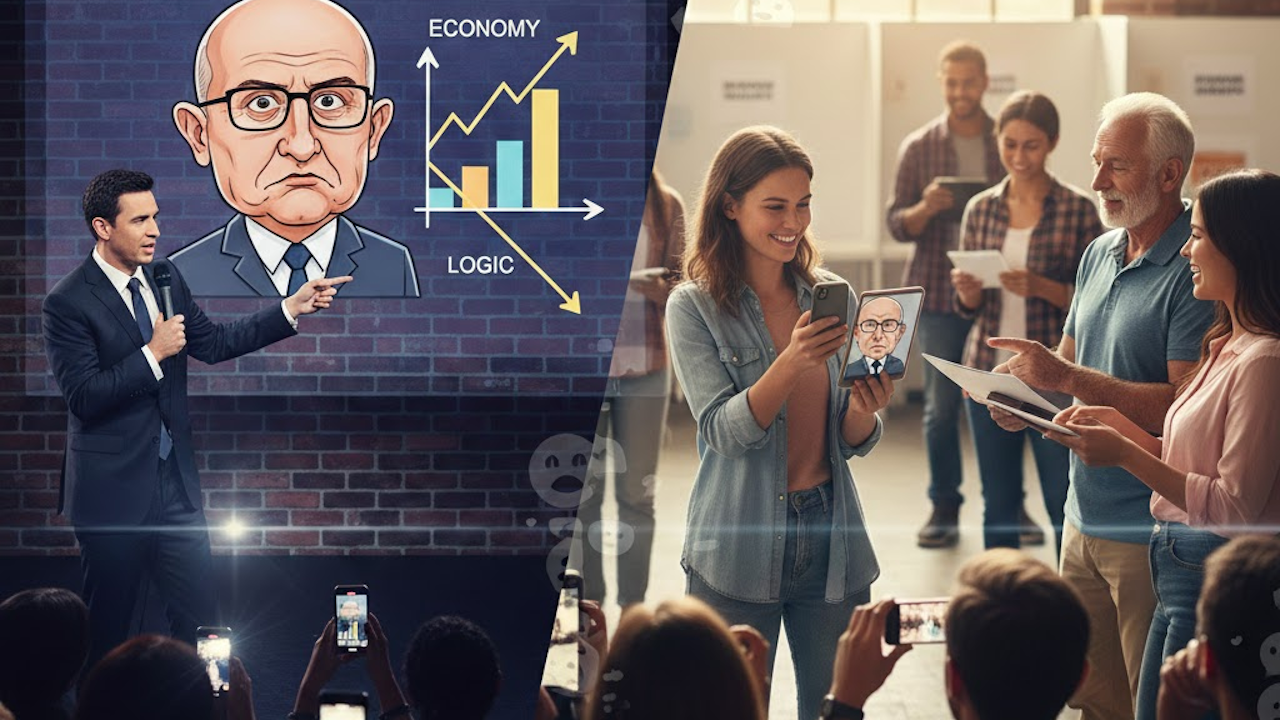
Humor has been a staple of political discourse since the days of Aristophanes and Mark Twain. However, in the modern era of viral clips and late-night monologues, comedy has transitioned from a mere side note to a primary driver of voter perception. Whether it is a satirical news segment, a candidate’s self-deprecating joke, or a biting political meme, humor functions as a sophisticated psychological tool that can dismantle a policy or humanize a politician in seconds.
1. The Psychology of the “Laughter Shortcut”
Humor operates by creating a cognitive shortcut. When a voter laughs at a political joke, they are participating in a brief moment of shared understanding. This process often bypasses the analytical, skeptical defenses that people typically use when listening to a standard campaign speech.
- Heuristic Processing: Instead of deeply analyzing a 50-page economic plan, voters might use a comedian’s summary as a mental shortcut to judge the plan’s validity.
- The “Trojan Horse” Effect: Because humor is entertaining, people are more likely to let their guard down. A message that would be rejected as blatant propaganda often finds a home in the mind of the viewer when wrapped in a joke.
- Affective Intelligence: Humor triggers positive emotions, which can lead to a more favorable view of the person delivering the joke, even if the voter originally disagreed with them.
2. Satire as a Tool of Deconstruction
Political satire, popularized by shows like The Daily Show or Saturday Night Live, does more than just mock; it frames the narrative. Satire works by identifying a specific trait or policy and exaggerating it until the absurdity becomes the defining characteristic of the politician.
When a satirical portrayal becomes iconic, it can become impossible for the politician to escape it. This phenomenon often leads to “image biting,” where the caricature replaces the actual person in the public imagination. If a comedian consistently portrays a candidate as confused or elitist, voters begin to look for evidence of those traits in every real-world appearance.
3. Humanization and the “Likability” Factor
For the candidates themselves, humor is an essential tool for humanization. In a landscape where politicians are often seen as robotic or scripted, a well-timed joke can signal authenticity and relatability.
Self-Deprecation
When a candidate makes fun of their own weaknesses, it serves a dual purpose. First, it “defangs” the opposition by acknowledging a flaw before a rival can weaponize it. Second, it projects confidence. Only a person comfortable in their position can afford to laugh at themselves.
Relatability
Humor helps bridge the gap between the “elite” politician and the “everyday” voter. By engaging in the same cultural references or using the same comedic timing as the audience, a candidate signals that they belong to the same community as the voters they are courting.
4. The Risks of Political Comedy
While humor can be a powerful bridge, it can also be a barrier. The effectiveness of a joke is entirely dependent on the “in-group” and “out-group” dynamics of the audience.
- Alienation: Humor that targets a specific demographic or belief system can solidify the support of the “in-group” while deeply offending and mobilizing the “out-group.”
- The Boomerang Effect: If a joke feels forced, mean-spirited, or out of touch, it can backfire. A failed attempt at humor often makes a candidate look desperate or insensitive, which can be more damaging than saying nothing at all.
- Trivialization: There is a risk that constant humor can lead to the “dumbing down” of serious issues. When complex policy debates are reduced to one-liners, the nuance required for effective governance can be lost.
5. The Digital Frontier: Memes and Viral Humor
In the current decade, the most influential form of political humor is the meme. Memes are the ultimate form of democratic satire because they are created by the voters themselves. They are fast, highly shareable, and carry a high level of social currency.
Because memes are often anonymous and decentralized, they feel more “honest” to younger voters than a televised advertisement. This type of humor creates a feedback loop where the most “meme-able” moments of a campaign become the most memorable, regardless of their actual political significance.
Conclusion
Humor is far more than just a way to pass the time between serious debates. It is a fundamental mechanism for shaping how voters perceive character, intelligence, and trustworthiness. By lowering cognitive defenses and creating emotional bonds, comedy serves as one of the most effective, albeit unpredictable, forces in modern democracy.