

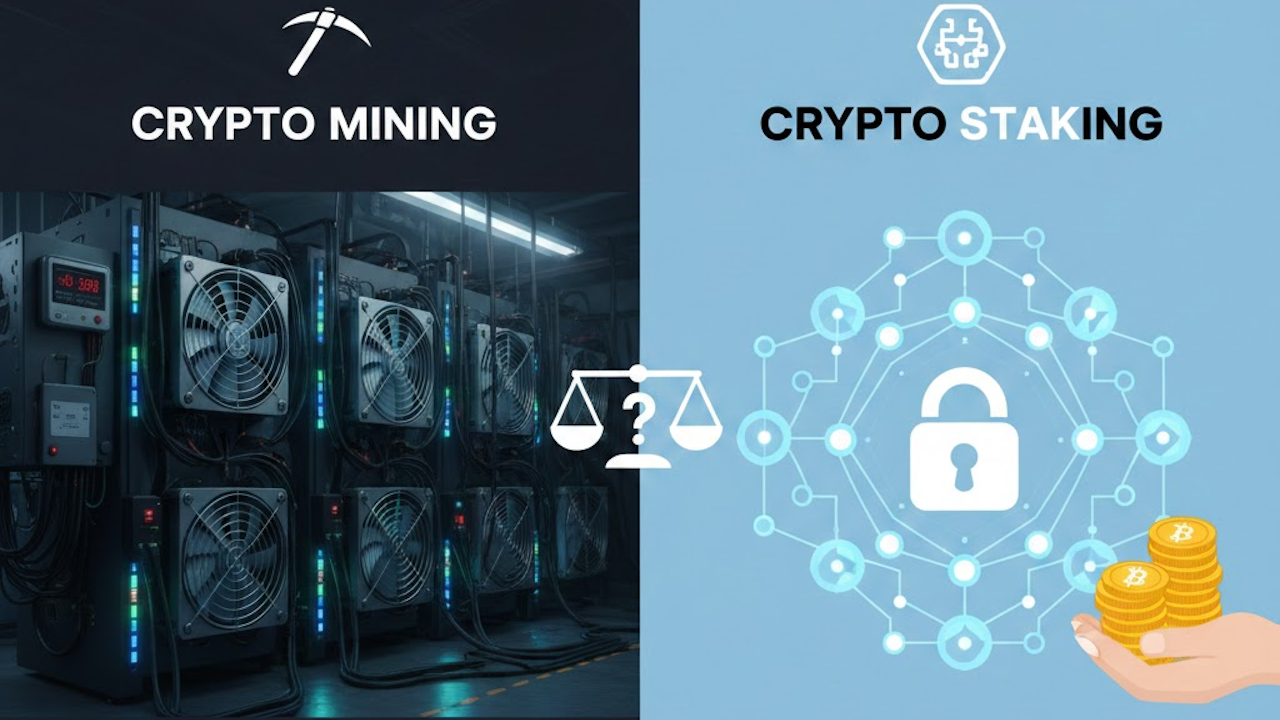
Cryptocurrency networks rely on participants to validate transactions, secure the blockchain, and maintain consensus. Two dominant approaches have emerged for this work: mining and staking. Mining, rooted in proof-of-work systems, involves computational competition. Staking, based on proof-of-stake mechanisms, depends on locked capital and network participation. Each method offers distinct rewards, risks, costs, and barriers. Understanding their differences helps investors, operators, and newcomers decide which path aligns with their resources, goals, and values.
This article examines both methods in detail, compares them across key dimensions, and evaluates which may prove better depending on individual circumstances. The goal is not to declare a universal winner but to provide a clear framework for informed choice.
What Is Crypto Mining?
Crypto mining is the process by which specialized computers solve complex mathematical puzzles to add new blocks of transactions to a blockchain. The first participant to find a valid solution receives newly minted coins and transaction fees as a reward. This system, known as proof of work, was pioneered by Bitcoin and remains the foundation for several major networks.
Miners compete by repeatedly hashing data until they produce a result that meets a difficulty target set by the network. Difficulty adjusts automatically so that blocks appear at a roughly constant rate, such as every ten minutes for Bitcoin. Success depends on hash rate, the total computational power directed at the puzzle. Higher hash rate increases the probability of winning a block.
Hardware has evolved dramatically. Early Bitcoin mining used ordinary CPUs, then shifted to GPUs, and later to application-specific integrated circuits designed solely for hashing. Today, competitive mining requires industrial-scale facilities filled with ASICs, advanced cooling systems, and access to low-cost electricity. Solo mining is rarely profitable for individuals because of the immense collective hash rate of large pools. Most miners join pools that distribute rewards proportionally to contributed power.
Mining serves two primary functions. It secures the network by making attacks extremely expensive, since an adversary would need to control a majority of the global hash rate. It also introduces new coins into circulation according to a predetermined schedule, such as Bitcoin’s halving events that reduce the block reward over time.
The process is energy intensive. Electricity consumption for Bitcoin mining alone has been compared to that of medium-sized countries. This has sparked ongoing debate about environmental impact, especially in regions that rely on fossil fuels. Miners often relocate to areas with surplus hydroelectric, geothermal, or flared natural gas power to reduce costs and carbon footprints.
What Is Staking?
Staking is the core activity in proof-of-stake networks. Instead of solving computational puzzles, participants lock a certain amount of the network’s native cryptocurrency as collateral. In return, they become eligible to validate transactions, propose new blocks, and earn rewards. The more coins a participant stakes, and the longer they remain locked, the higher their chance of being selected to perform validation duties.
Selection methods vary by protocol. Some use randomized algorithms weighted by stake size. Others incorporate factors such as the age of the stake or the validator’s performance history. Successful validators receive a portion of newly issued coins and transaction fees. If a validator behaves maliciously or goes offline for extended periods, the network can penalize them by confiscating part of their staked assets, a process called slashing.
Staking requires far less specialized hardware than mining. A reliable computer or cloud server with a stable internet connection is usually sufficient. Many networks also support delegated staking, in which coin holders assign their stake to professional validators and share in the rewards without running infrastructure themselves. This model lowers the technical barrier significantly.
Ethereum’s transition from proof of work to proof of stake in 2022 marked a major milestone. The change reduced the network’s energy consumption by more than 99 percent according to multiple independent estimates. Other prominent proof-of-stake chains include Cardano, Solana, Polkadot, Avalanche, and Cosmos. Each implements staking with unique parameters for minimum stake size, lock-up periods, reward rates, and penalty rules.
Staking contributes to network security by aligning economic incentives. An attacker seeking to disrupt the chain would need to acquire and risk a substantial fraction of the total staked supply. Because the attack would also devalue the very assets the attacker holds, the economic disincentive is strong.
Key Differences Between Mining and Staking
Several practical and structural differences separate the two approaches.
Energy and environmental impact stand out immediately. Mining demands continuous high power draw for hashing and cooling. Staking consumes electricity comparable to ordinary servers or even less when using cloud services. For environmentally conscious participants or those operating under carbon regulations, staking holds a clear advantage.
Capital and hardware requirements diverge sharply. Mining often requires tens of thousands of dollars in specialized equipment plus ongoing electricity and maintenance costs. Profitability hinges on electricity prices, hardware efficiency, and cryptocurrency prices. Staking primarily requires ownership of the native token. Some networks set minimum stakes that can be substantial, yet many allow smaller amounts through pooling or liquid staking services. The main cost is opportunity cost: the capital locked cannot be used elsewhere while it remains staked.
Technical complexity and operational burden also differ. Mining involves hardware procurement, facility setup, thermal management, firmware updates, and constant monitoring of hash rate and pool performance. Failures can erase margins quickly. Staking is simpler for most users. Running a validator node demands technical competence and uptime discipline, but delegated staking reduces participation to a few clicks in a wallet or exchange interface.
Reward structures and predictability vary. Mining rewards fluctuate with network difficulty, block luck, and price volatility. Pools smooth this variance but still leave miners exposed to sudden drops in coin price or rises in electricity cost. Staking rewards tend to be more stable in percentage terms, often expressed as an annual percentage yield that adjusts with total staked supply and network activity. However, these yields can decline as more participants join and dilute the reward pool.
Risk profiles contrast in important ways. Mining risks include hardware obsolescence, rising energy prices, regulatory crackdowns on power usage, and potential bans in certain jurisdictions. Equipment can become stranded assets if the network’s economics shift. Staking risks center on smart contract vulnerabilities, validator mismanagement, slashing events, and lock-up periods that prevent rapid exit during market downturns. Liquidity solutions such as liquid staking tokens mitigate some of these issues but introduce additional layers of smart contract risk.
Security models rest on different foundations. Proof of work ties security to real-world energy expenditure and specialized hardware. Proof of stake ties security to the economic value of the native token. Both have proven resilient at scale, yet each faces distinct theoretical attack vectors. Mining is vulnerable to 51 percent hash rate attacks; staking is vulnerable to coordinated stake concentration or long-range attacks that some protocols address through additional mechanisms.
Accessibility for ordinary participants favors staking in most cases. Anyone with sufficient tokens can stake, often with minimal technical knowledge. Mining remains the domain of specialized operators or those willing to invest heavily in infrastructure and expertise.
Profitability Considerations
Neither method guarantees profit. Both depend heavily on the market price of the underlying cryptocurrency. When prices rise, rewards become more valuable in fiat terms. When prices fall, even efficient operations can turn unprofitable.
Mining profitability is calculated by comparing revenue from block rewards and fees against electricity, hardware depreciation, cooling, and maintenance costs. Online calculators allow operators to model scenarios based on current hash rate, power consumption, and local electricity rates. Large operations sometimes negotiate power purchase agreements or locate near stranded energy sources to improve margins. Smaller miners often struggle once network difficulty rises or halvings reduce block rewards.
Staking profitability is typically measured by the nominal yield offered by the network minus any fees charged by validators or platforms. Yields commonly range from a few percent to double digits annually, depending on the protocol and market conditions. Additional returns may come from transaction fees or MEV opportunities captured by sophisticated validators. Because the principal remains denominated in the native token, staking participants retain full exposure to price movements. A high yield in a declining market can still produce net losses in fiat terms.
Tax treatment differs by jurisdiction and can materially affect net returns. Mining rewards are often treated as income at the time of receipt, with subsequent sales generating capital gains or losses. Staking rewards receive similar income treatment in many places, though some regions have introduced specific rules. Participants should consult local tax professionals, as reporting requirements can be complex.
Which Approach Suits Different Profiles?
The better choice depends on the participant’s starting position, risk tolerance, technical skill, capital size, and priorities.
Someone with access to cheap electricity, technical expertise, and capital for hardware may find mining attractive, especially on networks with favorable economics or during periods of rising prices. Mining also appeals to those who value the tangible nature of physical infrastructure and the direct contribution to proof-of-work security.
An individual with existing cryptocurrency holdings, limited technical knowledge, and a preference for lower operational complexity will usually prefer staking. The ability to participate with smaller amounts through delegation or liquid staking expands access further. Environmental concerns or regulatory constraints on energy use also tilt the balance toward staking.
Institutional players often pursue both strategies. Some operate mining facilities while simultaneously staking large holdings across multiple networks. Diversification across methods and assets can reduce concentration risk.
Time horizon matters. Mining equipment has a finite useful life as more efficient models appear and network difficulty climbs. Staking positions can be maintained indefinitely as long as the network remains secure and the participant accepts the lock-up terms.
Liquidity needs influence the decision. Mining produces liquid rewards that can be sold immediately, though the capital is tied up in hardware that is harder to liquidate. Staking often imposes unbonding periods that delay withdrawal of the principal. Liquid staking derivatives restore flexibility at the cost of additional risk and fees.
Longer-Term Trends and Considerations
The broader industry has shifted toward proof of stake for new networks. Energy efficiency, faster finality, and lower barriers to participation drive this preference. Existing proof-of-work chains, particularly Bitcoin, retain strong network effects, brand recognition, and a security model that many consider battle-tested. Hybrid or alternative consensus designs continue to appear, but mining and staking remain the two most established pathways.
Regulatory attention continues to grow. Energy consumption has drawn scrutiny in multiple countries, leading some jurisdictions to restrict or tax mining operations. Staking has faced questions about whether certain arrangements constitute securities offerings, especially when platforms intermediate between token holders and validators. Clarity in regulation will shape the relative attractiveness of each method in coming years.
Technological improvements affect both sides. Mining hardware efficiency advances slowly, and gains are often offset by rising difficulty. On the staking side, liquid staking protocols, restaking mechanisms that allow the same capital to secure multiple networks, and improved validator tooling expand opportunities and complexity.
Market cycles amplify differences. During bull markets, both methods can generate substantial returns. During prolonged downturns, miners with high fixed costs may shut down equipment, while stakers continue to earn yields that compound their holdings even if fiat value declines.
Making an Informed Decision
Evaluating mining versus staking requires honest assessment of personal constraints. Calculate realistic costs for mining, including not only electricity but also depreciation, downtime, and potential relocation expenses. For staking, examine the specific network’s parameters: minimum stake, expected yield, slashing conditions, and unbonding period. Diversify across networks rather than concentrating on a single asset or method. Monitor developments in hardware efficiency, protocol upgrades, and regulatory changes.
Neither approach is inherently superior in all contexts. Mining remains essential to the security of major proof-of-work networks and can be profitable under the right conditions. Staking offers broader accessibility, lower energy use, and simpler participation for most individuals. The better option is the one that matches available capital, technical capacity, risk appetite, and time commitment.
Participants who treat either activity as a long-term commitment to network security rather than a short-term speculative trade tend to navigate the inherent volatility more successfully. Continuous education about protocol mechanics, market dynamics, and operational best practices remains the most reliable edge available to anyone entering this space.