

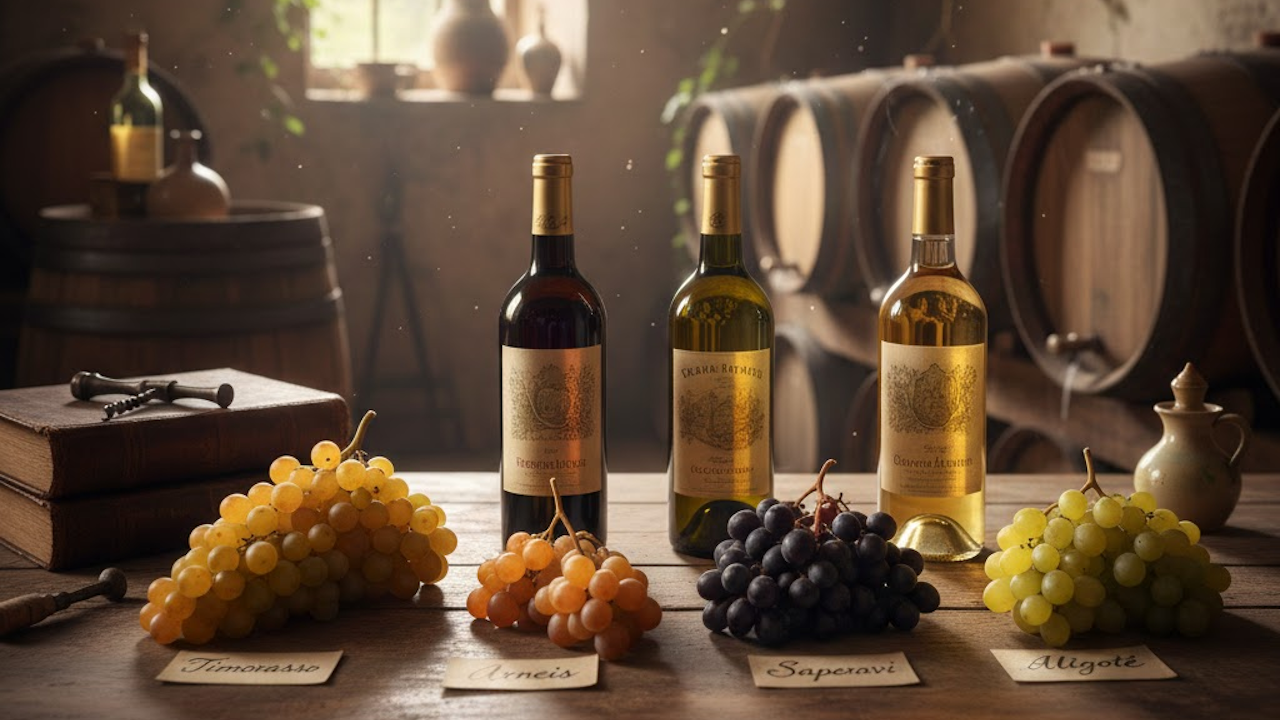
For much of the past century, the global wine landscape has been dominated by a handful of familiar names. Cabernet Sauvignon, Merlot, Chardonnay, Pinot Noir, and a few other international varieties have claimed the majority of vineyard space and shelf space. They travel well, yield reliably, and appeal to broad markets. Yet beneath this uniformity, a quieter movement has been gathering strength. Old grape varieties once nearly lost to history, neglect, or economic pressure are returning to vineyards and bottles. These retro grapes, sometimes called heirloom, forgotten, or indigenous varieties, carry centuries of adaptation to specific soils and climates. Their revival speaks to shifting tastes, environmental pressures, and a renewed appetite for authenticity in wine.
The story of their decline begins with catastrophe and continues through industrialization. In the late nineteenth century, the phylloxera epidemic devastated European vineyards, destroying vast plantings and forcing widespread replanting. Growers often chose high-yielding, disease-resistant, or internationally recognized varieties to rebuild quickly and secure income. Local grapes that had been cultivated for generations, sometimes for hundreds of years, were abandoned or reduced to tiny remnants. Later, the rise of global markets in the twentieth century reinforced the pattern. International buyers and large-scale producers favored grapes that delivered consistent volume and recognizable flavor profiles. In many regions, government policies or subsidies further encouraged the uprooting of older, lower-yielding vines in favor of more commercially viable ones. By the late twentieth century, thousands of distinct grape varieties had been pushed to the brink. Estimates suggest that of the more than ten thousand known grape varieties worldwide, only a small fraction account for the bulk of production and consumption.
The comeback of these older varieties rests on several overlapping forces. Climate change has altered ripening patterns for many mainstream grapes, sometimes pushing them toward higher alcohols, lower acidity, or unbalanced flavors in traditional growing areas. Indigenous varieties that evolved over centuries in the same places often show greater resilience to heat, drought, and local pests. Their genetic diversity offers a practical hedge against future environmental stress. At the same time, consumers have grown more curious. After decades of familiar flavors, many drinkers seek wines with distinct character, stories, and a clear sense of place. Smaller producers and natural winemakers have embraced the challenge of working with finicky or low-yielding grapes, finding that careful viticulture can unlock complex, age-worthy wines. Conservation efforts by researchers, ampelographers, and passionate growers have also played a role, identifying surviving vines in abandoned plots, monastery gardens, or isolated family holdings and propagating them anew.
Spain provides one of the clearest examples of successful revival. Godello, a white grape native to the northwest, particularly Galicia and the Valdeorras region, nearly disappeared by the 1970s. After phylloxera, many growers replaced it with higher-yielding options such as Palomino. By the mid-twentieth century, only a few hundred vines remained in some areas. Local initiatives, including the ReViVal project in Valdeorras and the determined work of figures such as Horacio Fernández Presa, began systematic replanting in the 1970s and 1980s. The first single-variety Godello wines appeared in the early 1980s and found an audience. Today the grape covers well over a thousand hectares. Its wines range from crisp and mineral-driven to richer, fuller styles that can evoke white Burgundy, often showing citrus, stone fruit, herbal notes, and a distinctive saline finish. The revival has helped elevate the reputation of Galician whites beyond Albariño and demonstrated that a nearly extinct variety can regain commercial and critical standing.
Italy offers multiple parallel stories. In Piedmont’s Colli Tortonesi, Timorasso had become almost insignificant by the 1980s, relegated to blending or table use after decades of preference for Cortese and Barbera. Walter Massa began recovering the few remaining vines in the late 1980s and planted dedicated parcels. His early pure Timorasso wines revealed a grape capable of producing textured, age-worthy whites with honeyed complexity, mineral depth, and remarkable structure. Neighboring producers followed, and the area under vine has expanded significantly. Timorasso now attracts attention from both local and outside investors, and its wines stand among Italy’s more distinctive white offerings.
Farther south, in the Lazio region surrounding Rome, ancient varieties linked to Roman-era cultivation are returning. Bellone, a white grape, produces bright wines with stone fruit, citrus, melon, and sometimes herbal or saline notes, particularly from coastal sites. Nero Buono yields deeply colored reds with dark fruit, rhubarb, and black pepper. Cesanese, prized in medieval times and associated with papal tables, delivers ruby-hued wines with dark berries, herbs, cedar, and spice, supported by firm acidity and tannins that allow aging. Producers such as Cincinnato, Casale del Giglio, and others have replanted these grapes, sometimes on historic sites, and the resulting wines have earned recognition while supporting a broader effort to raise the profile of Lazio beyond bulk production.
In Friuli-Venezia Giulia, Ribolla Gialla has regained ground after centuries of cultivation that stretched back at least to the thirteenth century. Its thick skins suit extended skin contact, making it a favorite among producers of amber or orange wines. The resulting bottles often show citrus, almond, floral notes, and layered texture. Elsewhere in Italy, Arneis in Piedmont survived near-extinction after being used mainly to distract birds from more valuable Nebbiolo plantings; its white peach and almond character is now appreciated on its own.
Georgia, often cited as a cradle of wine with evidence of cultivation stretching back thousands of years, has seen renewed interest in Saperavi. This teinturier grape, with red flesh as well as skin, produces deeply colored, tannic wines of dark fruit, spice, and earth that can age for decades. Traditional qvevri fermentation in buried clay vessels adds further complexity. After periods of industrialization and preference for other varieties, Saperavi has reclaimed a central place both in Georgia and among international producers seeking distinctive reds.
Chile’s País grape tells a New World version of the same narrative. Brought by Spanish missionaries in the sixteenth century, it became the first widely planted European variety in the region and formed the backbone of early colonial wine. Later, when French varieties arrived and export markets developed, País was dismissed as a peasant grape suitable mainly for bulk wine or local consumption. Many old vines, some more than two hundred years old, survived in the south. In recent decades, producers including Miguel Torres Chile and smaller operations such as Garage Wine Co. have demonstrated that carefully farmed País can yield light, bright, savory reds with red fruit, herbal notes, and refreshing acidity. The grape’s resilience to heat and drought has made it particularly relevant in a changing climate, prompting predictions of further growth.
Other examples continue the pattern. In France’s Loire Valley, Romorantin, a relative of Chardonnay, has been preserved in the Cour-Cheverny appellation and produces wines of bright acidity and subtle complexity. Carignan, long associated with high-volume production in southern France and Spain, has been reevaluated from old vines that deliver vibrant acidity, red currant, and herbal character when yields are controlled. Alicante Bouschet, a teinturier cross, appears in quality wines from Portugal’s Alentejo, Spain, and California’s historic plantings. In Greece, varieties such as Assyrtiko from Santorini have gained international stature for their high acidity and mineral intensity in volcanic soils, while lesser-known local grapes are also receiving renewed attention after periods of displacement by French imports. In the United States, Norton, an American hybrid with deep historical roots in Missouri and Virginia, has recovered from near disappearance during Prohibition and now produces distinctive, age-worthy reds valued for their dark fruit and structure.
These revivals are not without obstacles. Many older varieties can be difficult to cultivate. Some are susceptible to disease, produce uneven yields, or require meticulous canopy management. Market education takes time; consumers and distributors must learn new names and flavor profiles. Initial plantings are often limited, so supply remains modest while demand builds. Yet the advantages are compelling. Genetic diversity strengthens the long-term health of viticulture. Unique flavor profiles expand the sensory range available to drinkers. Cultural continuity reconnects communities with agricultural heritage. In an era of climate uncertainty, varieties already adapted to local extremes offer practical tools for adaptation.
The movement also reflects broader changes in how wine is valued. Where mid-twentieth-century production often prioritized consistency and scale, many contemporary producers and drinkers prize individuality, transparency of origin, and sustainability. Old vines themselves, whether of famous or obscure grapes, are increasingly recognized as living archives of flavor and resilience. Projects that recover cuttings from isolated surviving plants and reintroduce them into commercial vineyards function as both conservation and innovation.
Looking ahead, the trajectory appears promising. Plantings of several revived varieties continue to expand. Wine competitions and critical attention have helped establish quality benchmarks. Younger growers and consumers show particular openness to exploration. While the major international grapes will remain central to global production, the space for retro varieties is widening. Each successful revival demonstrates that commercial viability and historical fidelity need not conflict. A Godello from Valdeorras, a Timorasso from the Colli Tortonesi, a Saperavi from Kakheti, or a País from Maule carries both the memory of earlier centuries and the practical lessons needed for the decades ahead.
In the end, the return of these grapes is more than nostalgia. It is a practical response to homogenization, a creative engagement with terroir, and a recognition that the full spectrum of Vitis vinifera still has much to offer. As vineyards reclaim varieties once written off as relics, the wine world gains depth, resilience, and a richer set of stories in every glass.