

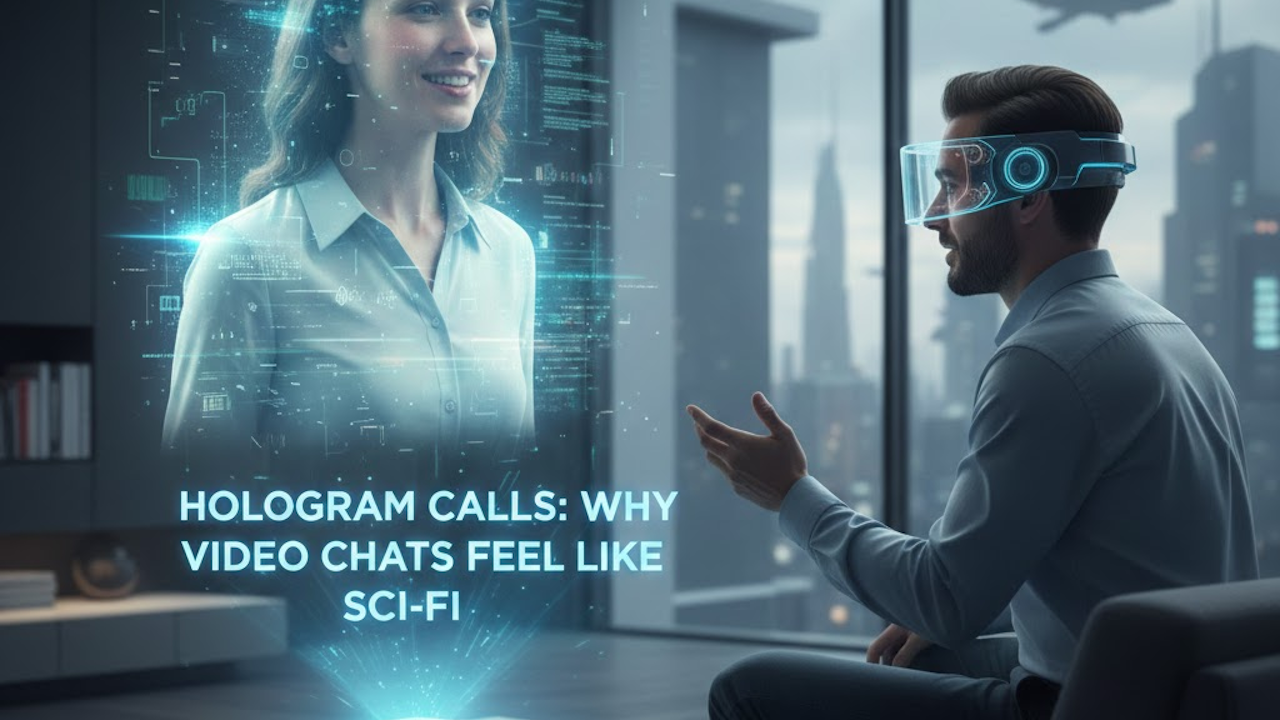
In the iconic scene from Star Wars, Princess Leia appears as a flickering blue hologram, pleading for help from Obi-Wan Kenobi. This moment, captured in a galaxy far, far away, has long symbolized the pinnacle of futuristic communication. Fast-forward to today, and video chats via apps like Zoom or FaceTime have become everyday tools for work meetings, family catch-ups, and global collaborations. Yet, even in our hyper-connected world, these flat-screen interactions often evoke that same sense of wonder. Why do video chats still feel like something out of science fiction? The answer lies in their roots in imaginative storytelling and the emerging reality of hologram calls, which promise to elevate communication to truly immersive levels. This article explores the technology behind hologram calls, their historical ties to sci-fi, real-world developments, and why our current video tools hint at a more holographic future.
The Sci-Fi Origins of Video Communication
Science fiction has always been a playground for envisioning technologies that bridge distances and defy physical limitations. Video calls, in particular, appeared in literature and film long before they became practical. As early as the 1880s, French author Jules Verne imagined a device called the “phonotelephote” in his story “In the Year 2889,” allowing people to see and speak to each other across vast distances. This concept predated even the widespread use of telephones, showing how writers anticipated visual communication as a natural evolution.
By the early 20th century, filmmakers brought these ideas to life. In the 1927 silent film Metropolis, directed by Fritz Lang, characters use large screens for video conversations, resembling oversized telephones with visual feeds. This was no mere fantasy; it reflected the era’s fascination with emerging radio and television technologies. Fast-forward to 1968, and Stanley Kubrick’s 2001: A Space Odyssey depicted a casual video call from space to Earth, complete with a young girl chatting with her father on a public videophone booth. The scene feels remarkably modern, mirroring today’s airport FaceTime sessions or remote work check-ins.
Television shows amplified this trend. The Jetsons, airing in the 1960s, featured cartoon families using wall-mounted screens for video calls, blending humor with prescient tech. Star Trek took it further, with communicators and viewscreens enabling interstellar face-to-face talks. These depictions weren’t just entertaining; they inspired real inventors. For instance, the flip-phone design of early mobile devices drew from Star Trek’s communicators, and video calling apps like Skype echo the show’s seamless connectivity.
What makes these sci-fi portrayals so enduring is their emphasis on presence. In stories, video calls aren’t just about seeing a face; they’re about feeling connected, as if the other person is right there. This illusion of intimacy is why modern video chats retain a futuristic allure, even as they’ve become mundane. They fulfill a dream that once seemed impossible, much like how early telephones must have felt magical.
From Fiction to Fact: The Evolution of Video Chats
The journey from sci-fi concept to everyday reality for video chats spans over a century. The idea of videotelephony emerged shortly after Alexander Graham Bell’s 1876 telephone patent. By the 1930s, experimental systems appeared, such as AT&T’s Iconophone, which transmitted images over wires. However, World War II halted progress, and it wasn’t until the 1960s that commercial videophones debuted. AT&T’s Picturephone, unveiled at the 1964 World’s Fair, allowed users to see each other in black-and-white, but high costs and limited infrastructure doomed it to failure.
The digital revolution changed everything. In the 1990s, internet-based video calling emerged with tools like CU-SeeMe, a simple webcam app for early computers. Microsoft’s NetMeeting followed, paving the way for consumer adoption. By 2003, Skype revolutionized the field with free, high-quality video calls over broadband. Smartphones accelerated this in the 2010s; Apple’s FaceTime in 2010 made video chatting as easy as a phone call. The COVID-19 pandemic supercharged usage, turning platforms like Zoom into household names.
Yet, despite these advances, video chats often fall short of the sci-fi ideal. Glitches, lag, and the “talking heads” format can make interactions feel stilted. This is where hologram calls enter the picture, promising to address these limitations by adding depth and spatial awareness.
Understanding Hologram Calls: The Technology Behind the Magic
At its core, a hologram is a three-dimensional image created through the interference of light beams, capturing not just an object’s appearance but its depth and parallax, allowing viewers to see it from different angles. Unlike traditional photos or videos, which are flat, holograms reconstruct light waves to mimic real-world perception.
Holographic communication applies this to real-time interactions. It involves capturing a person or object using cameras and sensors, processing the data into a 3D model, and projecting it via lasers or advanced displays. Computer-generated holography plays a key role, using algorithms to synthesize images without physical objects. Modern systems often rely on 5G networks for low-latency transmission, ensuring smooth, lifelike exchanges.
One common method is volumetric capture, where multiple cameras record from various angles, then AI reconstructs the 3D form. Displays might use special glass optics or metasurfaces to project the image, creating the illusion of a floating figure. This technology isn’t limited to labs; it’s edging into consumer spaces, blending augmented reality with everyday calls.
Real-World Examples: Hologram Calls in Action
Hologram calls are no longer confined to prototypes. In 2017, Verizon and Korea Telecom demonstrated the first international holographic call over 5G, linking employees in the US and South Korea in a 3D conversation. This milestone showed how mobile networks could support immersive communication.
Google’s Project Starline takes it further. Launched in 2021, it uses AI and 3D imaging to create lifelike holograms in booth-like setups, making eye contact and gestures feel natural. Users report feeling as if the other person is physically present, a step beyond flat video. Google has expanded testing to partners like Salesforce and T-Mobile, hinting at broader adoption.
Companies like Proto Hologram offer life-sized projections for events and meetings. For instance, NFL legend Chad Johnson has appeared as a hologram for live Q&As, beaming in from remote locations. Ericsson’s system uses consumer devices to generate holograms, focusing on enterprise uses like remote training. Even Meta is exploring holographic calling, aiming to integrate it with VR headsets for more immersive social experiences.
These examples illustrate how hologram calls build on video chats, adding depth to make interactions more engaging. In education, a teacher could project 3D models; in medicine, doctors might consult via holograms for precise diagnostics.
Why Video Chats and Holograms Evoke Sci-Fi Wonder
Video chats feel like sci-fi because they echo the holographic visions of films and books. Once, seeing a loved one’s face in real-time was a plot device for futuristic tales; now, it’s routine, but the thrill lingers. Hologram calls amplify this by blurring lines between physical and digital presence. They offer spatial awareness, where you can walk around the projection or make eye contact that feels genuine, mimicking in-person encounters.
This immersion taps into our innate desire for connection. Sci-fi often portrays technology as a way to overcome isolation, like in Back to the Future II, where video calls include data overlays and multi-tasking. Holograms take this to extremes, potentially integrating with metaverses for shared virtual spaces. Yet, this futurism comes with a caveat: it reminds us how far we’ve come from grainy calls, making even basic video feel advanced.
Challenges and the Horizon Ahead
Despite progress, hologram calls face hurdles. High data demands require robust 5G or 6G networks, and devices must handle complex processing without lag. Cost is another barrier; current setups like Proto’s booths are expensive, though miniaturization could bring them to smartphones. Privacy concerns arise with detailed 3D captures, and accessibility must ensure inclusivity.
Looking forward, experts predict widespread adoption by 2030. Ericsson envisions fully sensory experiences, digitizing touch and smell for ultimate immersion. Advances like Princeton’s compact holographic displays could fit into glasses, enabling AR holograms in daily life. In business, holographic meetings might replace travel; in entertainment, virtual concerts could feature interactive holograms.
AI will play a pivotal role, enhancing realism and personalization. By 2027, hospitals might use holograms for surgery planning, and personal devices could cost as little as $500. This evolution will transform society, making distance irrelevant and fostering global empathy.
Conclusion: A New Era of Connection
Hologram calls represent the next chapter in a story that began with sci-fi dreams. Video chats, once revolutionary, now serve as a bridge to this 3D future, explaining their lingering futuristic vibe. As technology advances, we’ll move from flat screens to spatial interactions, redefining how we connect. Whether in boardrooms or living rooms, holograms promise a world where presence transcends geography, turning yesterday’s fiction into tomorrow’s reality. The sci-fi feeling isn’t fading; it’s evolving, inviting us to imagine what’s next.