

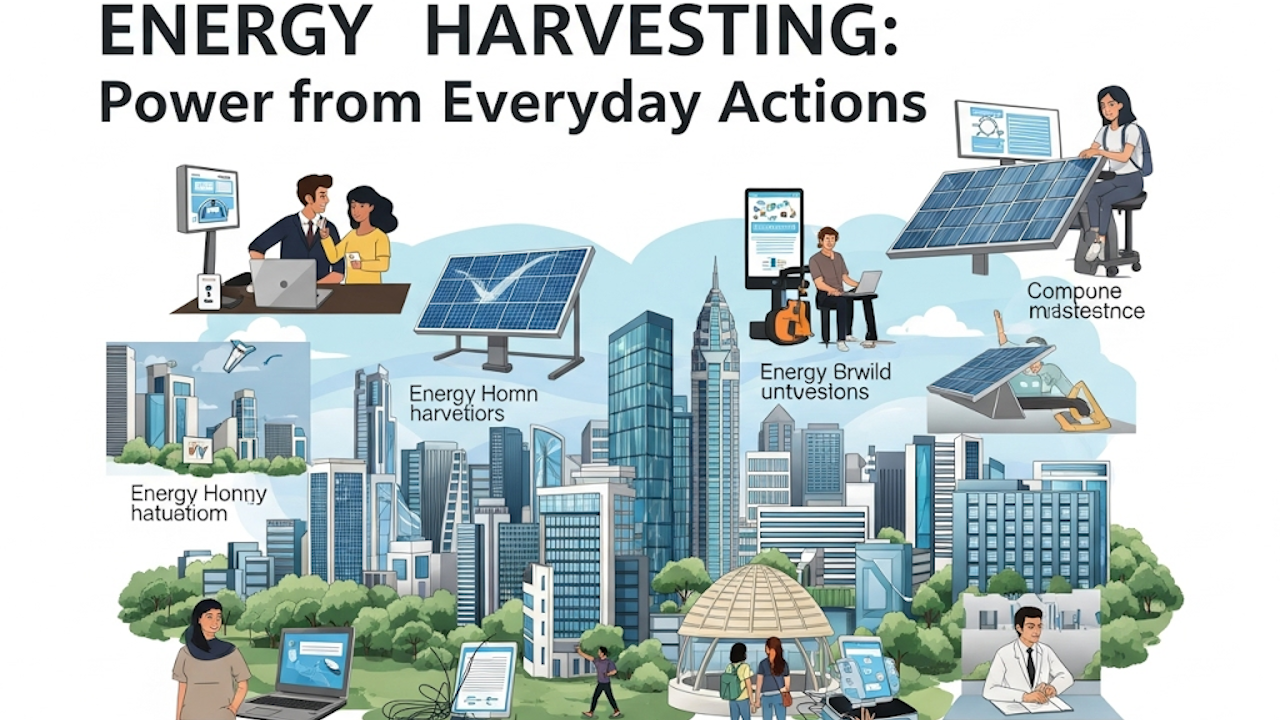
In a world increasingly reliant on portable electronics and sustainable energy sources, the concept of energy harvesting stands out as a promising solution. Energy harvesting refers to the process of capturing small amounts of ambient energy from the environment and converting it into usable electrical power. This technology draws from sources like light, heat, vibrations, and mechanical movements, but one of the most intriguing aspects is harvesting power from everyday human actions. Imagine generating electricity simply by walking, typing on a keyboard, opening a door, or even breathing. These routine activities produce kinetic, thermal, or vibrational energy that can be tapped to power low-energy devices such as wearables, sensors, and Internet of Things (IoT) gadgets. By focusing on human-generated energy, this approach reduces dependence on traditional batteries, which often require frequent replacement and contribute to environmental waste. As global energy demands rise and concerns about climate change intensify, harvesting power from everyday actions offers a clean, renewable alternative that integrates seamlessly into daily life.
The appeal of this technology lies in its accessibility. Unlike large-scale renewable sources such as solar panels or wind turbines, energy harvesting from human actions can occur on a personal scale. For instance, the motion of your footsteps could charge a smartphone, or the heat from your body could power a fitness tracker. Researchers and engineers have been exploring these possibilities for decades, with advancements accelerating in recent years due to improvements in materials science and nanotechnology. This article delves into the principles, types, technologies, applications, challenges, and future prospects of energy harvesting from everyday actions, highlighting how it could transform the way we power our devices.
Historical Background
The roots of energy harvesting trace back to the early 20th century, with inventions like self-winding watches that captured kinetic energy from wrist movements. However, modern developments began in earnest during the 1990s, driven by the need for battery-free sensors in remote or harsh environments. Early research focused on piezoelectric materials, which generate electricity under mechanical stress, inspired by natural phenomena like the electric charge produced when certain crystals are squeezed.
By the 2000s, interest shifted toward human-centric applications. Institutions like the Defense Advanced Research Projects Agency (DARPA) funded projects to harvest energy from soldiers’ movements, such as leg swings or backpack oscillations, to power communication devices without added weight. Around the same time, universities and companies began experimenting with wearable generators. For example, in 2009, researchers at Georgia Institute of Technology developed nanofibers that could be woven into clothing to capture energy from body motions. These early prototypes demonstrated the feasibility of turning everyday activities into power sources, setting the stage for today’s sophisticated systems.
Today, with the proliferation of IoT devices and wearables, energy harvesting has evolved into a multidisciplinary field combining physics, materials engineering, and computer science. Recent milestones include the development of triboelectric nanogenerators (TENGs) and flexible thermoelectric generators, which have made it possible to harvest energy efficiently from subtle actions like finger tapping or breathing.
Types of Energy Harvesting from Everyday Actions
Energy harvesting from everyday actions primarily falls into three categories: kinetic (motion-based), thermal (heat-based), and vibrational. Each type leverages different physical principles to convert ambient energy into electricity.
Kinetic Energy Harvesting
Kinetic energy harvesting captures power from movements such as walking, running, or gesturing. This is one of the most abundant sources in daily life, as the human body constantly generates mechanical energy through locomotion and interactions with objects.
Piezoelectric harvesting is a key method here. It uses materials like zinc oxide or polyvinylidene fluoride (PVDF) that produce voltage when deformed. For example, piezoelectric elements embedded in shoe soles can generate electricity from footsteps, potentially producing enough power to charge small devices. Studies show that a typical person can harvest around 0.6 milliamp-hours daily from body motions, with walking contributing significantly.
Triboelectric nanogenerators (TENGs) represent another advancement. These devices generate electricity through friction between two materials, such as when fabrics rub together during movement. Textile-based TENGs integrated into clothing can harvest energy from arm swings or leg strides, achieving outputs like 0.94 milliwatts from simple arm movements. This makes them ideal for self-powered wearables that monitor health metrics without batteries.
Electromagnetic induction is also used, where motion causes a magnet to move through a coil, inducing current. Devices like knee braces or backpacks employ this to capture energy from walking or carrying loads, generating up to 20 watts under heavy conditions.
Thermal Energy Harvesting
The human body maintains a core temperature around 37 degrees Celsius, creating a thermal gradient with the cooler ambient air. Thermoelectric generators (TEGs) exploit this using the Seebeck effect, where a temperature difference between two dissimilar materials produces voltage.
Flexible TEGs can be incorporated into wristbands or clothing, harvesting body heat to power sensors. For instance, a device might generate 3.5 microwatts per square centimeter, sufficient for low-power applications like heart rate monitors. Pyroelectric materials, which respond to temperature changes, are another option, useful for harvesting energy from breathing or environmental fluctuations.
Vibrational Energy Harvesting
Vibrations from everyday actions, such as typing on a keyboard or closing a door, can be harvested using similar principles. Nonlinear piezoelectric devices excel here, as they capture a broad range of frequencies from chaotic motions, potentially increasing efficiency by up to ten times compared to linear systems. Magnetic induction harvesters, like those using ferrofluids, are effective for low-frequency vibrations from household activities.
Technologies and Materials
Advancements in materials have been crucial. Nanostructures, such as zinc-oxide nanowires, enhance piezoelectric efficiency by allowing flexible, lightweight designs that can be woven into fabrics. For TENGs, polymers like PVDF-TrFE provide durability and high output.
Systems like E3D enable non-experts to create custom harvesters from 3D-printed mechanisms attached to objects like doorknobs or drawers. This toolkit classifies activities into categories like linear motions or rotations and generates parametric designs to convert them into rotational energy for generators. Power management units (PMUs) are integrated to store and regulate the harvested energy, achieving efficiencies up to 84.3 percent.
Biofuel cells harvest chemical energy from sweat or blood, though they are less common for everyday actions. Hybrid systems combine multiple methods, such as TENGs with solar cells, for reliable power.
Applications
The applications are vast. In wearables, harvested energy powers fitness trackers, smartwatches, and health monitors, extending battery life indefinitely. For medical devices, it sustains pacemakers or glucose sensors using heartbeats or blood flow, reducing surgery needs.
In smart homes, energy from opening doors or walking on floors powers sensors for lighting or security. IoT networks benefit from vibration harvesters on machinery or bridges for maintenance monitoring.
Public spaces see innovative uses, like piezoelectric floors in dance clubs generating power from footsteps, or gyms where exercise equipment contributes to the grid. Even radio frequency signals from Wi-Fi can be harvested for ultra-low-power devices.
Challenges and Limitations
Despite progress, challenges remain. Harvested power is often low, in the microwatt to milliwatt range, limiting it to low-energy applications. Efficiency varies with activity intensity; casual walking yields less than jogging.
Biocompatibility and durability are issues for wearables, as materials must withstand sweat and flexing without degrading. Integration requires sophisticated PMUs to handle intermittent energy flows.
Scalability is another hurdle. While personal devices work well, powering larger systems demands arrays of harvesters, increasing complexity. Environmental factors, like temperature affecting TEGs, also pose problems.
Future Prospects
The future looks bright, with research pointing toward self-powered closed-loop bioelectronic systems that integrate harvesting with devices and the body. Advances in nanomaterials could boost efficiency, enabling widespread adoption.
As AI and machine learning optimize designs, custom harvesters for specific activities will become common. Policy support for sustainable tech could accelerate commercialization, making energy from everyday actions a staple in green energy strategies.
Conclusion
Energy harvesting from everyday actions represents a paradigm shift toward sustainable, self-sufficient power. By converting routine movements, heat, and vibrations into electricity, it addresses battery limitations and promotes eco-friendly innovation. From piezoelectric shoes to thermal wristbands, the potential to power our connected world is immense. As technology matures, this approach could make energy scarcity a thing of the past, empowering individuals to generate their own power through the simple act of living.