

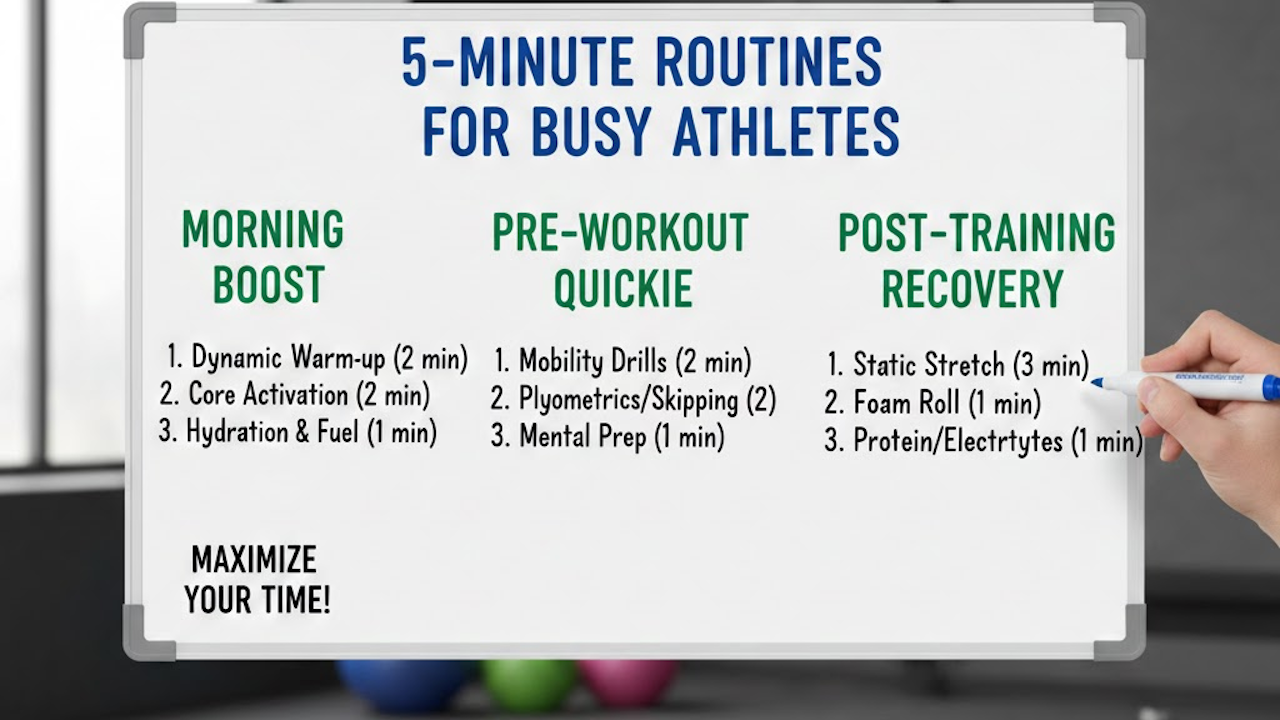
In today’s fast-paced world, busy athletes often struggle to find time for regular training sessions. However, the implementation of short-duration workouts, specifically 5-minute routines, can serve as a game-changer in maximizing performance. One of the primary benefits of these brief workouts lies in their efficiency; athletes can engage in high-intensity exercises that stimulate muscle growth, enhance cardiovascular fitness, and improve overall athletic performance in a fraction of the time required by traditional workouts.
Research has shown that short bursts of concentrated activity can significantly boost energy levels. After just a few minutes of vigorous exercise, athletes often experience increased endorphin production, leading to heightened mood and focus. This boost in energy can be especially advantageous for busy individuals who require both physical and mental sharpness during their daily routines.
Moreover, engaging in consistent, short workouts contributes to building mental resilience. Athletes who incorporate 5-minute routines can foster a sense of accomplishment and maintain motivation, even amidst a bustling schedule. The psychological benefits of brief yet intense workouts can help alleviate the stress associated with time constraints and create a mindset conducive to greater performance outcomes.
Scientific studies underline the effectiveness of high-intensity interval training (HIIT) and similar exercise formats that prioritize short durations, demonstrating that these methods can yield results comparable to longer, more traditional workout sessions. Such findings reinforce the notion that athletes need not sacrifice their physical conditioning due to constrained time; rather, they can leverage short workouts to maintain and even elevate their performance levels.
Quick and Effective Warm-Up Routines
For busy athletes, maximizing performance within a constrained schedule is critical. Engaging in quick yet effective warm-up routines can significantly enhance both athletic performance and injury prevention. A key element to a successful warm-up is incorporating dynamic stretches and mobility exercises that target the major muscle groups involved in the specific sport.
One effective warm-up routine consists of a series of dynamic stretches such as leg swings, arm circles, and walking lunges. For instance, leg swings involve swinging one leg forward and backward while balancing on the other, thereby improving hip flexibility and range of motion. Similarly, arm circles help loosen the shoulder joints and prepare the upper body for activity. Another beneficial exercise is the walking lunge, which not only stretches the hip flexors but also activates the quadriceps and glutes.
In addition to dynamic stretches, incorporating mobility exercises such as ankle circles and torso twists can enhance overall flexibility and prepare the body for performance. Ankle circles are particularly useful for athletes engaged in sports that require quick changes of direction, while torso twists adequately prepare the core for rotational movements.
To effectively customize these warm-up routines, athletes can consider their specific sport and personal requirements. For instance, runners may focus more on the lower body through additional calf stretches, while swimmers might prioritize shoulder mobility. Overall, dedicating just five minutes to these routines allows athletes to optimize their performance abilities while significantly reducing their risk of injury.
5-Minute High-Intensity Workouts
High-intensity workouts are an effective way for busy athletes to enhance their cardiovascular fitness and overall strength in a short amount of time. These 5-minute routines allow for maximum impact within a limited timeframe, making them ideal for individuals with tight schedules. Incorporating short bursts of intense activity can stimulate metabolic processes and improve endurance.
One exemplary high-intensity exercise is the burpee, which combines a squat, push-up, and jump. A 1-minute set of burpees can elevate heart rates quickly, providing a full-body workout. Similarly, squat jumps are another powerful exercise that targets the lower body while also improving explosive strength. Performing squat jumps for 30 seconds, followed by a brief rest, helps in achieving anaerobic conditioning.
High knees are also a fantastic option, promoting agility and coordination. Setting a timer for this exercise for 30 seconds encourages athletes to maintain pace while lifting their knees high to engage core muscles effectively. Each of these exercises can be structured into circuits that alternate between various activities, allowing minimal rest to keep the heart rate elevated.
Incorporating interval training techniques can further enhance these 5-minute workouts. For instance, one can integrate 20 seconds of maximum effort followed by 10 seconds of rest, repeating the cycle to increase the workout’s intensity. This structure not only maximizes calorie burn but also optimizes cardiovascular benefits within a short period. Therefore, busy athletes can efficiently utilize these brief high-intensity sessions to uphold their fitness levels. Their adaptability makes them particularly beneficial for those navigating a demanding routine.
Cool Down and Recovery Strategies in Five Minutes
For busy athletes, dedicating time for proper recovery can often be overlooked amidst rigorous training schedules. However, integrating effective cool down and recovery strategies into a five-minute routine can significantly enhance athletic performance and overall well-being. Emphasizing the importance of recovery, it is essential for athletes to adopt practices that actively promote muscle relaxation and repair after physical exertion.
One highly beneficial method involves stretching the major muscle groups used during workouts. Simple static stretches, such as hamstring and quadriceps stretches, can effectively alleviate muscle tension and enhance flexibility. Spending approximately one minute on stretching can foster improved range of motion and decrease the likelihood of injuries. Athletes should focus on holding each stretch for about 15-30 seconds, ensuring that they breathe deeply and remain mindful throughout the process.
Incorporating breathing techniques into the cool down phase is equally important. Deep, diaphragmatic breathing not only calms the mind but also facilitates a reduction in heart rate. Allocating one minute to this practice can help regulate the body’s transition from high-intensity activity to a state of rest. Athletes can practice inhaling through the nose for a count of four, holding for four, and exhaling through the mouth for a count of six.
Additionally, foam rolling serves as an excellent self-myofascial release technique that can be integrated into a brief recovery routine. Dedicate two minutes to targeting sore muscles, focusing on areas such as the calves, thighs, and upper back. Foam rolling enhances blood circulation, alleviates muscle tightness, and expedites the recovery process.
By combining these techniques—stretching, breathing exercises, and foam rolling—athletes can create a cohesive five-minute recovery routine that effectively mitigates muscle soreness, improves flexibility, and primes the body for subsequent training sessions. Such brief but focused practices are instrumental in ensuring sustained athletic performance and well-being.