

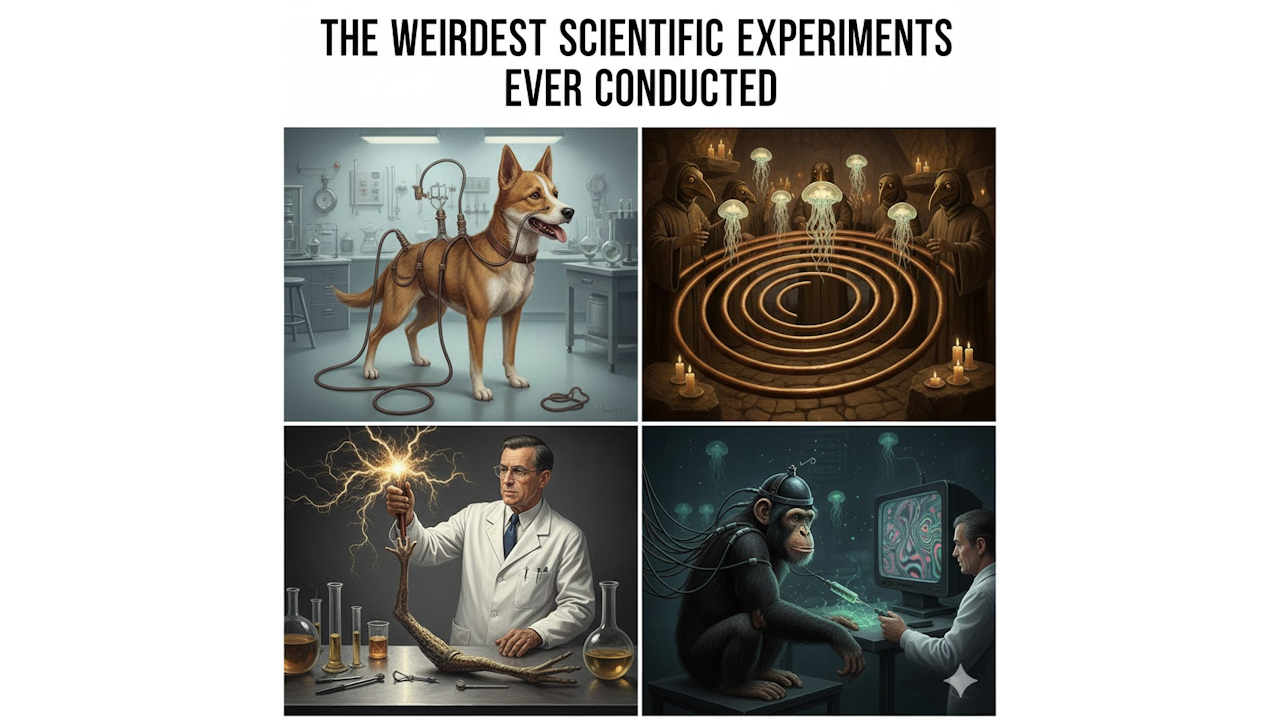
Science thrives on curiosity, and sometimes that curiosity leads researchers down paths that are as bizarre as they are fascinating. While many experiments have advanced medicine, technology, and our understanding of the universe, others stand out for their sheer strangeness. These unusual studies remind us that science is not always about serious laboratories and groundbreaking discoveries. It can also be quirky, eccentric, and occasionally absurd.
🐸 The Frog Leg Electricity Experiment
In the late 18th century, Italian scientist Luigi Galvani discovered that frog legs twitched when struck by an electrical spark. He believed he had uncovered “animal electricity,” a force inherent in living beings. Although his interpretation was later corrected by Alessandro Volta, who showed that the twitching was due to external electrical currents, Galvani’s frog leg experiment laid the foundation for modern bioelectricity. The image of frog legs jerking on a table remains one of the strangest yet most influential scientific demonstrations.
🎶 Music for Cows
In the 1990s, researchers in the United Kingdom tested whether playing music could influence milk production in dairy cows. They found that slow, soothing tunes such as classical music or ballads helped cows relax, leading to increased milk yield. Fast-paced or loud music had the opposite effect. The idea that cows have musical preferences may sound odd, but it highlights how environmental factors can affect animal productivity.
🍷 Drunk Elephants
In the mid-20th century, scientists studied the effects of alcohol on elephants. They wanted to know how much alcohol it would take to intoxicate such a massive animal. The conclusion was that elephants would need to consume enormous quantities of alcohol to feel any effect, far more than they would ever encounter in nature. The experiment raised eyebrows for its impracticality and ethical concerns, but it remains a curious footnote in zoological research.
🧪 The Stanford Prison Experiment
Although widely criticized today, the Stanford Prison Experiment of 1971 is infamous for its unsettling results. Psychologist Philip Zimbardo created a simulated prison environment with volunteers assigned roles as guards or prisoners. The guards quickly became abusive, and the prisoners showed signs of extreme stress. The study was terminated early due to ethical concerns. While not “weird” in a humorous sense, it demonstrated how quickly ordinary people can adopt disturbing behaviors when placed in certain conditions.
🐀 Rat Laughter
In the 1990s, neuroscientist Jaak Panksepp discovered that rats emit high-pitched chirps when tickled, which he interpreted as laughter. Using specialized equipment to detect ultrasonic sounds, he showed that rats enjoy play and social interaction in ways similar to humans. The idea of scientists tickling rats to study their giggles may sound eccentric, but it opened new avenues in understanding animal emotions.
🥔 The Potato Radiation Test
During the Cold War, scientists tested the effects of radiation on food. Potatoes were exposed to high doses of radiation to see if they could be preserved longer. While the experiments showed that radiation could kill bacteria and extend shelf life, the concept of “atomic potatoes” unsettled the public. The research eventually contributed to modern food irradiation techniques, but the image of glowing potatoes remains a strange chapter in food science.
🧊 Freezing Dogs and Reviving Them
In the 1940s, Soviet scientists conducted chilling experiments in which they drained blood from dogs, cooled their bodies to near-freezing, and then attempted to revive them using artificial circulation machines. Some dogs reportedly survived the process. These experiments were part of early research into resuscitation and organ preservation, but they remain among the most disturbing and bizarre animal studies ever recorded.
🧍 Human Sleep Deprivation Studies
Sleep researchers have long been fascinated by the effects of sleeplessness. In the 1960s, Randy Gardner, a high school student, stayed awake for 11 days under scientific observation. He experienced hallucinations, memory lapses, and mood swings, but no permanent damage. The experiment remains one of the longest documented cases of voluntary sleep deprivation. It raised questions about the limits of human endurance and the importance of rest.
🌌 The Space Spider Experiment
NASA once sent spiders into space to study how they would spin webs in zero gravity. The results were both strange and beautiful. Without gravity, the spiders created webs that were more symmetrical and orderly than those on Earth. The experiment revealed how environmental conditions shape animal behavior, even in the most unusual settings.
Conclusion
The weirdest scientific experiments ever conducted show that curiosity often leads to unexpected places. From tickling rats to playing music for cows, these studies may seem eccentric, but they often reveal profound truths about biology, psychology, and the environment. Science is not only about solving serious problems. It is also about exploring the unknown, even when the unknown looks downright peculiar.