

Cryptocurrency markets are renowned for their extreme volatility, with prices capable of surging hundreds of percent in months only to plummet equally dramatically shortly after. While factors like technological developments, regulatory news, and macroeconomic trends play roles, the primary driver of these boom-and-bust patterns is human psychology. Collective emotions such as fear, greed, hope, and despair create self-reinforcing cycles that amplify price movements far beyond what fundamentals alone might justify. This phenomenon mirrors traditional financial markets but is intensified in crypto due to its 24/7 trading, global accessibility, retail-dominated participation, and heavy influence from social media.
Behavioral finance, the study of how psychological biases affect financial decisions, provides the framework for understanding these cycles. Investors deviate from pure rationality due to cognitive shortcuts (heuristics), emotional impulses, and social influences. In crypto, these biases manifest acutely because of the asset class’s novelty, lack of intrinsic cash flows (for many tokens), and speculative nature. Key concepts include herd behavior, where individuals mimic others rather than relying on independent analysis; loss aversion, where losses feel more painful than equivalent gains; and overconfidence, leading traders to overestimate their knowledge in unpredictable markets.
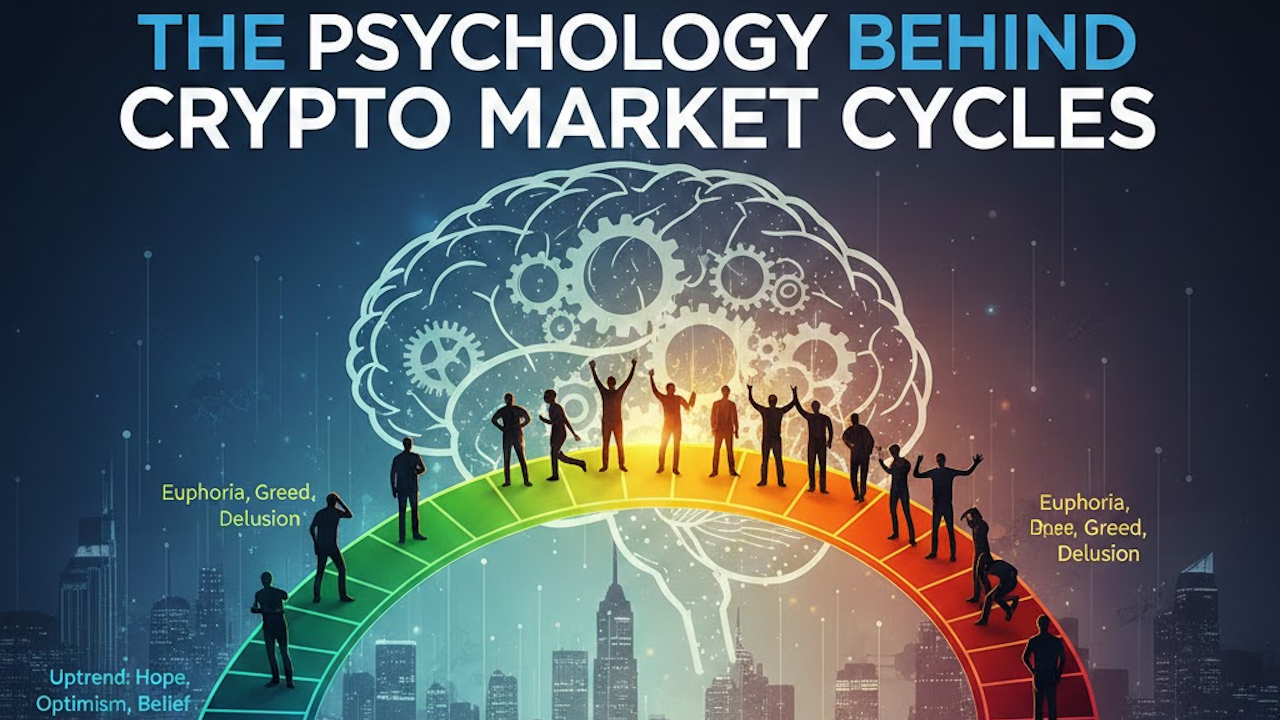
One of the most illustrative models is the “Psychology of a Market Cycle,” popularized by the Wall Street Cheat Sheet and widely applied to crypto. This model outlines emotional stages that correspond to price phases:
- Disbelief: After a prolonged bear market, prices begin to stabilize or rise modestly. Investors who endured heavy losses remain skeptical, dismissing the recovery as temporary.
- Hope and Optimism: As prices climb steadily, early adopters feel vindicated. New participants enter cautiously, hoping for further gains.
- Belief and Thrill: Momentum builds, with widespread media coverage and positive narratives. Confidence surges, driving rapid price appreciation.
- Euphoria: The peak phase, marked by extreme greed. Prices reach unsustainable highs, fueled by stories of overnight wealth. This is when “everyone” seems to be investing.
The cycle then reverses:
- Complacency and Anxiety: Initial pullbacks are viewed as buying opportunities, but doubt creeps in.
- Denial and Fear: Losses mount, yet many hold on, denying the downturn’s severity.
- Panic and Capitulation: Mass selling ensues as despair takes over. Prices crash sharply.
- Anger and Depression: At the bottom, investors feel regret and anger, vowing never to return. This capitulation often marks the cycle’s low, setting the stage for accumulation by contrarian buyers.
These stages repeat because human psychology is consistent across cycles. In crypto, they compress into shorter timeframes compared to stocks, sometimes completing in months rather than years, due to higher leverage, retail speculation, and viral information spread.
Central to crypto psychology are two acronyms: FOMO (Fear of Missing Out) and FUD (Fear, Uncertainty, and Doubt). FOMO dominates bull markets, compelling investors to buy surging assets impulsively to avoid regretting missed profits. It drives herd behavior, where social media hype and influencer endorsements create contagion effects, pushing prices higher in self-fulfilling prophecies. Studies show FOMO leads to overestimation of personal skill and preoccupation with trading, contributing to bubbles.
Conversely, FUD spreads during downturns, often through misinformation or negative news, triggering panic selling. Regulatory announcements, hacks, or prominent figures’ critical comments can amplify FUD, causing cascading liquidations. This asymmetry explains why crypto crashes are often sharper than rallies: fear motivates faster action than greed.
Tools like the Crypto Fear and Greed Index quantify these sentiments. Ranging from 0 (extreme fear) to 100 (extreme greed), it aggregates data on volatility, momentum, social media activity, and surveys. Extreme fear signals potential buying opportunities (when others capitulate), while extreme greed warns of overheated markets ripe for correction. Historical data shows the index often reaches greed peaks near cycle tops and fear troughs near bottoms.
Herd behavior is particularly pronounced in crypto. Empirical studies detect herding through metrics like cross-sectional return dispersion, finding it stronger in bear markets or high-volatility periods. During bull runs, especially Bitcoin halvings or ETF approvals, investors flock to dominant assets like Bitcoin, then spill over to altcoins. This coordination stems from informational cascades: lacking clear fundamentals, traders follow prices or crowd signals. Bitcoin’s dominance often peaks late in cycles, signaling risk as capital rotates irrationally.
Other biases exacerbate cycles. Prospect theory explains why investors hold losers too long (hoping for recovery) but sell winners prematurely (locking in gains). Overconfidence bias, fueled by past bull runs, leads to excessive risk-taking. Confirmation bias causes selective information processing, ignoring contrary evidence during euphoria or despair.
Crypto’s unique features intensify these effects. The 24/7 market prevents psychological breaks, leading to decision fatigue. Social platforms accelerate sentiment transmission: a single tweet can spark FOMO or FUD globally. Retail dominance (versus institutions in stocks) heightens emotional trading, as novices are more prone to biases.
Historical examples illustrate these dynamics. The 2017-2018 cycle saw euphoria around ICOs drive Bitcoin to $20,000, followed by capitulation to $3,000 amid regulatory FUD. The 2020-2021 bull, boosted by institutional adoption and stimulus, peaked near $69,000 with widespread FOMO, then crashed over 70% in 2022 due to rate hikes and scandals like FTX. Recovery in 2023-2024, aided by spot ETF approvals, again followed the pattern: initial disbelief, then optimism and euphoria.
Understanding cycle psychology offers practical benefits. Contrarian strategies, like buying during extreme fear and selling during greed, outperform emotional trading. Dollar-cost averaging mitigates timing errors by removing emotion. Long-term holding (HODLing) counters short-term FOMO/FUD for those with high conviction.
However, challenges persist. Identifying exact phases in real time is difficult; what seems like capitulation can extend further. External shocks, like pandemics or policy changes, disrupt patterns. As markets mature with more institutional involvement, cycles may lengthen or dampen, but psychological drivers remain fundamental.
In conclusion, crypto market cycles are profoundly psychological phenomena, driven by collective emotions and biases rather than pure economics. Recognizing these patterns, from euphoria to despair, empowers investors to navigate volatility more rationally. By prioritizing discipline over impulse, studying sentiment indicators, and maintaining perspective, participants can avoid common pitfalls and capitalize on the opportunities these cycles inevitably present. Ultimately, mastering market psychology is as crucial as any technical or fundamental analysis in the unpredictable world of cryptocurrency.