

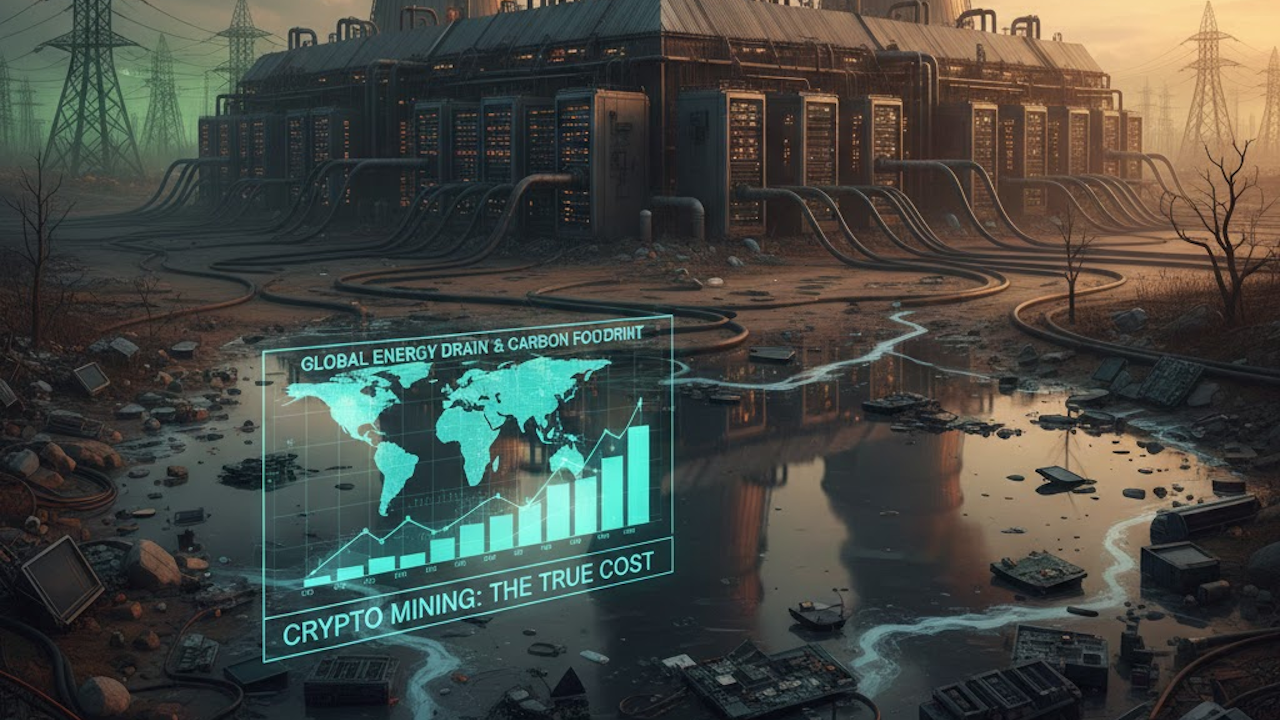
Cryptocurrency mining, particularly for Bitcoin, has emerged as one of the most energy-intensive processes in the digital economy. The process involves using specialized computers to solve complex mathematical problems, validating transactions and securing the blockchain network through a mechanism known as proof-of-work (PoW). While this ensures decentralization and security, it comes at a significant environmental cost. As of late 2025, Bitcoin alone accounts for the vast majority of these impacts among cryptocurrencies, with its network consuming vast amounts of electricity, contributing to carbon emissions, generating electronic waste, and straining water resources. Other PoW-based cryptocurrencies add to the burden, though to a lesser extent. This article examines these impacts in detail, explores and explores ongoing efforts toward sustainability.
Energy Consumption: A Global-Scale Demand
The primary environmental concern with cryptocurrency mining stems from its enormous electricity requirements. Miners compete to solve cryptographic puzzles, a process that escalates in difficulty over time, driving up power usage. Estimates for Bitcoin’s annual electricity consumption in 2025 vary, but reliable sources place it between 120 and 175 terawatt-hours (TWh), equivalent to the energy use of countries like Argentina or the Netherlands. The Cambridge Centre for Alternative Finance reports around 138 TWh, representing about 0.5 percent of global electricity consumption.
This demand is driven by the network’s hash rate, a measure of computational power, which has grown exponentially. For context, Bitcoin’s energy use rivals that of entire nations, and a single transaction can consume as much electricity as an average household uses in weeks. The U.S. has become the largest hub for mining after China’s 2021 crackdown, accounting for over a third of global activity, with facilities often locating near cheap power sources, including fossil fuel plants.
Carbon Emissions and Climate Contribution
When powered by fossil fuels, mining translates directly into greenhouse gas emissions. In 2025, Bitcoin’s carbon footprint is estimated at 39.8 to 98 million metric tons of CO2 equivalent annually, comparable to the emissions of countries like Qatar or Slovakia. The Cambridge Centre estimates 39.8 Mt CO2, while others, factoring in higher fossil fuel reliance, reach nearly 100 Mt.
Much of this stems from the energy mix: even as renewables grow, fossil fuels like natural gas (now the largest source at around 38 percent) and coal persist in key regions. Studies show that mining in coal-heavy grids exacerbates emissions, with one analysis linking it to increased fine particulate pollution (PM2.5) affecting millions in the U.S. Critics argue this undermines global climate goals, as mining’s emissions rival those of entire industries without producing tangible goods.
Electronic Waste: The Hidden Hardware Toll
Beyond energy, mining generates substantial electronic waste (e-waste). Specialized hardware called Application-Specific Integrated Circuits (ASICs) becomes obsolete roughly every 1.5 years due to rapid advancements and increasing network difficulty. This short lifespan leads to annual e-waste estimates of 30,000 to 60,000 metric tons for Bitcoin alone, comparable to the small IT equipment waste of nations like the Netherlands.
ASICs cannot be repurposed for other tasks, unlike general-purpose computers, exacerbating the problem. Global e-waste already exceeds 50 million tons yearly, with low recycling rates allowing toxic materials to leach into soils and water. As mining scales, this waste stream grows, highlighting a cycle of constant hardware turnover driven by competition.
Water Usage and Local Resource Strain
Mining’s water footprint is often overlooked but significant. Power plants supplying electricity to miners use water for cooling, while data centers employ evaporative or direct cooling systems. In 2025, Bitcoin’s global water consumption is estimated at over 2,200 gigaliters annually, with per-transaction figures reaching thousands of liters, equivalent to filling a backyard swimming pool.
In water-scarce regions like parts of the U.S. or Central Asia, this strains local supplies and can lead to thermal pollution when heated water is discharged. Indirect water use from thermoelectric power generation dominates, but direct cooling adds further pressure, particularly in drought-prone areas.
Other Impacts: Air Pollution and Ecosystem Effects
Mining contributes to air pollution beyond CO2. In the U.S., large mines have increased PM2.5 levels, exposing millions to health risks like respiratory and cardiovascular diseases. Fossil fuel reliance amplifies this, with studies linking mining to pollution comparable to adding millions of gas-powered cars to roads. Land use for facilities and associated infrastructure also disrupts ecosystems, though this is less quantified.
Counterarguments: Potential Benefits and Sustainability Efforts
Proponents argue that mining can drive positive change. Miners’ flexible demand allows curtailment during peak grid stress, stabilizing renewables and absorbing excess energy from wind or solar. Some operations use flared methane from oil fields, reducing potent greenhouse gases, or waste heat for heating homes. Coordinated mining has been shown to cut microgrid costs and improve solar economics.
Renewable adoption is rising: over 52 percent of Bitcoin mining electricity comes from clean sources in 2025, up from previous years, including hydropower in Canada and wind in Texas. Innovations like immersion cooling reduce water and energy needs, and some miners partner with renewables to build new capacity.
Toward a More Sustainable Future
Despite progress, unmanaged growth risks higher emissions and resource strain. Alternatives like proof-of-stake (used by Ethereum, slashing energy use by over 99 percent) offer a path forward, though Bitcoin resists change due to security concerns. Policy options include transparency requirements, carbon taxes on mining electricity, and incentives for renewables.
Regulators in places like New York and the EU are scrutinizing impacts, with proposals for monitoring and restrictions. As cryptocurrency evolves, balancing innovation with environmental responsibility is crucial. Without targeted interventions, mining’s footprint could undermine sustainability goals, but with shifts toward efficient mechanisms and clean energy, it may contribute positively to the energy transition. The industry stands at a crossroads, where technological and policy choices will determine its long-term legacy.