

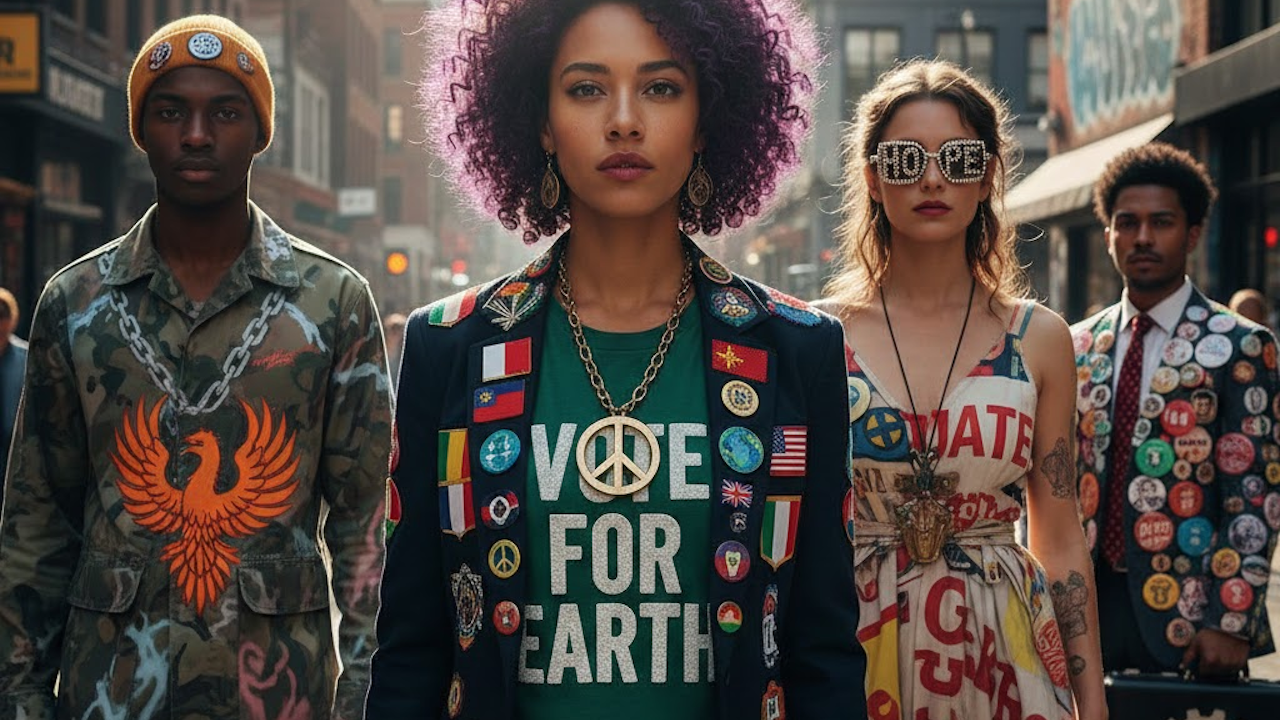
Political fashion has long served as a visual language through which individuals and movements express power, dissent, identity, and solidarity. Clothing and style choices communicate messages that often reach further and faster than speeches or manifestos. From uniforms that enforce authority to garments that challenge oppression, fashion operates as a symbolic system embedded in political life. By examining historical examples, contemporary movements, and the psychology behind visual signaling, it becomes clear that political fashion is not superficial decoration but a strategic tool in shaping public meaning.
One of the most enduring political fashion symbols is the uniform. Military attire, police dress, and ceremonial garments establish hierarchy, discipline, and legitimacy. The uniform signals order and collective identity while suppressing individual difference. In authoritarian regimes, strict dress codes often mirror strict political control. The Mao suit in China, for example, became a symbol of revolutionary equality by rejecting bourgeois style and emphasizing sameness. Yet even this enforced simplicity carried political weight, marking loyalty to the state and adherence to ideological purity.
In contrast, political resistance often manifests through deviation from imposed norms. During colonial rule, indigenous dress became a site of struggle, as colonized peoples used traditional garments to assert cultural survival. Mahatma Gandhi’s adoption of simple khadi cloth symbolized self sufficiency and rejection of British industrial dominance. His clothing was not merely personal preference but a deliberate performance of political philosophy. By dressing like the rural poor, Gandhi aligned his body with his message of moral authority and collective sacrifice.
The twentieth century saw fashion become a stage for mass political movements. The suffragettes used coordinated colors and accessories to unify supporters and gain visibility in public space. White dresses signaled purity and moral legitimacy, while sashes and pins created a recognizable identity that newspapers could easily reproduce. Similarly, the Black Panther Party adopted leather jackets, berets, and dark sunglasses to project discipline, militancy, and pride. Their style communicated readiness to defend their communities and challenged stereotypes of passive victimhood.
In democratic societies, politicians themselves carefully manage appearance to craft public personas. Suits, ties, and tailored dresses convey competence, stability, and respectability. Deviations from these norms can signal reform or rebellion. When female politicians choose bright colors, pantsuits, or culturally specific dress, they negotiate visibility in a male dominated arena. Clothing becomes a way to balance authority with approachability, individuality with institutional expectation. These choices are rarely accidental, as every photograph becomes part of a larger narrative.
Contemporary protest movements continue to use fashion as a rallying symbol. The pink knitted hats worn during women’s marches transformed a simple accessory into a global emblem of resistance. Yellow vests in France turned workwear into a marker of class anger and economic frustration. Face masks, once medical tools, became politicized during public health crises, signaling either solidarity with collective protection or defiance against state mandates. In each case, everyday objects acquired ideological meaning through repetition and media circulation.
Social media has amplified the power of political fashion. Images travel instantly across borders, allowing a single outfit to inspire imitation and debate. Hashtags turn garments into slogans, and viral photos crystallize complex positions into a single visual moment. This speed increases both the reach and the fragility of symbolic style. A gesture that resonates today may be forgotten tomorrow, replaced by a new icon. Yet the cycle itself shows how deeply politics depends on visual cues to mobilize emotion and attention.
The effectiveness of political fashion lies in its ambiguity. Clothing speaks without words, allowing multiple audiences to interpret meaning according to their own values. A raised fist on a shirt may signify justice to one viewer and threat to another. This openness can unite diverse supporters under a shared image, but it can also provoke backlash. Governments have long understood this power and often regulate dress through bans on religious symbols, protest attire, or specific colors. Such restrictions reveal anxiety about the capacity of clothing to challenge authority.
Political fashion also raises questions about commodification. Once a symbol gains popularity, it often enters the marketplace. Revolutionary slogans appear on luxury items, and protest styles are sold by major brands. This commercialization can dilute meaning, turning dissent into trend. Yet it can also spread awareness to wider audiences. The tension between authenticity and appropriation remains central to debates about style as political expression.
At its core, political fashion works because humans are visual beings. We read bodies before we read texts, and we assign moral and social meaning to surfaces. Style offers a way to participate in politics even when speech is restricted or risky. It allows individuals to declare allegiance, defiance, or hope in a language that is immediate and shared. Across cultures and eras, the wardrobe has functioned as both armor and banner.
In an age of rapid communication and polarized identities, political fashion continues to shape how movements are seen and remembered. It reminds us that power is not only exercised through laws and weapons but also through symbols worn on the skin. By choosing what to wear, people choose how to be seen, and in doing so, they take part in the ongoing struggle over meaning, belonging, and change.