

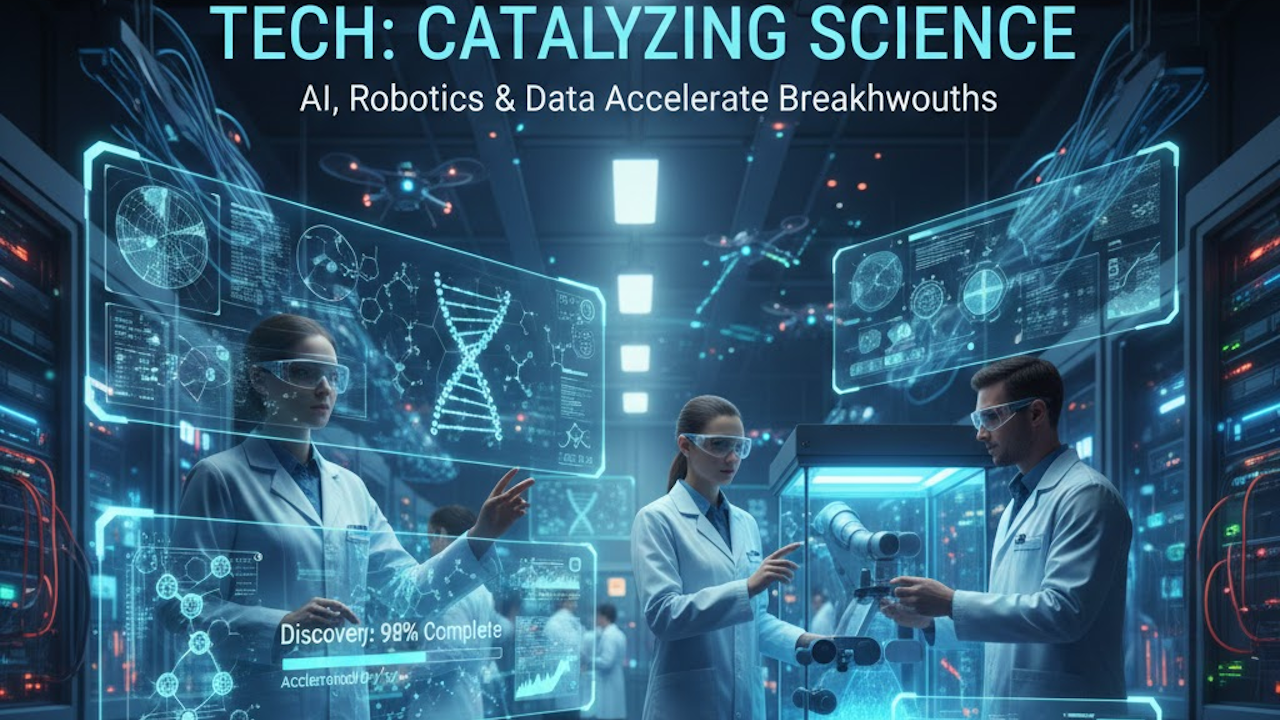
Technology is transforming how science is done, dramatically accelerating the pace at which discoveries are made. What once took decades of careful observation, manual calculation, and trial and error can now happen in years or even months. Advances in computing, data collection, automation, and global communication have reshaped the scientific process itself. As a result, researchers are not only discovering more, but also asking bolder questions and exploring areas that were previously out of reach.
One of the most important drivers of faster scientific discovery is computing power. Modern computers can process vast amounts of data at incredible speeds, allowing scientists to run simulations and analyze results that would have been impossible in the past. In fields such as physics, chemistry, and climate science, computer models help researchers test ideas without needing constant physical experiments. Simulations of molecular interactions, galaxy formation, or weather systems allow scientists to explore countless scenarios quickly and safely. This reduces cost, saves time, and helps narrow down the most promising directions for real world experiments.
Artificial intelligence and machine learning have further amplified this effect. These tools can detect patterns in massive datasets that humans might miss. In biology and medicine, AI systems are used to analyze genetic data, identify potential drug candidates, and predict how proteins fold. This has led to breakthroughs in understanding diseases and developing treatments. Rather than manually testing thousands of possibilities, scientists can use algorithms to focus on the most likely solutions. This shifts research from slow exploration to targeted discovery.
Another major factor is the explosion of data collection technologies. Advanced sensors, satellites, microscopes, and sequencing machines generate enormous streams of information. For example, modern telescopes collect more data in a single night than older instruments gathered in years. In genetics, the cost and time required to sequence DNA have dropped dramatically, enabling large scale studies involving millions of samples. This abundance of data allows scientists to study systems in greater detail and across wider scales, from subatomic particles to entire ecosystems.
Automation also plays a crucial role in speeding up science. Robotic laboratories can run experiments around the clock with high precision and consistency. Automated systems can mix chemicals, grow cells, and measure outcomes far faster than human researchers working by hand. This not only increases productivity but also reduces human error. Scientists can then spend more time designing experiments and interpreting results rather than performing repetitive tasks. Automation is especially powerful when combined with AI, creating feedback loops where machines design, run, and refine experiments with minimal human intervention.
Technology has also transformed scientific collaboration. Digital communication tools allow researchers across the world to share data, methods, and results instantly. Online databases, open access journals, and collaborative platforms make it easier for scientists to build on each other’s work. A discovery made in one lab can be tested, replicated, or expanded by others within days. This global exchange reduces duplication of effort and accelerates progress. It also makes science more inclusive by allowing researchers from different regions and institutions to contribute meaningfully.
The rise of interdisciplinary research is another outcome of technological progress. Complex scientific challenges, such as climate change, pandemics, and sustainable energy, require insights from multiple fields. Technology provides the common tools and languages that connect disciplines. A physicist, a biologist, and a computer scientist can work together using shared datasets and computational methods. This blending of perspectives often leads to innovative solutions that would not emerge within a single field.
Technology is also changing how science is funded and guided. Data driven approaches help organizations identify promising research areas and allocate resources more efficiently. Real time monitoring of experiments and projects allows for quicker adjustments when results do not match expectations. This flexibility helps research programs move faster and avoid long delays caused by rigid planning.
Despite these advantages, the speed of modern science also raises challenges. The sheer volume of data can be overwhelming, and poorly designed algorithms can introduce bias or errors. Rapid publication cycles may sometimes prioritize speed over careful validation. However, technology also provides tools to address these issues, such as better data management systems, reproducibility checks, and transparent research practices.
In conclusion, technology is fundamentally reshaping the pace and nature of scientific discovery. Faster computing, artificial intelligence, advanced data collection, automation, and global collaboration have compressed timelines and expanded possibilities. Science is no longer limited by slow calculations, isolated labs, or scarce information. Instead, it operates in a connected, data rich environment where ideas can be tested and refined at unprecedented speed. As technology continues to evolve, it is likely that scientific discoveries will not only arrive faster, but also tackle problems of increasing complexity and importance.