

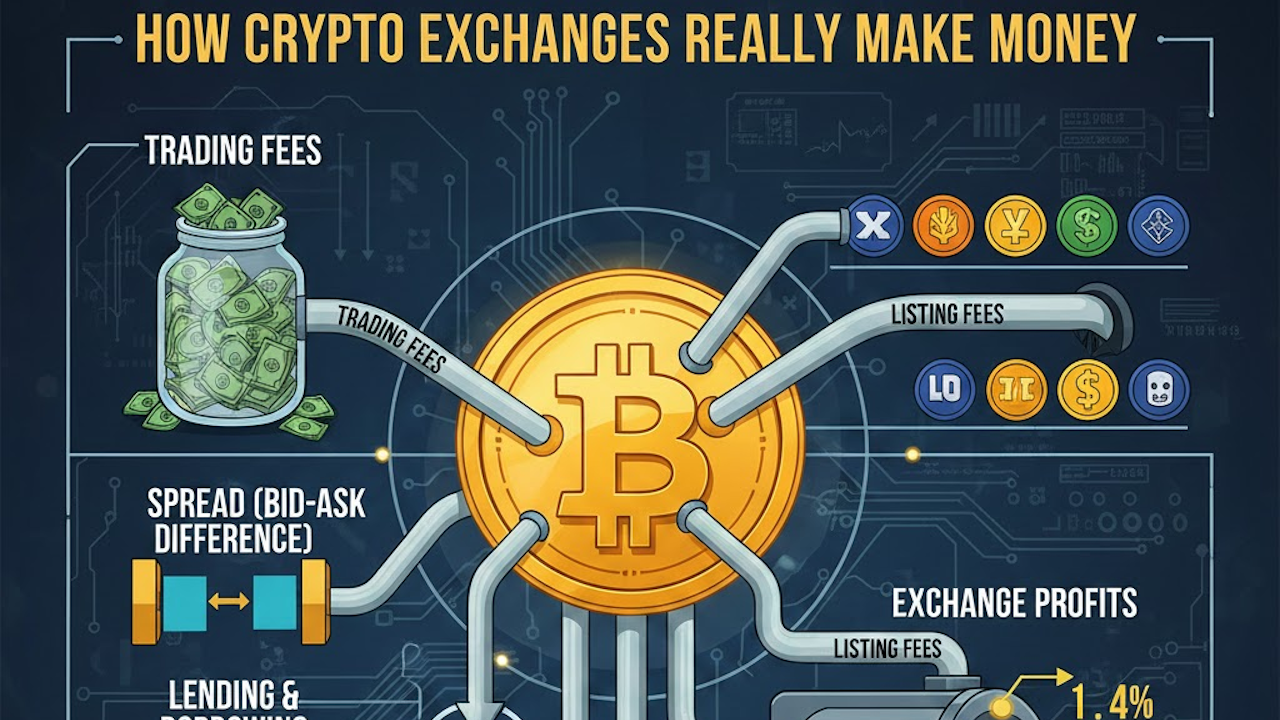
Crypto exchanges have become the bustling marketplaces of the digital asset world, facilitating billions of dollars in trades daily. These platforms, ranging from centralized giants like Binance and Coinbase to decentralized alternatives like Uniswap, serve as gateways for users to buy, sell, and trade cryptocurrencies. But behind the sleek interfaces and real-time charts lies a sophisticated business model designed to generate substantial revenue. In an industry valued at over $30 billion in 2022 and projected to grow further, understanding how these exchanges profit is essential for investors, traders, and entrepreneurs alike. This article delves into the primary and secondary ways crypto exchanges make money, drawing on real-world examples and strategies that have propelled platforms to profitability.
The Core Revenue Driver: Trading Fees
At the heart of most crypto exchange revenue models are trading fees, which form the bulk of income for many platforms. Every time a user executes a buy or sell order, the exchange takes a small cut, typically a percentage of the transaction value. This model is straightforward yet incredibly scalable, as high trading volumes amplify earnings even with low fee rates.
Exchanges often employ a maker-taker fee structure to incentivize liquidity. Makers, who place limit orders that add depth to the order book, usually pay lower fees or even receive rebates. Takers, who execute market orders that remove liquidity, pay higher fees. For instance, Coinbase uses a tiered system where fees decrease with higher monthly trading volumes: for trades under $10,000, takers pay 0.60% and makers 0.40%, dropping to 0.05% for takers and 0% for makers at over $500 million. Binance, the world’s largest exchange by volume, charges a flat 0.1% for both makers and takers but offers up to 25% discounts when fees are paid with its native BNB token, encouraging user loyalty and boosting token demand.
These fees might seem minimal, but consider the scale. On a $10,000 trade with a 0.1% fee, the exchange earns $20 (accounting for both sides of the trade). Multiplied across millions of daily transactions, this adds up quickly. In fact, former Binance CEO Changpeng Zhao revealed in 2022 that 90% of the platform’s revenue came from transaction fees, underscoring their dominance. For Coinbase, trading fees from major pairs like BTC-USD can generate estimated daily revenue ranging from hundreds of thousands to millions, depending on volume and tiered rates.
Some exchanges innovate further. BitMEX, known for derivatives, offers negative maker fees (rebates) as low as -0.025%, while takers pay 0.075%, allowing the exchange to profit from the spread between the two. This approach not only attracts liquidity providers but also ensures steady income in volatile markets.
Withdrawal and Deposit Fees: The Hidden Costs of Moving Assets
Beyond trading, exchanges monetize the movement of funds in and out of their platforms. Withdrawal fees are charged when users transfer cryptocurrencies to external wallets, often to cover blockchain network costs like gas fees on Ethereum. However, exchanges typically add a markup, turning this into a profit center. For example, Binance charges about 0.0005 BTC (roughly $17 at current prices) for Bitcoin withdrawals, while Kraken’s fees range from 0.0005 to 0.001 BTC.
Deposit fees are less common but still prevalent, especially for fiat currencies. Coinbase imposes up to 3.99% on credit card deposits, offsetting processing expenses while generating revenue. These fees discourage frequent transfers, keeping assets on the platform longer and increasing the likelihood of additional trades. In high-volume environments, withdrawal fees alone can contribute significantly, with millions of transactions daily amplifying even small charges.
Fiat conversion fees add another layer, where exchanges charge for exchanging traditional currencies like USD to crypto. Coinbase applies a 0.50% spread on such conversions, capitalizing on users’ need for seamless entry into the crypto space.
Listing Fees: Gatekeeping New Tokens
One of the more lucrative, albeit selective, revenue streams is listing fees. Projects seeking visibility pay substantial sums to have their tokens listed on prominent exchanges. These fees can range from $10,000 on smaller platforms to over $1 million on majors like Binance, depending on the token’s potential and the exchange’s user base. The process often involves rigorous vetting, but the payoff is mutual: the exchange gains from increased trading volume post-listing, while the project accesses liquidity and credibility.
For instance, Binance and OKX negotiate rates based on a project’s market cap and community strength, sometimes waiving fees for high-profile tokens in exchange for future trading activity. This model is particularly profitable for established exchanges, as the demand for listings far outstrips supply.
Margin Trading and Lending: Profiting from Leverage
Crypto’s volatility makes margin trading a high-risk, high-reward feature and a key revenue source. Exchanges lend funds to traders for leveraged positions, charging interest on the borrowed amount. Binance offers up to 125x leverage with interest rates starting at 0.02% per hour, while Kraken charges 0.02% every four hours. Additionally, liquidation fees kick in when positions are force-closed due to market swings, further boosting income.
Lending extends beyond margin to general crypto loans, where users borrow against collateral. Exchanges like Binance Earn offer up to 10% annual interest on lent assets, sharing a portion while retaining the spread. This can represent over 20% of total revenue, especially during bull markets when leverage demand surges.
Custodial interest is another angle: exchanges invest idle user funds in lending pools or DeFi protocols, earning interest. Coinbase, for example, generated $201.4 million in interest income in Q2 2023 alone.
Staking Services: Earning from Network Security
With the rise of proof-of-stake (PoS) blockchains, staking has become a popular passive income tool and a revenue generator for exchanges. Users lock up assets to validate transactions, earning rewards, while the exchange takes a cut typically 5-25%. Coinbase charges 25% on staking rewards, contributing $62 million (10% of revenue) in a 2022 quarter. Binance deducts 5-10% on staked assets like Ethereum and Cardano.
This model fosters user retention, as locked assets reduce selling pressure and encourage long-term holding. For DEXes, staking ties into governance tokens, where platforms earn from protocol fees.
Initial Exchange Offerings and Token Sales
Exchanges host Initial Exchange Offerings (IEOs), where new projects sell tokens directly on the platform. In return, the exchange takes 5-10% of raised funds or token allocations. Binance Launchpad has facilitated successful IEOs like Polygon, driving engagement and subsequent trading fees. This not only generates upfront revenue but also attracts new users eager for exclusive launches.
Market Making and Spread Capture
To ensure liquidity, exchanges act as market makers, placing buy and sell orders to narrow bid-ask spreads. They profit from the difference, especially on low-volume pairs. Reddit discussions highlight how exchanges capture spreads by quoting prices slightly above or below market rates, adding $1 or more per trade in some cases. Larger platforms partner with professional market makers, sharing fees from increased volume.
Premium Services and Subscriptions
Many exchanges offer VIP or subscription tiers for advanced features. These include lower fees, priority support, trading bots, and analytics. Monthly or yearly plans provide recurring revenue, diversifying beyond transaction-based income. Coinbase, for example, earned $29.4 million from subscriptions and services in Q2 2023.
API charges target institutional users, with premium access for high-frequency trading. Kraken offers tiered API plans beyond free limits.
Affiliate Programs and Advertising
Affiliate programs reward partners for referrals, with commissions up to 50% of trading fees from new users. Binance’s program is a prime example, leveraging influencers to expand reach.
Advertising monetizes traffic through banners, sponsored listings, or partnerships. Exchanges sell ad space to projects, generating revenue without relying on trades.
Liquidity Pools and DEX-Specific Models
For decentralized exchanges (DEXes), revenue comes from liquidity pools, where users provide assets and earn fees from trades. Platforms like Uniswap take a small protocol fee, often 0.05-0.3% per swap. Governance tokens add value, with holders voting on fee structures.
Other Streams: Debit Cards, NFTs, and Investments
Exchanges like Coinbase issue debit cards, earning from conversion and withdrawal fees on spending. Some launch NFT marketplaces or venture arms, investing in startups for long-term gains.
Custody fees for secure storage, as with Coinbase Custody, add another layer, generating $17 million in Q2 2023.
Challenges and Risks in Revenue Generation
While profitable, these models face hurdles. Regulatory scrutiny, as seen with Coinbase’s SEC interactions over lending, can limit offerings. Volatility affects volumes, with global trading dropping from $2.23 trillion in May 2021 to $622 billion in June, pressuring fees. Competition drives fee reductions, pushing diversification.
Projections for 2025 show average revenue per user at $52.7, with the U.S. market hitting $9.4 billion, highlighting sustained growth.
Conclusion: A Multifaceted Business Model
Crypto exchanges thrive by blending core fees with innovative services, creating ecosystems that retain users and maximize earnings. From trading commissions to staking cuts, the strategies are diverse yet interconnected. As the industry evolves, platforms that adapt to regulations and user needs will continue to profit, shaping the future of digital finance. Whether you’re a trader or aspiring exchange operator, grasping these mechanics reveals the ingenuity behind the crypto boom.