

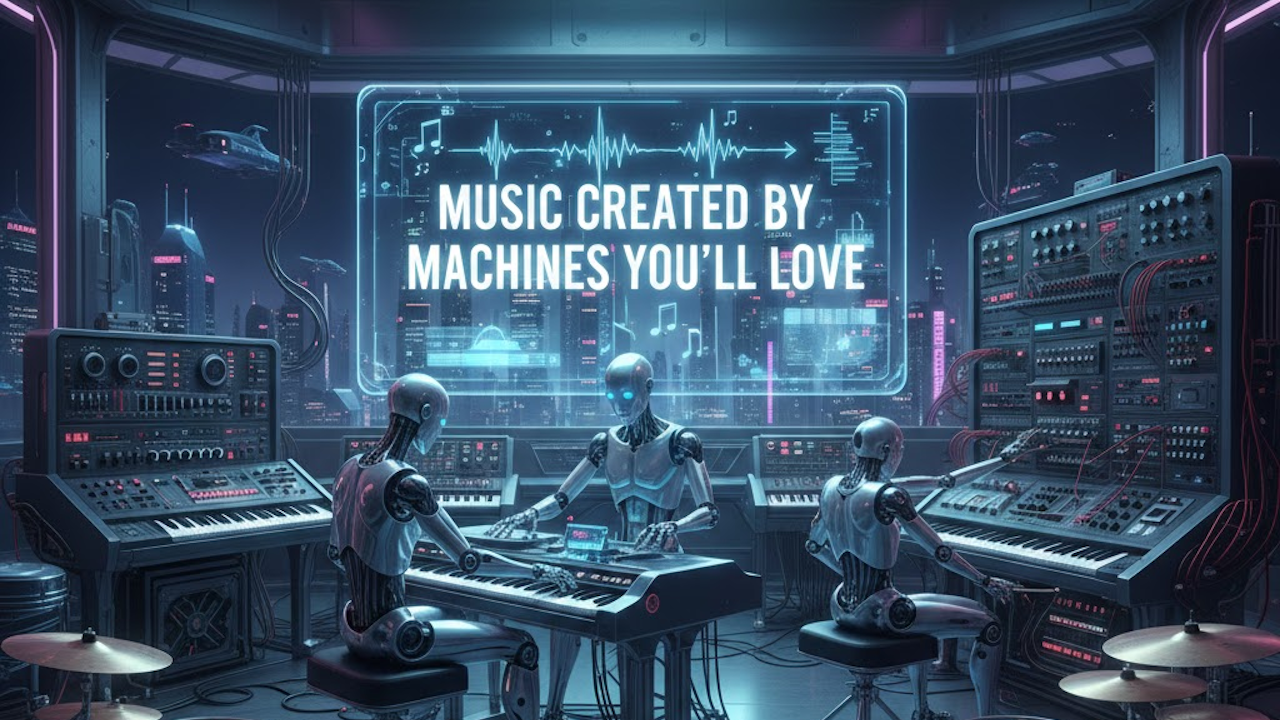
In a time when technology weaves itself into nearly every corner of daily life, music stands out as one of the most thrilling areas of transformation. Machines now compose original symphonies, craft infectious electronic beats, generate full songs complete with lyrics and vocals, and even improvise alongside human performers. What once sounded like science fiction has become a vibrant reality, producing tracks that stir emotions, spark curiosity, and expand the very definition of creativity. This is not about cold calculations replacing human feeling. It is about powerful new tools that unlock possibilities previously out of reach, delivering music that listeners genuinely connect with and return to again and again.
The story begins decades ago, yet the pace of progress has accelerated dramatically in recent years. Early experiments proved that computers could follow musical rules to produce coherent pieces. Today, advanced models learn from enormous collections of existing works and generate fresh material that often surprises even seasoned musicians. The result feels alive, nuanced, and full of personality. Whether you crave sweeping orchestral scores for film, intimate acoustic ballads, high energy dance tracks, or experimental ambient soundscapes, machine created music offers something that fits your mood and keeps you coming back for more.
Early Steps Toward Machine Composition
The journey started in the 1950s when researchers first explored whether computers could handle the rules of harmony and counterpoint. In 1957, Lejaren Hiller and Leonard Isaacson programmed the ILLIAC I computer at the University of Illinois to compose the ILLIAC Suite for string quartet. The piece applied strict musical logic to generate four movements that respected traditional forms while venturing into new territory. Audiences heard structure, tension, and resolution, even though every note traced back to algorithmic decisions.
By the 1980s and 1990s, composer David Cope pushed the concept further with his Experiments in Musical Intelligence system. Cope fed the program thousands of works by masters such as Bach, Mozart, and Chopin. The software analyzed patterns in melody, phrasing, and harmonic progression, then produced new compositions in those same styles. Some listeners struggled to tell the difference between the machine output and authentic historical pieces. This raised profound questions about authorship and creativity that continue to shape discussions today, yet it also demonstrated that machines could capture and extend recognizable musical voices.
These pioneering efforts relied on explicit rules and databases of examples. They required deep musical knowledge from their creators and produced results that still needed human editing. Nevertheless, they established a foundation. They showed that computation could serve as a genuine partner in artistic work rather than a mere recorder or processor of sound. The lessons from those early systems informed every subsequent breakthrough.
The Technology Behind Modern Machine Music
Contemporary systems operate on an entirely different scale. Deep learning models, particularly transformer architectures, now process vast datasets containing millions of tracks across every genre and era. These models absorb patterns in rhythm, melody, harmony, dynamics, instrumentation, and even lyrical themes. Once trained, they can generate new music from scratch or respond to specific prompts provided by users.
Two main approaches dominate. Symbolic generation works with abstract representations such as MIDI data or musical notation. The model predicts sequences of notes, chords, and rhythms that can later be rendered by virtual instruments. Audio based generation goes further by synthesizing actual sound waves. Models learn the acoustic properties of real instruments and voices, then produce realistic audio directly. Techniques such as diffusion and autoregressive prediction allow the system to build music moment by moment, maintaining coherence over several minutes while introducing variation and surprise.
Conditioning makes the process especially powerful. A user can describe a desired mood, tempo, key, instrumentation, or even reference a particular artist or era. The model interprets the request and steers its output accordingly. Advanced systems also accept partial musical ideas, such as a hummed melody or a short chord progression, and expand them into complete arrangements. The speed is remarkable. What once took weeks or months of sketching and revision can now emerge in seconds or minutes, freeing creators to explore many more directions.
Training data continues to grow in both quantity and quality. Public domain works, licensed catalogs, and carefully curated collections all contribute. As hardware improves and techniques refine, the models develop a stronger grasp of long range structure, emotional arc, and stylistic nuance. The gap between machine output and human composition narrows with each generation of technology, yet the distinctive flavor of machine creativity remains, often blending elements in ways that feel fresh and unexpected.
Tools That Bring Machine Music to Everyone
A thriving ecosystem of platforms now places these capabilities in the hands of anyone with an internet connection or a modest computer. Suno and Udio allow users to type a description or paste lyrics and receive a complete song with vocals, instrumentation, and polished production. Many tracks created on these platforms have circulated widely on social media, earning praise for catchy hooks, coherent storytelling, and professional sounding mixes. Listeners frequently express amazement at how natural the singing feels and how well the arrangement supports the emotional content of the words.
AIVA focuses on classical, cinematic, and orchestral music. It has composed soundtracks for short films, video games, and advertisements. The system releases its own albums and holds membership in collecting societies as a recognized composer. Users appreciate the elegant phrasing and emotional depth that emerge from its generations, qualities that make the music suitable for serious listening or background use in visual media.
Other platforms serve specific needs. Soundraw generates royalty free tracks optimized for content creators who require background music without licensing headaches. Boomy lets beginners produce original songs instantly and distribute them across streaming services. Open source projects such as Google’s Magenta provide building blocks for developers and researchers, encouraging experimentation and customization. Major digital audio workstations now incorporate AI assisted features for chord suggestions, drum pattern generation, melody variation, and mixing assistance.
These tools lower barriers dramatically. A solo artist working from a bedroom can access orchestral textures, complex electronic layers, or vocal harmonies that previously demanded large budgets and teams of specialists. The democratization extends beyond creation to discovery. Playlists can adapt in real time to listener feedback, and generative systems can produce endless variations tailored to personal taste or activity.
Standout Creations That Capture Hearts
Certain machine generated works stand out for their emotional resonance and structural sophistication. AIVA compositions often feature graceful melodic lines that develop naturally over time, supported by rich harmonic progressions and dynamic orchestration. Listeners describe feeling transported by the sense of narrative and the careful balance between tension and release. These pieces work equally well as concert works or as underscoring for visual storytelling.
Electronic experiments push boundaries in different directions. Projects that generate continuous streams of music in specific genres, such as ambient, techno, or even extreme metal, create immersive environments that evolve without repetition. The endless quality suits long listening sessions, meditation, or focused work, offering a sonic landscape that never grows stale.
Viral successes from prompt based generators demonstrate the reach of current technology. Tracks with clever lyrics, memorable choruses, and convincing vocal performances spread rapidly across platforms. Many listeners report returning to these songs not because of novelty alone but because the music itself delivers genuine pleasure. The emotional delivery in the generated vocals has improved to the point where nuance, phrasing, and expressive timing feel convincing.
Hybrid projects highlight the best of both worlds. Artists feed their own voice recordings or musical sketches into custom trained models, then shape the results with traditional production techniques. The outcome blends recognizable human sensibility with the expansive idea generation that machines provide. Such collaborations often yield music that neither a purely human nor a purely machine process would have produced on its own.
Personalized applications add another layer of appeal. Systems can generate music matched to biometric signals, daily routines, or stated preferences. A calming track for winding down at night, an energizing sequence for exercise, or a focused instrumental backdrop for study can appear on demand. This responsiveness turns passive listening into an active, tailored experience.
Human and Machine Working Together
The most compelling results arise when people and machines collaborate rather than compete. Composers sketch core ideas, then invite the system to explore variations, develop sections, or suggest unexpected turns. The human ear selects the most promising directions and refines details through traditional editing. This workflow multiplies creative output while preserving artistic intent.
In film and game scoring, the speed of generation proves invaluable. A composer can produce multiple temp tracks for a scene, test emotional impact with directors, and iterate rapidly before committing to final orchestration. The machine handles the volume of work, allowing the human to concentrate on the precise emotional shading required.
Live performance opens further possibilities. Systems that analyze incoming audio from musicians and generate responsive accompaniment create genuine dialogue between performer and algorithm. The music shifts in real time, introducing new motifs or altering texture based on what the human plays. Audiences experience something unrepeatable, a living conversation between organic expression and computational exploration.
This partnership model addresses many concerns about replacement. Rather than displacing musicians, the technology amplifies their reach. A single composer can now realize ideas that once required an entire team. Producers gain new sonic palettes. Educators use generated examples to illustrate concepts and inspire students. The technology serves as a tireless collaborator that never tires of generating fresh options.
Reshaping Creation, Distribution, and Listening
Machine music influences every stage of the musical ecosystem. Independent creators gain access to high quality production elements without large financial outlays. Demos that once took days to assemble can appear in hours, accelerating the path from idea to finished recording. Distribution platforms see increased volume of original content, some of it entirely machine assisted.
Discovery changes as well. Recommendation engines incorporate generative techniques to create playlists that adapt continuously. Listeners encounter music matched not only to past behavior but to momentary context. Background music for videos, podcasts, and live streams becomes easier to source legally and affordably.
The broader culture absorbs these developments in varied ways. Some genres embrace the new tools openly, incorporating generated elements as part of their aesthetic. Others approach cautiously, valuing the irreplaceable qualities of human performance while still experimenting behind the scenes. Educational programs introduce students to both traditional technique and computational methods, preparing a generation comfortable with hybrid practice.
Challenges exist alongside opportunities. Questions of training data provenance and compensation for original creators have prompted legal discussions and evolving best practices. Quality remains uneven across different models and prompts, requiring discernment from users. Yet the trajectory points toward greater refinement, clearer ethical frameworks, and wider acceptance of machine assisted work as a legitimate and valuable part of the musical landscape.
Why Listeners Connect So Strongly
The affection for machine created music stems from tangible qualities that listeners experience directly. Accessibility stands first. Anyone can summon new music tailored to personal taste without waiting for a favorite artist to release fresh material. Variety follows closely. The same system can produce a delicate piano miniature one moment and a driving orchestral epic the next, all while maintaining internal consistency within each piece.
Innovation appears in unexpected combinations. Models sometimes juxtapose stylistic elements that human composers might never consider together, yielding hybrid forms that feel both surprising and coherent. This capacity for novel synthesis keeps the catalog feeling alive and exploratory rather than repetitive.
Emotional impact proves decisive. Well crafted generations convey tension, joy, melancholy, or excitement through phrasing, dynamics, and timbral choices. Listeners respond to these cues regardless of whether the notes originated in silicon or on paper. The music moves them because it satisfies the same perceptual and emotional expectations that great human compositions fulfill.
For creators, the joy lies in expanded possibility. Ideas that might have remained unrealized due to technical or time constraints now find expression. Experimentation becomes low risk and high reward. The machine serves as a source of constant inspiration, a mirror that reflects and extends the user’s own musical imagination.
The Road Ahead
Looking forward, integration will deepen. Real time generation during live events will become more responsive and sophisticated. Music in virtual environments will react fluidly to user actions and narrative developments. Multimodal systems will coordinate sound with visuals, text, and interactive elements, producing unified artistic experiences.
Voice and style transfer will grow more seamless, allowing creators to explore interpretations in the timbres of historical instruments or personal vocal characteristics. Training methods will incorporate greater respect for original sources while still enabling transformative new work. Compute efficiency will improve, bringing high quality generation to a broader range of devices and users.
The distinction between human and machine contributions will continue to blur in productive ways. Listeners will focus less on origin and more on whether the music rewards attention and repeated listening. New roles will emerge for curators, prompt designers, and hybrid artists who specialize in guiding and shaping machine output. The overall effect will be a richer, more diverse musical world.
An Open Invitation
Machine created music has moved beyond novelty into a mature and expressive medium. It offers beauty, emotional depth, structural interest, and endless variety. It serves casual listeners seeking fresh discoveries, dedicated fans exploring new sonic territories, and working musicians looking for powerful creative partners. The technology amplifies rather than diminishes human imagination, turning what might have been limitations of time, resources, or technical skill into opportunities for greater expression.
The invitation is simple. Seek out tracks generated by current platforms. Experiment with a prompt based tool to hear what emerges from your own descriptions. Listen with an open ear to symphonic works, electronic explorations, or hybrid collaborations. Notice the moments that surprise you, the phrases that linger, and the overall sense of possibility.
Music created by machines is already delivering experiences worth loving. As the technology continues to mature, those experiences will only grow more compelling, more personal, and more integral to the way we create, share, and enjoy sound. The future of music includes silicon alongside strings and voices, and that future sounds remarkably bright.