

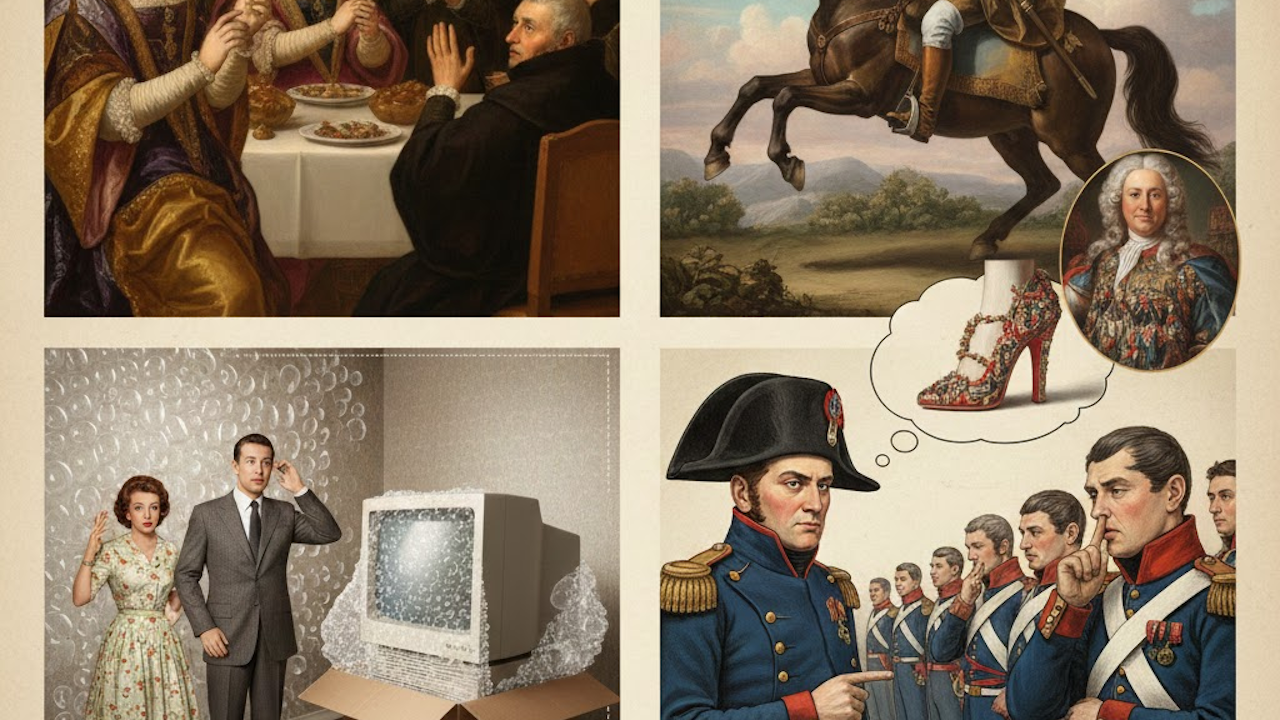
We often move through our days surrounded by tools and technologies that feel as though they have always existed in their current form. From the buttons on our sleeves to the zippers on our bags, these objects are so common that they have become invisible. However, if you look closer, almost every mundane item in your home carries a secret history shaped by accidental discoveries, military necessity, or quirky social customs.
The Fork: A Tool Once Considered Blasphemous
It is difficult to imagine a dinner party without forks, yet for centuries, much of the Western world viewed them with deep suspicion. While the Greeks used large forks for carving meat, the small table fork did not gain traction in Europe until the Middle Ages.
When a Byzantine princess brought gold forks to Venice in the eleventh century, the local clergy were outraged. They argued that God had provided humans with natural fingers and that replacing them with metal prongs was an insult to the Creator. It took several hundred years and the influence of the Italian Renaissance for the fork to become a standard utensil. Even then, many men resisted using them, fearing that forks were too delicate or feminine.
The High Heel: Originally Designed for Men
High heels are frequently associated with modern feminine fashion, but their origin was strictly functional and masculine. They were first worn by Persian cavalry soldiers in the tenth century. The heel served a specific purpose: it helped the rider’s foot “lock” into the stirrups, providing a stable platform so the soldier could stand up and shoot arrows more effectively.
When Persian diplomats visited Europe in the late 1500s, the style caught the eye of aristocrats. European nobles began wearing heels to project a sense of height, power, and military prowess. King Louis XIV of France famously wore heels decorated with battle scenes. It was only later, as women began adopting masculine fashion trends to assert equality, that the high heel transitioned into a staple of women’s closets.
Bubble Wrap: The Wallpaper That Failed
In 1957, Alfred Fielding and Marc Chavannes were trying to create a new type of textured wallpaper. They sealed two shower curtains together with a layer of air bubbles trapped inside, hoping it would appeal to the avant garde interior design market. The wallpaper was a total commercial disaster.
Undeterred, they tried to market the material as greenhouse insulation, but that also failed to take off. It wasn’t until 1960 that the creators realized their invention’s true calling. IBM had just launched the 1401 computer and needed a way to protect the fragile hardware during shipping. Bubble Wrap proved to be the perfect solution, transitioning from a failed home decor item to an essential industrial tool.
Buttons on Sleeve Cuffs: A Napoleonic Legend
Have you ever wondered why suit jackets have buttons on the sleeves that serve no real purpose? While historians debate the exact origin, one of the most popular theories involves Napoleon Bonaparte.
According to the legend, Napoleon was annoyed by his soldiers’ habit of wiping their noses and faces on their uniform sleeves. To put a stop to this unhygienic practice, he ordered brass buttons to be sewn onto the tops of the cuffs. The buttons made the fabric too scratchy and uncomfortable for wiping, forcing the soldiers to maintain a more professional appearance. Over time, the buttons moved to the underside of the cuff and remained there as a permanent element of formal attire.
The Slinky: A Naval Engineer’s Accident
During World War II, mechanical engineer Richard James was working in a shipyard trying to develop springs that could stabilize sensitive instruments on ships during rough seas. One day, he accidentally knocked a prototype spring off a shelf.
Instead of falling flat, the spring “walked” down a stack of books, onto a table, and eventually onto the floor where it stood upright. James went home and told his wife that he thought he could turn the spring into a toy. After experimenting with different types of steel wire, they debuted the Slinky at Gimbels Department Store in Philadelphia in 1945. They sold 400 units in ninety minutes, and a household icon was born.
The next time you reach for a fork or lace up a pair of shoes, remember that you are holding a piece of history. These objects are not just tools; they are the result of centuries of human ingenuity and happy accidents.