

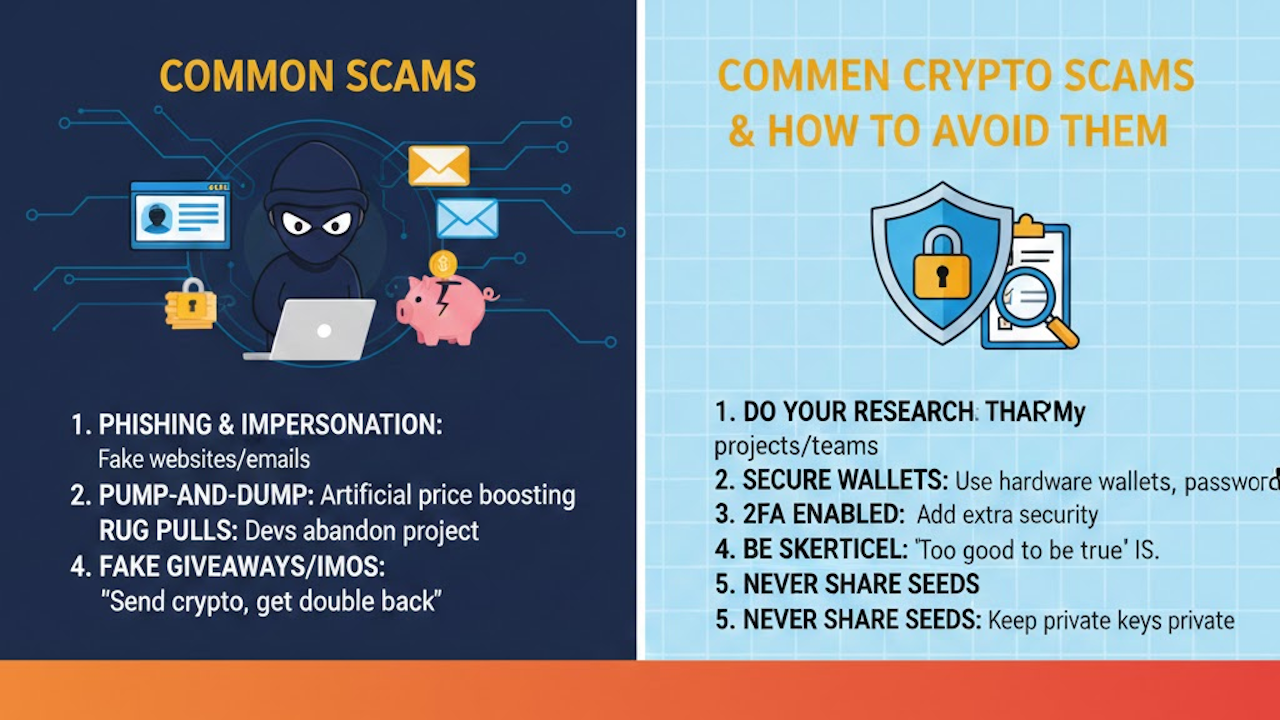
The cryptocurrency market has exploded in popularity over the past decade, attracting millions of investors with promises of high returns and financial independence. As of early 2026, the global crypto market capitalization hovers around trillions of dollars, with Bitcoin and Ethereum leading the charge. However, this growth has also drawn in a wave of sophisticated scammers who exploit the decentralized and often anonymous nature of blockchain technology. According to recent reports, an estimated $17 billion was stolen through crypto scams and fraud in 2025 alone, marking a significant increase from previous years. This surge is driven by tactics like impersonation scams, which saw a 1400% year-over-year growth, and the integration of AI to make fraud more convincing.
Crypto scams come in various forms, from digital phishing attacks to elaborate social engineering schemes. What makes them particularly dangerous is the irreversibility of blockchain transactions: once funds are sent, they are often gone forever. Victims reported losses totaling $6.1 billion from investment scams in the first three quarters of 2025, with cryptocurrency being the preferred payment method for fraudsters. The FBI’s Internet Crime Complaint Center noted over 113,000 investment scam reports in that period, highlighting the scale of the problem.
This article aims to educate readers on the most common crypto scams circulating in 2026, drawing from expert analyses, government warnings, and real-world examples. By understanding how these scams operate, spotting red flags, and implementing protective measures, you can significantly reduce your risk. We’ll break down each scam type, explain its mechanics, and provide practical avoidance strategies. Remember, while crypto offers exciting opportunities, vigilance is key to safeguarding your assets.
Phishing Scams: The Digital Bait and Switch
Phishing remains one of the most prevalent crypto scams, accounting for a large portion of reported incidents. In this scheme, fraudsters create fake websites, emails, or messages that mimic legitimate platforms like exchanges (e.g., Coinbase or Binance) or wallets (e.g., MetaMask). The goal is to trick users into entering sensitive information, such as private keys, seed phrases, or login credentials.
For instance, a scammer might send an email claiming your account is compromised and urging you to click a link to “secure” it. The link leads to a cloned site where any input data is stolen. In 2025, phishing attacks evolved with AI-generated content, making them harder to detect. Social media phishing, where fake ads or DMs promise giveaways, is also common. One variant involves “smishing” via text messages, impersonating banks or utilities to demand crypto payments for alleged issues.
Red flags include unsolicited messages with urgent language like “Act now or lose everything,” misspelled URLs (e.g., coinbasse.com instead of coinbase.com), and requests for seed phrases. To avoid phishing:
- Always verify URLs by typing them directly into your browser.
- Enable two-factor authentication (2FA) on all accounts, preferably using hardware keys.
- Use bookmarking for official sites and avoid clicking links from unknown sources.
- Install reputable antivirus software with phishing detection.
- Educate yourself on official communication channels; legitimate companies never ask for private keys via email or DM.
By following these steps, you can prevent the majority of phishing attempts, which drained billions in 2025.
Impersonation Scams: Faking Authority and Fame
Impersonation scams involve fraudsters posing as trusted figures, such as celebrities, influencers, or company representatives. A common tactic is creating fake social media accounts that mimic real ones, complete with stolen photos and bios. Scammers then promote bogus investments or giveaways, asking victims to send crypto first.
In 2025, these scams surged, with reports of fake Elon Musk or Vitalik Buterin accounts promising to “double” any crypto sent to them. Victims are directed to fraudulent wallets, and the money vanishes. Another form is fake tech support, where scammers claim to help with wallet issues but instead steal access. Government impersonation is also rising, with fraudsters posing as IRS or FBI agents demanding crypto for “fines.”
Spotting these includes checking for verified badges on platforms like X (formerly Twitter), mismatched usernames, and promises of guaranteed returns. Avoidance tips:
- Verify identities through official channels; celebrities don’t randomly DM investment advice.
- Report suspicious accounts to the platform.
- Use tools like X’s search to check for similar scam reports.
- Never send crypto to unverified addresses.
- Cross-reference claims with reputable news sources.
These scams prey on trust, but skepticism can save you from losses that totaled $5.7 billion in crypto investment fraud complaints in 2024, a trend continuing into 2026.
Romance and Pig Butchering Scams: Emotional Exploitation
Often called “pig butchering” (a term some find controversial), these scams build emotional relationships via dating apps or social media before pivoting to crypto investments. Scammers “fatten” victims with affection, then “butcher” them by convincing them to invest in fake platforms showing illusory gains.
A typical scenario: A charming online match shares “successful” crypto trades and encourages joint investing. Victims transfer funds to scam-controlled wallets, only to find withdrawal blocked unless they pay more fees. In 2025, these accounted for massive losses, often starting as romance but evolving into investment fraud.
Red flags: Quick escalation to financial talks, refusal to meet in person, and pressure to use specific apps. To avoid:
- Never mix romance and finance; legit partners don’t need your crypto.
- Use reverse image search on profile photos.
- Consult friends or family about suspicious relationships.
- Report to authorities like the FTC if targeted.
- Stick to well-known exchanges for investments.
These scams caused $9.3 billion in losses in 2024, emphasizing the need for caution in online interactions.
Ponzi and Pyramid Schemes: Unsustainable Promises
Ponzi schemes promise high returns funded by new investors’ money, not legitimate profits. Pyramid schemes add recruitment layers, rewarding those who bring in others. In crypto, these manifest as “high-yield investment programs” (HYIPs) or tokens with referral bonuses.
Examples include fake ICOs (Initial Coin Offerings) where projects raise funds without delivering, collapsing when new money dries up. Affinity scams target specific communities, like religious groups, to build trust.
Warning signs: Guaranteed returns, emphasis on recruitment, and lack of transparent operations. Prevention:
- Research whitepapers and team backgrounds; use sites like CoinMarketCap for verification.
- Avoid schemes requiring upfront fees or constant referrals.
- Check regulatory warnings from bodies like the DFPI or SEC.
- Diversify investments and never risk more than you can lose.
- Use blockchain explorers to track fund flows.
These have been rampant since crypto’s inception, with billions siphoned annually.
Rug Pulls: The Sudden Exit
In rug pulls, developers hype a project (often memecoins or DeFi tokens), raise funds via liquidity pools, then drain the assets and abandon it. High-profile cases in 2025 included memecoins on Solana where devs held majority tokens and sold off suddenly.
Red flags: Anonymous teams, locked liquidity for short periods, and massive hype without utility. To dodge:
- Check token distribution with tools like Bubble Maps or DeDotFi scanners.
- Invest only in audited projects.
- Monitor for unusual wallet activity.
- Start small and withdraw profits early.
- Join communities for real-time alerts.
Rug pulls stole millions in 2025, underscoring the volatility of new tokens.
Pump and Dump Schemes: Market Manipulation
Scammers artificially inflate (pump) a low-cap token’s price through coordinated buying and hype, then sell (dump) at the peak, crashing the value. Often orchestrated in Telegram groups or via influencers.
Indicators: Sudden price spikes without news, “FOMO” messaging, and insider selling. Avoidance:
- Avoid low-liquidity tokens.
- Use technical analysis to spot anomalies.
- Don’t chase hype; focus on fundamentals.
- Report groups to platforms.
- Set stop-loss orders.
These manipulations target retail investors, leading to widespread losses.
Fake Exchanges and Wallets: Counterfeit Platforms
Fraudsters create bogus exchanges or wallet apps that steal funds upon deposit or connection. In 2026, lists of reported scam companies include hundreds of fake sites.
Signs: Unrealistic fees, no regulation, and poor reviews. Protect yourself:
- Use only licensed exchanges like Binance or Coinbase.
- Download apps from official stores.
- Verify licenses on regulatory sites.
- Test with small amounts.
- Enable wallet whitelisting.
Advance Fee and Blackmail Scams
Advance fee scams require upfront payments for promised services, like “unlocking” frozen funds. Blackmail involves threats to expose data unless paid in crypto.
Avoid by ignoring unsolicited demands and reporting to law enforcement.
Wrench Attacks and Physical Threats
Rare but rising, these involve physical coercion to access wallets. Prevention: Don’t publicize holdings, use multi-sig wallets, and store seeds securely.
General Prevention Tips for 2026
Beyond specific scams, adopt these habits:
- Use hardware wallets like Ledger for cold storage.
- Regularly update software and use VPNs.
- Educate via resources like FTC guides.
- Join scam-aware communities on X.
- If scammed, report to IC3.gov and seek professional recovery, though success varies.
- Only invest disposable funds.
Conclusion
Crypto scams in 2026 are more advanced, but knowledge is your best defense. By staying informed, verifying everything, and acting cautiously, you can navigate this space safely. Remember, if it sounds too good to be true, it probably is. Prioritize security, and crypto can be a rewarding venture rather than a risky gamble. Stay vigilant, and protect your digital assets.