

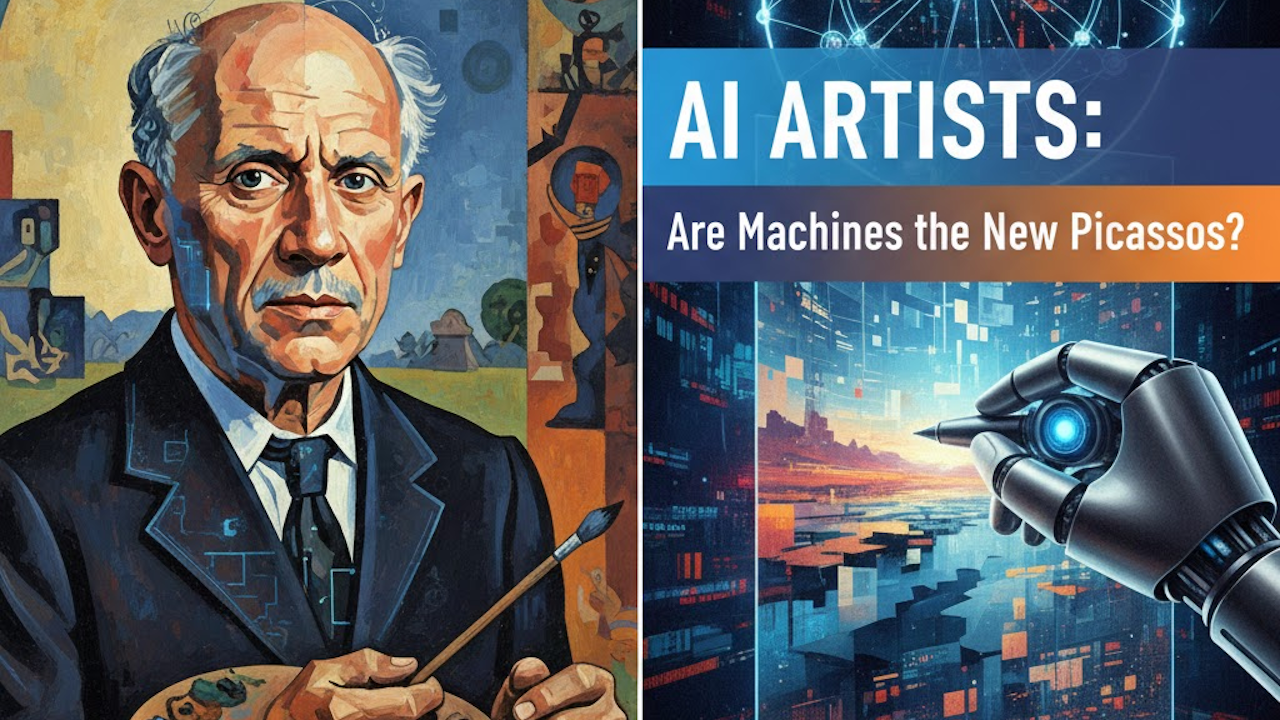
Artificial intelligence has entered the creative world with remarkable speed, and its growing presence raises a vivid question: can a machine be considered an artist in its own right, or is it simply a powerful tool in human hands? As algorithms generate paintings, music, scripts, and immersive digital worlds, many observers wonder whether we are witnessing the rise of a new class of creators. The debate touches on aesthetics, authorship, cultural values, and the very meaning of artistic expression. To explore this topic, it helps to look at what AI systems actually do, how audiences respond to their work, and whether creativity requires something machines may never possess.
AI systems that generate images or music operate by learning patterns from enormous datasets. When an AI model creates a portrait or landscape, it does not feel inspiration or emotion. Instead, it synthesizes learned shapes, colors, and textures into new arrangements that mimic the statistical characteristics of human art. This process can be dazzling. Many AI generated images display striking originality in composition and style. Some are whimsical, others deeply atmospheric. They provoke thought and emotional reactions. Still, the mechanism behind them is pattern recognition at scale, not intuition or lived experience.
Supporters of AI artistry argue that art has never been purely about human emotion. They point to centuries of craftsmanship built on rules, imitation, and technique. From Renaissance workshops to modern film studios, creative work has always included collaboration between human skill and technological innovation. Photography, synthesizers, and digital editing were once regarded with suspicion before they became widely accepted artistic tools. By that logic, AI is simply the next step in the evolution of creative technology. If an AI system can produce a compelling painting or song, proponents argue, why should it matter that it lacks consciousness?
The counterargument is rooted in the belief that art is not just the final product but the intention and experience behind it. A painting by Picasso carries historical significance because it embodies the vision of a particular individual shaped by personal struggle, cultural movements, and emotional insight. When we value human created art, we often consider the story of the artist as much as the artwork itself. Machines have no personal narrative. They have no memories, fears, or ambitions. Critics claim that without an inner life, a machine cannot truly create. It can only generate artifacts that resemble art while lacking the authentic source of meaning that human works possess.
Another important question concerns authorship. Who is the real artist when an AI produces a striking piece of visual media? Is it the model? The engineers who designed it? The artists whose works were included in the training data? Or the user who typed the prompt? These issues extend into moral and legal territory. Many artists fear that AI systems trained on their work dilute their style, reduce the value of their craft, and compete unfairly in commercial spaces. They argue that without clear principles of ethical training and attribution, AI art undermines the rights of human creators.
Despite these tensions, AI art has opened new creative possibilities. Some artists embrace AI as a collaborator. They treat algorithms as experimental partners that can spark unexpected ideas. Instead of replacing human creativity, the technology becomes a catalyst for imagination. A sculptor might use AI to explore hundreds of shapes before choosing one to carve. A filmmaker might generate storyboards or visual textures that inspire new narratives. In these contexts, AI functions like a creative assistant that expands rather than replaces human expression.
Audience perception also plays a major role. Studies and exhibitions have revealed that many viewers cannot consistently distinguish between human created and AI generated artworks. Some even prefer pieces made by machines when unaware of their origin. This challenges the assumption that humans automatically seek human emotion in art. It suggests that visual appeal, surprise, and originality may be enough for many people, regardless of the creator’s identity. Still, when viewers are informed that a piece was generated by an algorithm, their evaluations often change. They may appreciate the aesthetic quality but feel detached from the work’s meaning.
One of the most intriguing implications of AI art is how it reshapes the concept of creativity itself. Creativity has long been seen as a uniquely human trait connected to imagination, spontaneity, and emotional depth. Yet AI demonstrates that novel combinations and aesthetic complexity can emerge from nonhuman processes. This raises philosophical questions. Is creativity defined by the internal experience of the creator, or by the novelty and impact of the output? Can a process be considered creative if it has no awareness of what it is doing?
At present, machines are not the new Picassos. Picasso was not only a painter but a force of cultural disruption who transformed the visual language of his time. No algorithm possesses a worldview or a conscious drive to innovate. What AI does possess is speed, flexibility, and the ability to generate variations that can astonish and challenge our understanding of art. In that sense, AI may become an engine of artistic experimentation, reshaping creative practices without replacing the human role entirely.
The future likely belongs to hybrid creativity. Human insight combined with machine generated possibilities could produce art that neither could achieve alone. Rather than seeing AI as a rival, many may come to see it as a transformative companion that expands the boundaries of imagination. Whether or not machines ever rival the cultural stature of great artists, they are undeniably changing how art is made, shared, and understood. The conversation about authorship, meaning, and creativity will continue to evolve, and in that evolution lies one of the most profound cultural shifts of our time.