

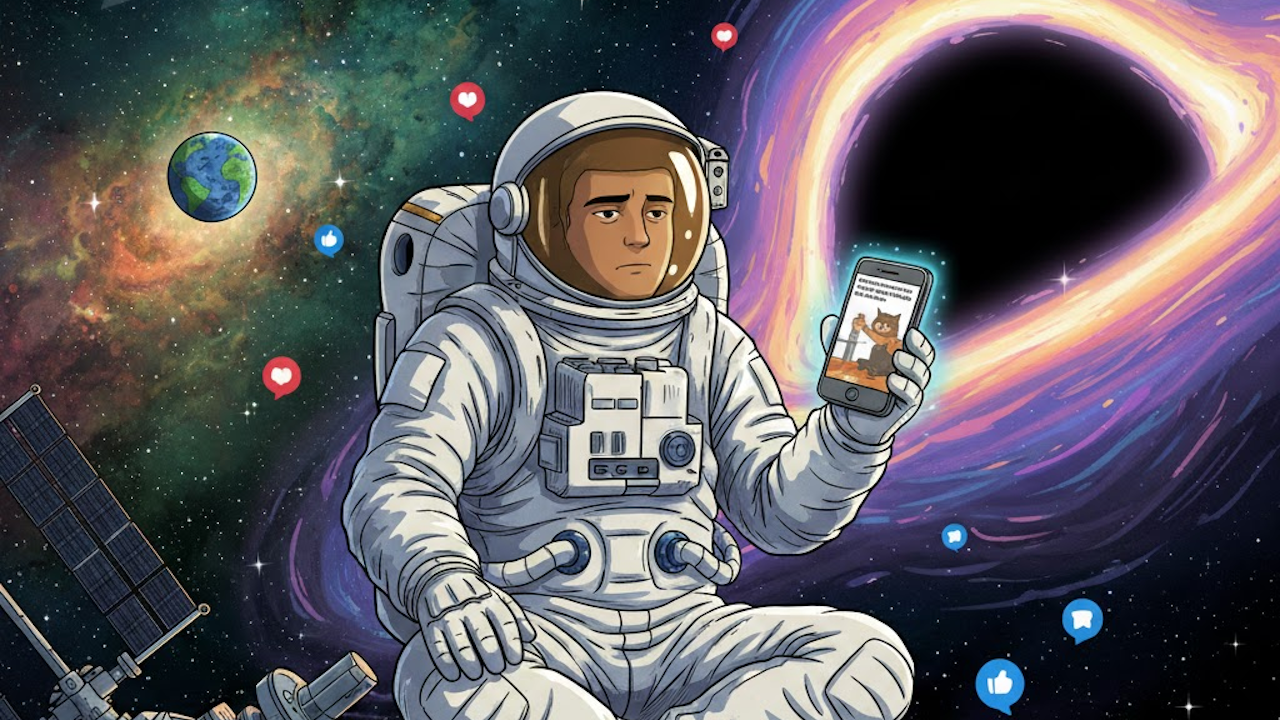
In the sprawling, often chaotic, landscape of social media, trends flicker and die with the speed of a supernova. Yet, one genre of humor has proven to have surprisingly deep roots in the digital collective consciousness: cosmic humor. From memes featuring indifferent astronauts to tweets contemplating the crushing insignificance of human existence against the backdrop of an infinite universe, social media is demonstrably obsessed with using the cosmos for comedic relief.
This isn’t just about pretty pictures of the Milky Way; it’s a profound, complex, and highly effective way for digital natives to process the sheer scale of the modern world. The internet’s fascination with the vastness of space as a source of jokes speaks volumes about our current anxieties, our search for meaning, and the unique psychological refuge the void provides.
The Allure of Existential Scale: Insignificance as a Shield
At the heart of cosmic humor lies the concept of existential dread, but treated with a lighthearted, self-deprecating touch. The digital age, with its constant bombardment of information, global crises, and pressure for personal achievement, can feel overwhelming. People are expected to manage careers, maintain social lives, stay informed on politics, and cultivate an aesthetically pleasing personal brand, all simultaneously.
Cosmic humor offers a mental escape route from this relentless pressure. By juxtaposing a mundane human problem—a bad day at work, a forgotten grocery list, or an embarrassing social faux pas—with the crushing, incomprehensible scale of the universe, the problem is instantly diminished to near nothingness. A tweet that reads, “I spent 45 minutes looking for my phone, but on a cosmic timescale, I’ve spent less than a nanosecond looking for my phone,” doesn’t solve the problem, but it reframes it. It’s a comedic application of philosophical perspective, allowing the user to laugh at their own perceived failures by wrapping them in the blanket of cosmic indifference.
The Rise of the Apathetic Astronaut and the Universal ‘Vibe’
Many popular cosmic humor memes feature characters or scenarios that personify this detached perspective. The Apathetic Astronaut is a prime example. He or she is often depicted staring out of a spaceship window at an unbelievably beautiful nebula or a planet on fire, with a caption suggesting a completely trivial thought.
- “Wait, did I leave the stove on?”
- “Gotta remember to pay my electric bill.”
- “Honestly, I’m just here for the catering.”
This character works because it perfectly captures the contemporary feeling of being over it. The astronaut has transcended Earthly drama, yet remains bound by the same petty concerns. This juxtaposition is the punchline. It suggests that even when faced with the sublime truth of the universe, the human mind defaults to the familiar, the trivial, and the relatable. This creates a powerful connection with users who feel similarly overwhelmed by the sheer scale of their own lives.
From Nihilism to Comfort: The Psychological Paradox
Cosmic humor operates on a fascinating psychological paradox. At its core, the joke is based on nihilism—the belief that life is without objective meaning, purpose, or intrinsic value. Yet, instead of inducing despair, this brand of humor generates comfort.
When everyone collectively acknowledges that “we’re all tiny dust motes on a small blue marble circling a mediocre star,” the pressure to be uniquely successful or significant evaporates. Shared insignificance becomes a bonding experience.
This phenomenon is sometimes referred to as cosmic relief. If nothing we do truly matters in the grand scheme of things, then perhaps we can afford to take ourselves, and our endless online performances, a little less seriously. The universe, in its terrifying indifference, grants a kind of ultimate permission: Just be. This shared, dark irony is a powerful social lubricant, fostering connection through mutual, well-articulated despair.
The Perfect Medium: Social Media’s Infinite Scroll
Social media platforms are the ideal vessel for cosmic humor for several structural reasons:
- Visual Impact: Space imagery is inherently beautiful and awe-inspiring, which makes it highly effective for visual memes. A stunning photo of the Orion Nebula instantly captures attention, making the absurd caption that follows even more jarring and funny.
- Brevity and Juxtaposition: The format of tweets and short captions excels at the kind of sharp, dramatic contrast that defines cosmic humor. A 280-character post can effortlessly pivot from a detailed personal annoyance to the death of the sun in five billion years.
- Search for Authenticity: In an age of heavily curated online presences, the brutal honesty of cosmic humor feels authentic. It’s an antidote to the “hustle culture” and the performative optimism often found on platforms like Instagram. When a user tweets about how they are just “vibing in the infinite blackness,” it’s often read as a genuine, non-toxic expression of feeling overwhelmed.
In essence, cosmic humor turns the internet’s existential malaise into material. It recognizes that in a world of infinite connectivity, the only truly universal, non-controversial subject is the universe itself.
A Timeless Reflection of Human Nature
The obsession with cosmic humor is not a purely modern phenomenon. Writers and philosophers have long explored the comedic potential of human frailty against the monumental backdrop of existence. Social media has simply democratized and accelerated this process, providing a global town square for sharing this particular brand of gallows humor.
Ultimately, social media is obsessed with cosmic humor because it allows users to connect with a fundamental human experience: the feeling of being small, confused, and yet still able to find something funny in the abyss. It’s a collective shrug in the face of the sublime, a comforting reminder that no matter how embarrassing that last text message was, the stars, thankfully, don’t care.