

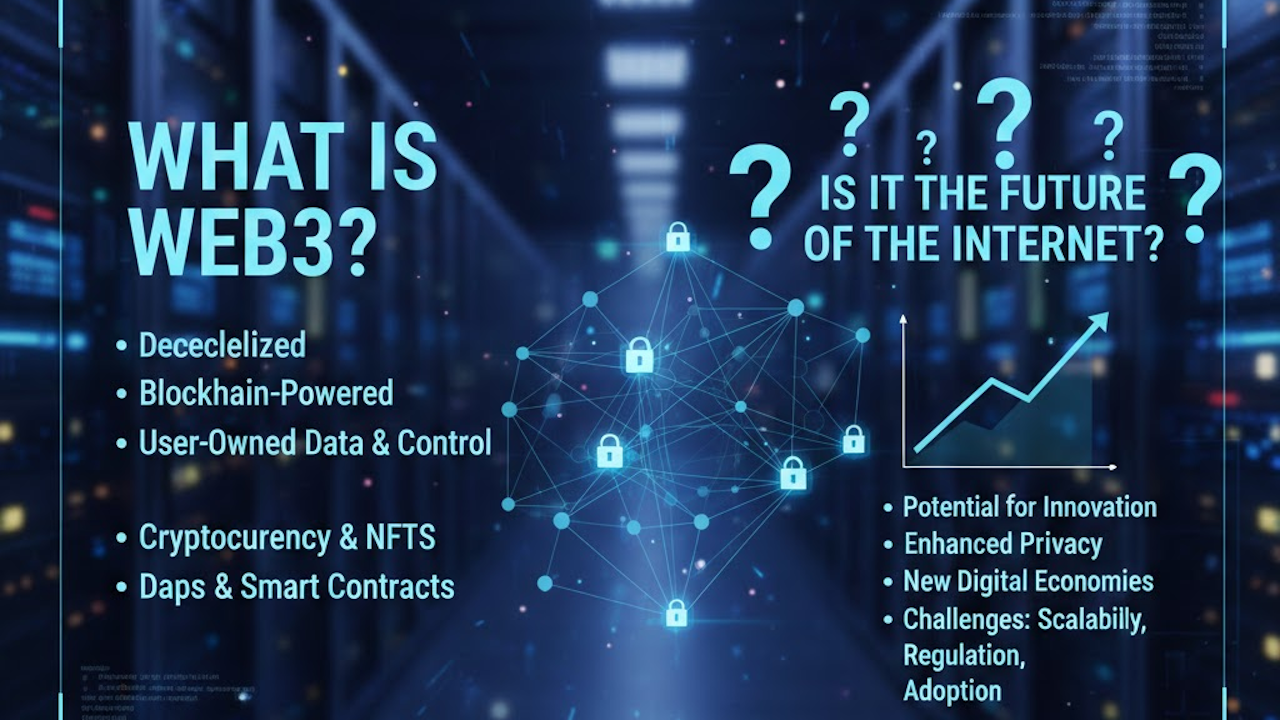
The internet has transformed society over the past few decades, evolving from a simple network of static pages to a dynamic platform for social interaction, commerce, and information sharing. As we enter 2026, a new paradigm known as Web3 is gaining attention as a potential successor to the current web. Web3 promises a decentralized, user-controlled internet built on blockchain technology, where individuals own their data and participate in governance without relying on centralized corporations. But what exactly is Web3, and does it represent the future of the internet? This article explores the definition, history, technologies, benefits, challenges, and ongoing debates surrounding Web3, drawing on recent developments up to 2025 to provide a comprehensive overview.
Web3 is not just a technological upgrade. It is a philosophical shift toward empowerment, transparency, and community-driven systems. Proponents argue it addresses the flaws of today’s internet, such as data monopolies and privacy invasions, while critics question its scalability and real-world viability. By examining these aspects, we can better understand whether Web3 is hype or a genuine evolution.
The Evolution of the Web: From Web1 to Web3
To grasp Web3, it is essential to trace the internet’s history through its major phases: Web1, Web2, and now Web3. Each stage reflects technological advancements and changing user needs.
Web1, often called the “read-only” web, emerged in the 1990s with the invention of the World Wide Web by Tim Berners-Lee. It consisted of static websites where users could only consume information, like reading digital brochures or news articles. There was little interactivity; content was created by a few webmasters, and users had no way to contribute. This era emphasized one-way communication, with limited multimedia and no social features. Websites were basic HTML pages, and the internet served as a vast digital library.
By the early 2000s, Web2 introduced the “read-write” web, revolutionizing online experiences. Platforms like Facebook, YouTube, and Twitter (now X) allowed users to create, share, and interact with content. This shift was powered by technologies such as JavaScript, AJAX, and cloud computing, enabling dynamic, user-generated content. Social media, e-commerce, and collaborative tools like Wikipedia flourished, turning the internet into a participatory space. However, Web2 centralized power in the hands of tech giants like Google, Meta, and Amazon, who control user data, algorithms, and monetization. While it democratized content creation, it also led to issues like data breaches, misinformation, and surveillance capitalism.
Web3, coined in 2014 by Ethereum co-founder Gavin Wood, builds on these foundations but aims for a “read-write-own” model. It seeks to decentralize the web using blockchain and related technologies, giving users ownership of their digital assets and identities. Unlike Web2’s centralized servers, Web3 relies on distributed networks where no single entity holds control. This evolution addresses Web2’s shortcomings by promoting transparency, security, and user sovereignty. As of 2025, Web3 is transitioning from conceptual to practical applications, with growing adoption in finance, gaming, and social platforms. Some envision a Web4 on the horizon, incorporating AI and immersive realities, but Web3 remains the current focus of innovation.
This progression from static to interactive to decentralized highlights how the web adapts to societal demands for more control and equity.
What Is Web3? Definition and Key Concepts
Web3 refers to a decentralized version of the internet built on blockchain technology, where users collectively control data and applications rather than corporations. It is an umbrella term for open-source, interconnected systems that emphasize ownership, privacy, and interoperability. Unlike Web2, where platforms like Google own user data, Web3 allows individuals to manage their information through digital wallets and smart contracts.
At its core, Web3 is about rethinking the internet’s architecture. It uses distributed ledgers, or blockchains, to record transactions transparently and securely without intermediaries. Key concepts include decentralization, where no central authority governs the network; tokenization, turning assets into digital tokens; and permissionless access, allowing anyone to participate. For creators, Web3 means owning intellectual property via non-fungible tokens (NFTs) and earning directly from audiences without platform fees.
In 2025, Web3 is described as a cultural revolution, enabling users to control their digital destinies. It is not fully defined yet, as it remains a work-in-progress, but its principles focus on shifting power from Big Tech to individuals. Examples include decentralized finance (DeFi) apps for lending without banks and social networks where users vote on rules. Web3’s vision is an internet that is more equitable, resilient, and innovative.
Core Technologies and Components of Web3
Web3’s foundation rests on several interconnected technologies that enable its decentralized nature.
Blockchain is the backbone, a distributed ledger that records data across multiple nodes, ensuring immutability and transparency. Platforms like Ethereum and Solana power smart contracts, self-executing agreements that automate processes without trusted third parties.
Cryptography secures transactions and identities, using techniques like public-key encryption to protect data. Decentralized networks, such as peer-to-peer systems, distribute computing power, reducing single points of failure.
Other components include digital assets like cryptocurrencies (e.g., Bitcoin, Ether) and NFTs for unique ownership. The InterPlanetary File System (IPFS) enables decentralized storage, while decentralized autonomous organizations (DAOs) allow community governance.
Artificial intelligence (AI) and machine learning integrate with Web3 for smarter applications, such as predictive analytics in DeFi. Semantic web technologies enhance data connectivity, making information more machine-readable. 3D graphics and metaverses add immersive elements, blending virtual realities with blockchain economies.
The tech stack also includes wallets for managing assets, oracles for real-world data integration, and layer-2 solutions for scalability. These elements create a robust ecosystem for building decentralized applications (dApps).
Advantages and Benefits of Web3
Web3 offers numerous advantages that could reshape online interactions and economies.
First, enhanced privacy and data ownership: Users control their information via wallets, reducing risks from centralized data breaches. This empowers individuals to monetize their data directly.
Second, decentralization eliminates intermediaries, lowering costs and increasing efficiency in sectors like finance and supply chains. DeFi, for instance, enables global lending without banks.
Third, transparency and security: Blockchain’s immutable records prevent fraud and build trust. Smart contracts automate agreements, reducing disputes.
For creators and businesses, Web3 fosters new models like token-based incentives and community ownership. Brands can engage audiences more authentically through NFTs and DAOs.
Additionally, it promotes inclusivity, reaching underserved communities with borderless access. In 2025, Web3 benefits enterprises by improving scalability and integrating with AI for innovative applications.
Overall, Web3 could democratize the internet, making it more user-centric and resilient.
Challenges, Criticisms, and Drawbacks
Despite its promise, Web3 faces significant hurdles that temper enthusiasm.
Usability is a major issue: Managing wallets and keys can be complex for average users, hindering mass adoption. The technology’s steep learning curve alienates non-tech-savvy individuals.
Scalability problems persist, with blockchains like Ethereum struggling with high transaction fees and slow speeds during peak times. Energy consumption is another drawback, as proof-of-work mechanisms contribute to environmental concerns.
Critics argue Web3 is overhyped, with venture capitalists dominating despite decentralization claims. Security vulnerabilities, such as hacks and scams, have led to substantial losses, eroding trust.
Regulatory uncertainty poses risks, as governments grapple with how to oversee cryptocurrencies and DAOs. Large tech firms may resist adoption, preferring their centralized models.
Furthermore, Web3 could exacerbate inequalities if access requires expensive hardware or knowledge. Performance issues, like blockchain’s inefficiency compared to traditional databases, fuel skepticism.
These challenges highlight that Web3 is not a panacea and requires solutions for broader acceptance.
Is Web3 the Future of the Internet? Debates and Outlook
The question of whether Web3 is the internet’s future sparks intense debate. Proponents see it as inevitable, with trends like DeFi, AI integration, and metaverses driving adoption in 2025. Modular blockchains and decentralized social media could address Web2’s flaws, creating a more equitable digital world.
However, skeptics argue it may remain niche due to persistent challenges like scalability and regulation. In 2025, while advancements in decentralized physical infrastructure (DePIN) and AI show promise, hype often overshadows reality. Some view Web3 as an extension rather than a replacement, blending with Web2 elements.
Predictions for 2025 include growth in real-world utilities, but success depends on solving security and usability issues. Debates on X (formerly Twitter) in 2025 pit AI against Web3, with both vying for dominance. Ultimately, Web3’s future hinges on balancing innovation with practicality, potentially leading to a hybrid internet.
Conclusion
Web3 represents a bold vision for a decentralized internet, addressing Web2’s centralization through blockchain, ownership, and community governance. Its technologies and benefits offer exciting possibilities, but challenges like complexity and regulation must be overcome. As of 2026, Web3 is evolving, with 2025 marking key advancements. Whether it becomes the future depends on collective efforts to make it accessible and sustainable. The internet’s next chapter may well be written in code, by users for users.