

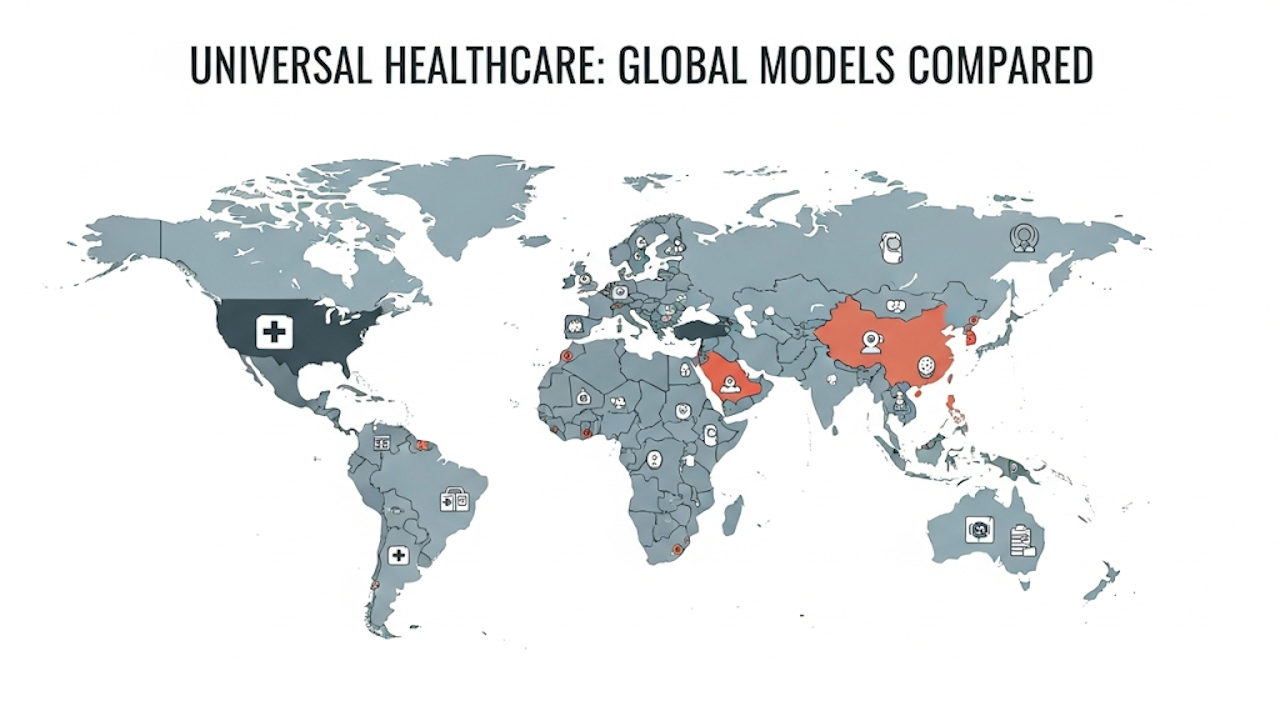
Universal healthcare refers to a system in which all residents of a country have access to essential medical services without facing financial hardship. Most developed nations have implemented some form of universal coverage, though the structures vary significantly. These systems differ in funding mechanisms, delivery models, and the balance between public and private involvement. This article examines prominent global models, drawing on examples from the United Kingdom, Canada, Germany, Sweden, Australia, and Singapore. It compares their performance on key metrics such as cost, access, health outcomes, and administrative efficiency.
The Beveridge Model: Tax-Funded, Government-Provided Care
The Beveridge Model, named after British economist William Beveridge, features healthcare funded primarily through general taxation and delivered through government-owned or operated facilities. Providers often work as public employees or under contract with the state.
The United Kingdom exemplifies this approach with its National Health Service (NHS), established in 1948. The NHS provides care that is free at the point of service for most services, including hospital stays, doctor visits, and many prescriptions. Funding comes mainly from national taxes. Hospitals are publicly owned, and many physicians are salaried government employees, though private practice exists alongside the system.
Strengths: This model promotes equity by removing direct financial barriers. Administrative costs remain low because of centralized funding and simplified billing. The UK often ranks highly in international comparisons for affordability and equity.
Challenges: Centralized budgeting can lead to capacity constraints and longer wait times for non-emergency procedures. Budget pressures occasionally result in staffing shortages or delays in elective care. Critics note that innovation and responsiveness may lag compared to more market-oriented systems.
Variations of the Beveridge Model appear in countries such as Spain, New Zealand, and parts of Scandinavia, where public ownership and tax funding dominate.
The Bismarck Model: Mandatory Multi-Payer Insurance
The Bismarck Model relies on nonprofit insurance funds, often called sickness funds, financed through payroll contributions from employers and employees. Government regulates the system to ensure universal coverage, while care delivery remains largely private.
Germany provides a leading example. Workers and employers contribute to sickness funds based on income. These funds compete but must offer a standard benefits package. Coverage is near-universal, with subsidies for low-income individuals. Hospitals and physicians operate privately but negotiate rates collectively with the funds.
Strengths: Competition among insurers can drive efficiency and patient choice. The model maintains strong provider autonomy and often features shorter wait times than single-payer systems. Germany achieves excellent health outcomes with lower per-capita spending than the United States.
Challenges: Administrative overhead is higher than in single-payer systems due to multiple payers. Contribution rates can rise with aging populations, and the system requires careful regulation to prevent risk selection by insurers.
Similar multi-payer approaches operate in France, Japan, and Switzerland, with varying degrees of government oversight and private involvement. France supplements its social insurance with general revenues and offers high patient satisfaction.
Single-Payer National Health Insurance
In single-payer systems, a single public entity (usually the government) acts as the primary insurer, collecting funds through taxes and paying providers. Private delivery of care persists, but financing is centralized.
Canada’s Medicare system illustrates this model. Each province administers its own plan, with federal guidelines ensuring universality. Hospitals and physicians bill the provincial plan directly. Patients face no bills for medically necessary services, though coverage for drugs, dental care, and vision often requires supplementary insurance.
Strengths: Centralized purchasing power helps control costs and negotiate lower prices for drugs and services. The system eliminates much administrative waste associated with multiple insurers. Canada achieves strong equity and protects citizens from catastrophic medical debt.
Challenges: Wait times for specialists and elective procedures can be lengthy due to global budgets and capacity limits. Some patients purchase private insurance or travel abroad for faster care. Canada ranks as a high spender among universal systems but faces criticism for resource availability.
Sweden and other Nordic countries blend single-payer elements with strong local governance and emphasis on primary care prevention. These nations often report high life expectancy and patient satisfaction.
Hybrid and Mixed Models: Australia and Singapore
Australia operates Medicare, a public insurance scheme funded by taxes and a Medicare levy on income. It covers hospital and physician services with bulk billing for many patients. Private insurance supplements the system, covering faster access and extras such as dental care. This public-private mix balances universal access with choice.
Singapore stands out for its unique framework emphasizing personal responsibility. The system uses the “3Ms”: MediSave (compulsory savings accounts), MediShield Life (catastrophic insurance), and MediFund (safety net for the needy). Government subsidies support public hospitals, while competition encourages efficiency. Citizens pay significant out-of-pocket costs for routine care, moderated by savings accounts.
Strengths of hybrids: Australia achieves top rankings in international assessments for overall performance, balancing access and outcomes. Singapore maintains exceptionally low per-capita spending while delivering high-quality care and strong health metrics. Its model discourages overutilization through cost-sharing.
Challenges: In Australia, private insurance can create a two-tier system. Singapore’s approach requires robust individual savings and may burden lower-income or chronically ill residents without sufficient subsidies.
Comparative Analysis
Coverage and Access: All featured countries achieve near-universal coverage, unlike the United States, which remains the only major developed nation without it. Single-payer and Beveridge models excel in equity and financial protection. Multi-payer systems offer more choice but require stronger regulation to avoid gaps.
Costs: Universal systems generally spend far less per capita and as a percentage of GDP than the fragmented U.S. approach. Administrative costs are notably lower in single-payer and Beveridge models. Germany and Singapore demonstrate effective cost control within multi-payer or hybrid frameworks. High U.S. prices for services and drugs drive much of the spending difference.
Health Outcomes: Countries with universal systems often report higher life expectancy, lower infant mortality, and better management of chronic conditions than the U.S. Australia, the Netherlands, and the UK frequently lead in comparative rankings. However, outcomes also reflect broader social determinants such as education, income inequality, and lifestyle factors.
Wait Times and Innovation: Single-payer and Beveridge systems may experience longer waits for non-urgent care, while multi-payer models like Germany’s tend toward quicker access. Universal systems can still foster innovation, particularly when private providers participate. Concerns about rationing exist but are balanced by overall population health gains.
Pros of Universal Models Overall:
- Reduced administrative waste and billing complexity.
- Better risk pooling and protection from medical bankruptcy.
- Emphasis on preventive care and public health.
- Improved health equity across socioeconomic groups.
Cons:
- Potential for longer waits in budget-constrained systems.
- Higher taxes or mandatory contributions.
- Reduced individual choice in some designs.
- Political challenges in sustaining funding amid demographic shifts.
Lessons and Considerations
Global experience shows that multiple pathways can achieve universal healthcare. No single model is perfect; success depends on cultural context, governance quality, and complementary policies in education and social support. Centralized systems prioritize equity and cost control, while regulated multi-payer approaches preserve choice and competition.
As populations age and chronic diseases rise, adaptability becomes crucial. Countries like Singapore demonstrate that combining individual responsibility with targeted government support can yield efficiency. Nordic nations highlight the value of integrated primary and preventive services.
For nations considering reform, evidence suggests that moving toward universal coverage correlates with better population health at sustainable costs. Implementation requires careful design to address local needs, provider incentives, and long-term fiscal sustainability. The comparative success of these models underscores that universal healthcare is achievable through diverse structures tailored to each society’s values and resources.