

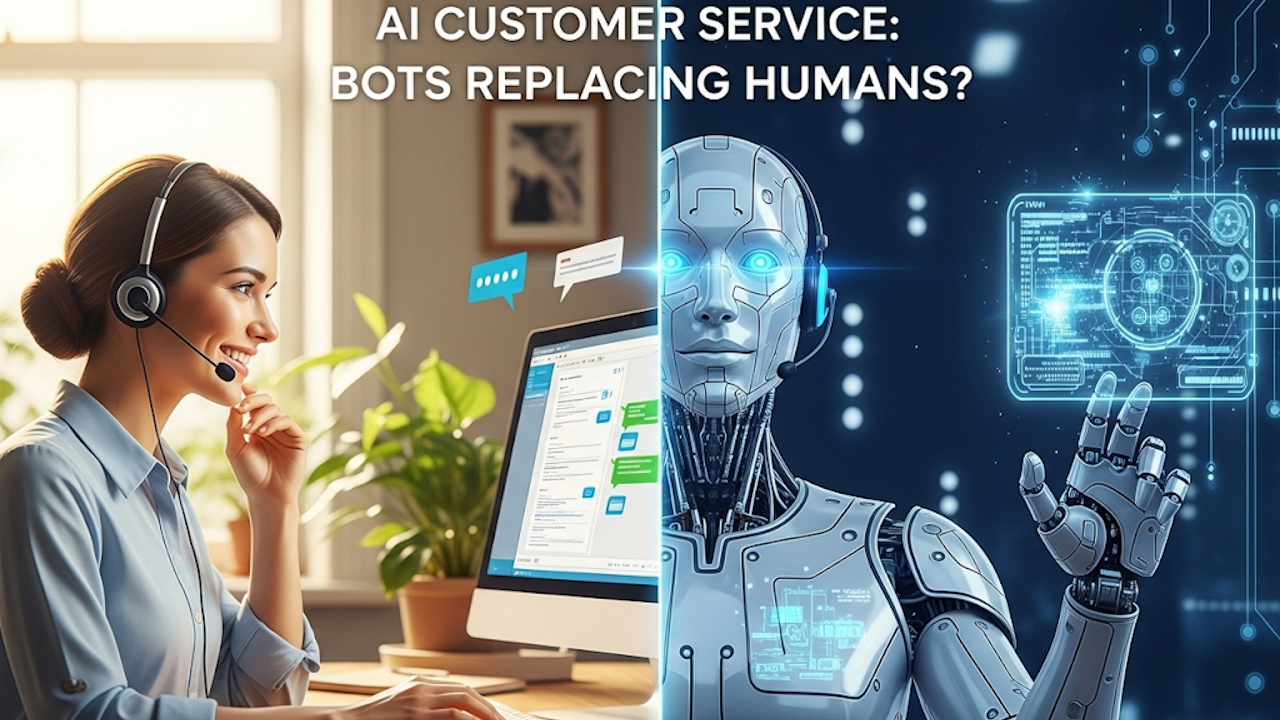
Customer service has always been at the heart of business success. From the corner store clerk who remembers your name to massive call centers handling thousands of inquiries daily, the way companies interact with their customers defines loyalty and growth. Today, artificial intelligence is transforming this field at an unprecedented pace. Chatbots, virtual assistants, and automated systems powered by large language models are now handling millions of interactions every day. The central question many ask is whether these AI bots are truly replacing human agents or simply reshaping the role of people in service.
This article explores the evolution, capabilities, limitations, and future of AI in customer service. We will examine real-world impacts, weigh the arguments for and against full automation, and consider what a balanced approach might look like in the coming years.
The Traditional Model Meets Digital Disruption
Customer service began as a deeply personal endeavor. In the pre-internet era, it relied on face-to-face conversations, telephone calls, and written letters. The rise of e-commerce and global operations in the 1990s and 2000s led to the growth of large contact centers. Companies invested heavily in training thousands of agents to handle queries across phone, email, and later live chat.
Even then, efficiency was a challenge. Average handle times, first-contact resolution rates, and customer satisfaction scores became key metrics. High employee turnover plagued the industry due to repetitive tasks, emotional labor, and sometimes difficult customer interactions. This created an opening for automation.
Early automated systems used Interactive Voice Response (IVR) menus and rule-based chatbots. These could handle simple tasks like password resets or order tracking but often frustrated users when queries grew complex. The breakthrough came with advances in natural language processing, machine learning, and generative AI around 2022-2023. Tools like GPT models enabled bots to understand context, generate human-like responses, and even show empathy in text.
By 2026, major platforms from companies like Zendesk, Salesforce, Intercom, and specialized AI providers have integrated sophisticated agents capable of multilingual support, sentiment analysis, and seamless handoffs to humans when needed.
The Promise: Efficiency, Scale, and Cost Savings
The business case for AI customer service is compelling. Companies report significant benefits:
First, scalability stands out. A single AI system can handle thousands of simultaneous conversations without fatigue. During peak periods like holiday sales or product launches, bots prevent long wait times that drive customers away.
Second, cost reduction is dramatic. Human agents require salaries, benefits, training, and workspace. AI systems, while requiring initial investment and ongoing maintenance, can operate at a fraction of that cost over time. Industry analyses suggest some organizations have reduced support staffing needs by 30 to 60 percent in certain departments after successful AI deployments.
Third, consistency and speed improve. AI delivers the same quality of response regardless of time of day or agent experience level. Response times drop from minutes to seconds. Bots can pull from vast knowledge bases instantly, providing accurate product information, troubleshooting steps, or policy explanations.
Fourth, data insights become richer. Every interaction generates structured data that companies can analyze to spot trends, improve products, or personalize future communications. Sentiment analysis helps flag unhappy customers before issues escalate.
Many businesses now use AI for tier-one support: answering frequently asked questions, processing returns, scheduling appointments, or guiding users through self-service portals. This frees human agents for complex, high-value interactions that require creativity, negotiation, or emotional intelligence.
Real-World Examples of AI Deployment
Several large organizations have shared their experiences. Retail giants use AI chatbots on their websites and mobile apps to handle order status checks and recommendation queries. Telecom companies deploy voice AI that can troubleshoot connection issues by analyzing account data in real time.
Banking and finance sectors have been early adopters. AI systems verify identities, detect fraud patterns during customer calls, and provide personalized financial advice within regulatory boundaries. Healthcare providers use bots for appointment booking and basic symptom triage, though always with human oversight for medical decisions.
E-commerce platforms report that over 70 percent of initial customer contacts in some cases are now fully resolved by AI without human involvement. This percentage continues to climb as models improve.
Small and medium businesses also benefit. Affordable no-code platforms allow even startups to implement intelligent chatbots that operate 24/7, giving them parity with larger competitors in responsiveness.
The Human Element: Where Bots Still Fall Short
Despite impressive advances, AI is not a complete replacement for humans in many scenarios. Several limitations persist.
Context and nuance remain challenging. While modern AI excels at pattern matching, it can misinterpret sarcasm, cultural references, or highly specific personal situations. A customer explaining a unique product defect or emotional frustration about a service failure may receive generic responses that feel impersonal or off-target.
Empathy is difficult to simulate convincingly. Humans can genuinely connect, apologize with sincerity, or adjust tone based on subtle cues. Customers often report feeling more satisfied after speaking with a person, especially when the issue involves money, health, or significant inconvenience.
Complex problem-solving involving multiple departments or exceptions to policy frequently requires human judgment. AI can escalate these cases, but the handoff process sometimes creates friction if not designed well.
Bias and errors also pose risks. AI systems trained on historical data may perpetuate past prejudices in responses or decision-making. Hallucinations, where the model confidently provides incorrect information, can damage trust if not caught.
Privacy and security concerns grow with AI handling sensitive customer data. Compliance with regulations like GDPR or emerging AI-specific laws requires careful governance.
Finally, some customers actively prefer human interaction. Surveys consistently show segments of the population, particularly older demographics or those with high-stakes issues, who want to speak with a real person.
Hybrid Models: The Realistic Path Forward
The evidence suggests that full replacement of humans is neither happening nor desirable in most cases. Instead, the winning strategy appears to be intelligent collaboration between AI and humans.
In a typical hybrid setup, AI handles initial triage and routine queries. Sophisticated routing systems analyze query complexity, customer value, sentiment, and history to decide when to involve a human agent. The best systems allow AI to summarize the conversation for the human, providing context so the agent can jump in effectively without repeating questions.
This approach boosts agent productivity. Rather than spending time on repetitive tasks, humans focus on building relationships, upselling, or resolving tough problems. Job satisfaction often increases as agents move away from mundane work.
Training has evolved too. Companies now teach agents how to work alongside AI tools, review bot suggestions, and override decisions when necessary. Some forward-thinking organizations use AI to coach human agents in real time, suggesting better responses or empathy techniques.
Economic and Social Implications
The shift toward AI customer service has broader effects. On one hand, it creates new jobs in AI development, prompt engineering, system training, and oversight. On the other, it displaces traditional call center roles, particularly in regions where these jobs provided significant employment.
Businesses must manage this transition thoughtfully, offering reskilling programs and clear career paths. Governments and educational institutions are increasingly focused on preparing workforces for an AI-augmented economy.
Customer expectations are also changing. People have grown accustomed to instant responses from bots but still demand the option for human escalation. Companies that remove this option entirely often face backlash on social media and review sites.
Looking Ahead: Trends to Watch
Several developments will shape the next phase of AI customer service.
Multimodal AI that combines text, voice, and even video analysis will become more common. Imagine a bot that not only chats but can view a customer’s uploaded photo of a damaged product and diagnose the issue.
Personalization at scale will improve as AI integrates deeper with customer relationship management systems, remembering preferences across channels while respecting privacy.
Voice AI quality is advancing rapidly, with more natural prosody and accent adaptation. This could make automated phone support far less frustrating.
Ethical AI frameworks and transparency requirements will likely increase. Customers may demand to know when they are speaking with AI and what data is being used.
Integration with augmented reality could allow bots to guide customers through physical repairs or product setups using visual overlays on their phone cameras.
By the end of the decade, we may see AI agents that maintain long-term relationships with customers, acting almost like dedicated account managers for routine needs while humans handle strategic or sensitive matters.
Conclusion
AI bots are not fully replacing humans in customer service, but they are fundamentally changing the landscape. They excel at speed, availability, and handling volume, while humans remain superior in empathy, creativity, and complex judgment.
The most successful companies will be those that view AI as a powerful tool rather than a total substitute. By combining the strengths of both, businesses can deliver faster, more consistent service without losing the personal connection that builds lasting loyalty.
The question is not whether bots will replace humans, but how thoughtfully we integrate them to create better experiences for customers and more fulfilling work for employees. The future of customer service is hybrid, and those who embrace this balance stand to gain the most in an increasingly competitive market.