

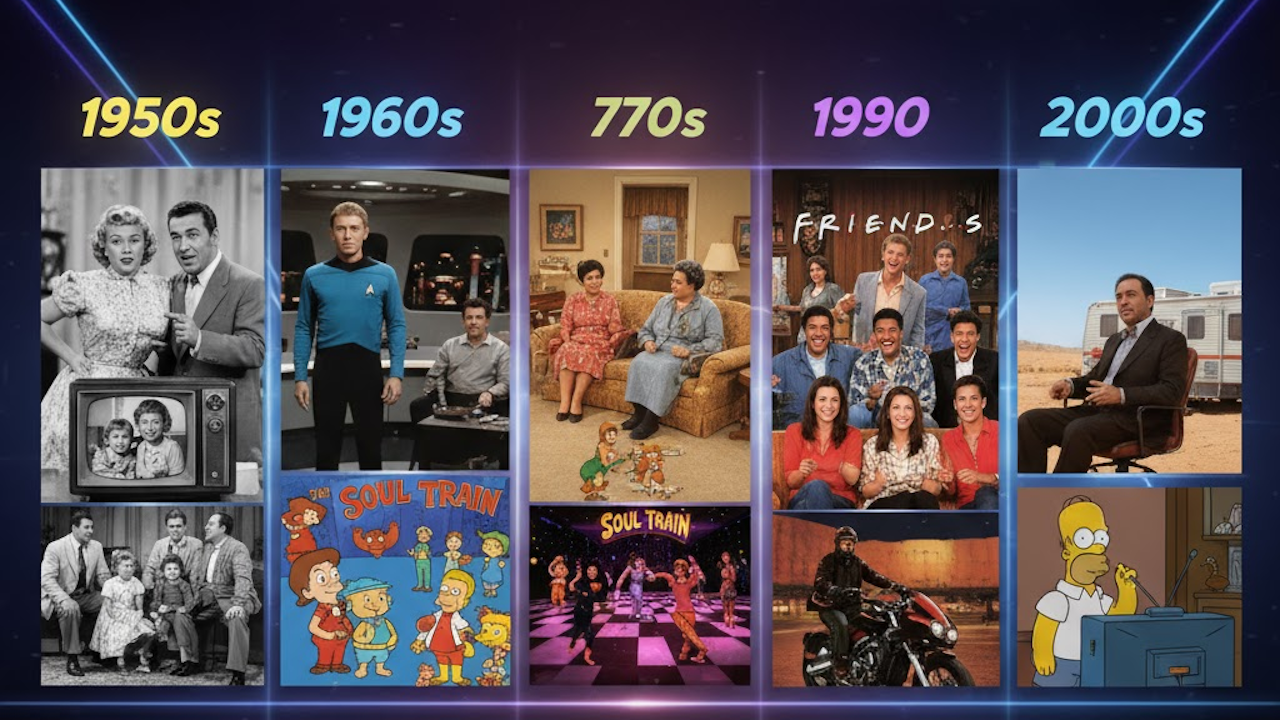
Television has been the dominant cultural force in homes for over 70 years, shaping tastes, sparking conversations, and reflecting (and sometimes leading) societal change. Each decade produced a handful of shows that were more than just popular; they became reference points, water-cooler moments, and mirrors of their time. Here is a decade-by-decade look at the programs that truly defined their eras.
1950s: The Birth of the Mass Medium
The 1950s saw television explode from a novelty into a fixture in most American (and increasingly British) households. Live broadcasts, tiny screens, and rigid sponsorship ruled the day.
- I Love Lucy (1951–1957) The most important show of the decade, and arguably of all time. Lucille Ball and Desi Arnaz pioneered the three-camera sitcom format still used today, introduced reruns as a viable business model, and made a married couple sleeping in twin beds feel revolutionary. Episodes like “Lucy Does a TV Commercial” (the Vitameatavegamin bit) remain instantly recognizable.
- The Honeymooners (1955–1956) Jackie Gleason’s loud, loving bus driver Ralph Kramden gave working-class Brooklyn a loud voice on national television. Only 39 episodes were made, yet lines like “To the moon, Alice!” entered the language.
- What’s My Line? (1950–1967) and other panel shows Elegant, civilized, and sponsored by corporations like Stopette deodorant, these programs showed that television could be sophisticated as well as silly.
Honorable mention: Dragnet (1951–1959) for bringing police procedural realism to the screen with its deadpan “Just the facts, ma’am” style.
1960s: From Black-and-White Comfort to Color Chaos
As color sets became affordable and the decade’s social upheavals intensified, television split between escapism and uneasy reflection.
- The Twilight Zone (1959–1964) Rod Serling used science fiction and fantasy to tackle racism, nuclear war, conformity, and McCarthyism in ways straightforward drama could not.
- The Beverly Hillbillies (1962–1971) The highest-rated show for several seasons, proving rural comedy could crush urban sophistication in the ratings.
- The Fugitive (1963–1967) Ended with the most-watched episode in U.S. history at the time (the 1967 finale), showing audiences would follow long-form storytelling.
- Star Trek (1966–1969) Canceled after three low-rated seasons, it became a cultural juggernaut in syndication, launching conventions, novels, and a franchise that still dominates today.
- The Avengers (UK, 1961–1969) With Honor Blackman and later Diana Rigg as stylish, lethal partners to Patrick Macnee’s John Steed, it exported British cool worldwide and influenced spy fiction for decades.
1970s: Relevance and Realism Take Center Stage
The decade of “socially relevant” programming arrived alongside gritty cinematography and laugh tracks starting to fade.
- All in the Family (1971–1979) Norman Lear’s adaptation of the British Till Death Us Do Part brought bigotry, menopause, impotence, and Vietnam into the living room. Archie Bunker became America’s lovable (and hateable) everyman.
- MAS*H (1972–1983) A comedy about the Korean War that functioned as a commentary on Vietnam. Its 1983 finale remains the most-watched scripted episode in U.S. television history.
- The Mary Tyler Moore Show (1970–1977) Mary Richards was television’s first truly independent career woman who didn’t need marriage as a happy ending.
- Roots (1977) The miniseries event that forced America to confront slavery head-on. An estimated 130 million people watched at least part of it.
- Fawlty Towers (UK, 1975–1979) Only 12 episodes, yet John Cleese’s Basil Fawlty is routinely voted the greatest British sitcom character ever.
1980s: Gloss, Excess, and the Rise of Prime-Time Soap
Big hair, big shoulder pads, and bigger ratings.
- Dallas (1978–1991) “Who shot J.R.?” became a global obsession in 1980. The prime-time soap invented the cliffhanger season finale.
- Hill Street Blues (1981–1987) Overlapping dialogue, handheld cameras, and moral ambiguity revolutionized police dramas.
- Cheers (1982–1993) “Where everybody knows your name” offered comfort food television for a decade obsessed with wealth.
- Miami Vice (1984–1989) Pastel colors, Jan Hammer synth score, and designer stubble made law enforcement look like a fashion shoot.
- The Cosby Show (1984–1992) For years the number-one show, it presented an affluent, loving Black family at a time when such images were rare (its later reputational collapse does not erase its contemporary impact).
- Only Fools and Horses (UK, 1981–2003) David Jason’s Del Boy became Britain’s most beloved comic character.
1990s: Peak Network, Birth of Prestige
The last decade before cable and streaming shattered the monoculture.
- Seinfeld (1989–1998) “A show about nothing” that dominated conversation with catchphrases (“No soup for you!”, “Master of my domain”) and ruthless social observation.
- The Simpsons (1989–present) Started as crude shorts on The Tracey Ullman Show, became the longest-running scripted primetime show ever, and redefined animation for adults.
- Friends (1994–2004) Six beautiful New Yorkers drinking coffee defined aspirational friendship (and haircuts) for a generation.
- The X-Files (1993–2002) “The truth is out there” captured 1990s paranoia about government and technology.
- ER (1994–2009) George Clooney’s breakthrough and a masterclass in real-time medical chaos.
- Buffy the Vampire Slayer (1997–2003) Turned teen horror into sharp feminist allegory.
UK highlights: Absolutely Fabulous (1992–2012) and The Royle Family (1998–2012) offered very different takes on British domestic life.
2000s: Cable Eats Network’s Lunch
HBO, AMC, and FX proved you could tell adult stories on television.
- The Sopranos (1999–2007) The first true anti-hero drama of the new century. Tony Soprano in therapy changed everything.
- Lost (2004–2010) Mysterious island, flash-forwards, polar bears: appointment viewing returned.
- 24 (2001–2010) Real-time storytelling and Jack Bauer’s growl defined post-9/11 anxiety.
- The Wire (2002–2008) Critically adored but never a ratings hit, it is now routinely called the greatest television show ever made.
- Breaking Bad (2008–2013) Walter White’s transformation from chemistry teacher to drug kingpin became the template for the golden age anti-hero.
- Mad Men (2007–2015) Slow-burn 1960s nostalgia that made advertising look profound.
2010s: Peak TV and the Streaming Wars
More scripted shows aired in 2019 than ever before (or since). A few rose above the noise.
- Game of Thrones (2011–2019) Fantasy for people who hated fantasy. Its cultural dominance peaked with “The Red Wedding” and crashed with the finale.
- Breaking Bad spin-off Better Call Saul (2015–2022) Often argued to have surpassed its parent show.
- Stranger Things (2016–present) Pure 1980s nostalgia distilled into binge format.
- The Crown (2016–2023) Made British royal history appointment drama for Americans.
- Fleabag (2016–2019) Phoebe Waller-Bridge’s fourth-wall-breaking tragicomedy redefined what a half-hour show could be.
- Succession (2018–2023) Shakespearean media-family dysfunction with perfect one-liners.
2020s (So Far): Fragmentation and Global Reach
With linear ratings collapsing, cultural impact now spreads through memes, TikTok, and international co-viewing.
- The Last of Us (2023) Proved video-game adaptations could be prestige events.
- Succession’s final season (2023) and The Bear (2022–present) Both dominated awards and conversation.
- Squid Game (2021) The most-watched Netflix launch ever; a South Korean dystopian thriller that became a global Halloween costume phenomenon.
- Shogun (2024) A reminder that subtitled historical epic could still dominate English-language conversation.
- Baby Reindeer (2024) Turned a one-man Edinburgh Fringe show into a worldwide phenomenon about stalking and trauma.
Television no longer has a single shared text the way I Love Lucy or the MAS*H finale once did. Yet certain shows still cut through the noise to become the stories we argue about, quote, and dress up as. From Lucy stomping grapes to Kendall Roy screaming on a balcony, these are the programs that didn’t just entertain their decades; they defined them.