

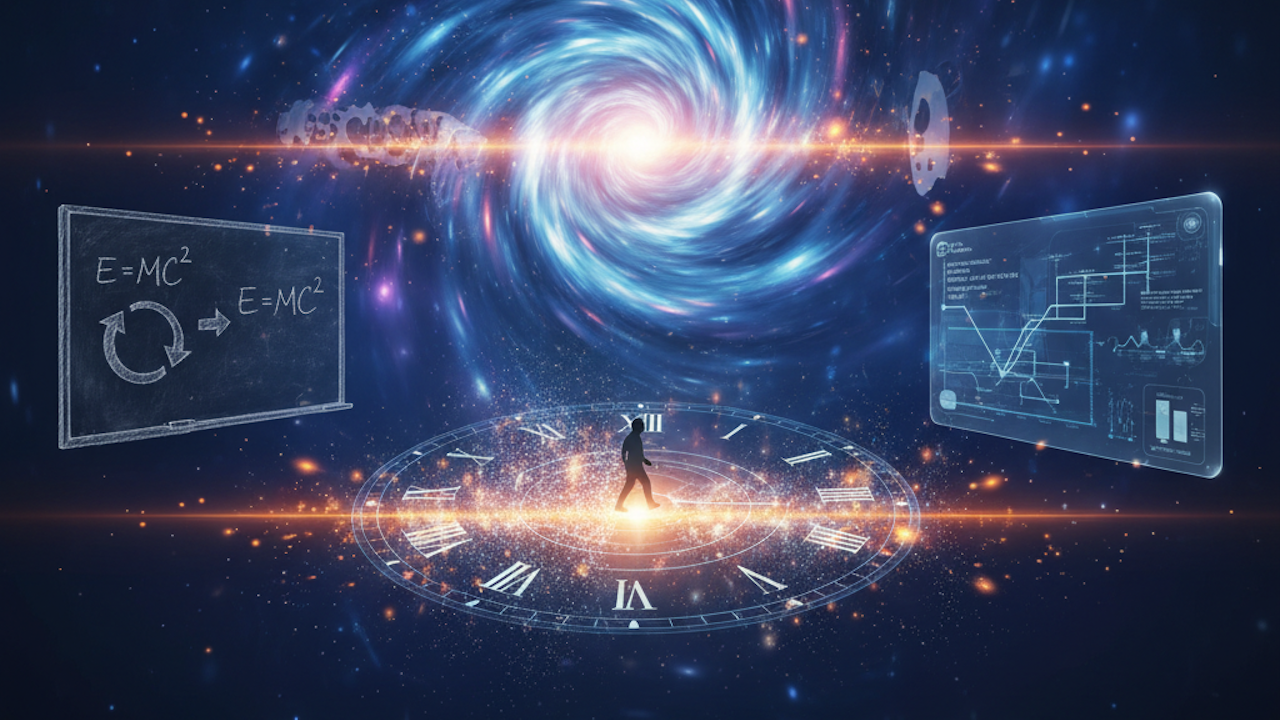
Time travel has captivated human imagination for centuries. From ancient myths to modern science fiction, the idea of moving backward or forward in time beyond the ordinary flow of days stirs profound questions about reality, causality, and free will. But beyond storytelling, does physics allow for time travel? This article explores the theoretical foundations, key concepts from relativity and quantum mechanics, major challenges like paradoxes, and the current scientific consensus on whether time travel could ever become more than speculation.
The Concept of Time in Classical Physics
To understand time travel, one must first examine how time itself is conceptualized in physics. In the Newtonian framework that dominated science for over two centuries, time was absolute and universal. Isaac Newton described time as flowing equably without regard to external things. It moved forward uniformly for all observers, independent of motion or location. In this view, time travel would require some extraordinary mechanism to reverse or accelerate this fixed arrow, but Newtonian physics offered no such pathways. Events followed a strict cause-and-effect sequence, making backward travel incompatible with the deterministic laws of motion.
This absolute time suited everyday experience and classical mechanics well. However, it began to crack with the advent of Einstein’s theories in the early 20th century. Albert Einstein revolutionized our understanding by showing that time is relative, intertwined with space in a four-dimensional fabric known as spacetime.
Special Relativity and Forward Time Travel
Einstein’s special theory of relativity, published in 1905, introduced the idea that time is not the same for everyone. It depends on relative velocity. The faster one moves relative to another observer, the slower time passes for the moving object. This phenomenon, called time dilation, has been experimentally verified countless times.
For example, muons, subatomic particles created in the upper atmosphere, decay quickly in their rest frame. Yet many reach Earth’s surface because, from our perspective, their internal clocks run slower due to high speeds. Similarly, astronauts on the International Space Station age slightly less than people on Earth due to their orbital velocity.
This form of time travel is one-way and forward-directed. By traveling near the speed of light or experiencing strong gravitational fields, a person could return to Earth having aged less than those left behind. In extreme scenarios, such as a near-light-speed round trip to a distant star, centuries could pass on Earth while only years elapse for the traveler. This is often called the twin paradox: one twin stays home while the other journeys and returns younger.
Forward time travel aligns with established physics and requires no new laws. It is theoretically possible today with sufficient energy and technology, though impractical for large time jumps with current capabilities. The real debate centers on backward time travel, which would involve revisiting or altering the past.
General Relativity and Closed Timelike Curves
Einstein’s general theory of relativity from 1915 describes gravity as the curvature of spacetime caused by mass and energy. Massive objects warp spacetime, and this curvature dictates the paths of objects, including light. Solutions to the equations of general relativity allow for exotic possibilities, including paths where time loops back on itself.
These are known as closed timelike curves (CTCs). A CTC is a worldline in spacetime that returns to the same point in space and an earlier time, allowing an object or signal to travel into its own past. The first such solution came from mathematician Kurt Godel in 1949. Godel’s universe model incorporated rotating matter, leading to CTCs throughout the cosmos. In this hypothetical rotating universe, one could depart from a point and return before leaving by following a suitable path.
Other theoretical constructs include wormholes, or Einstein-Rosen bridges. These are tunnels connecting distant regions of spacetime. In 1988, physicists Kip Thorne, Michael Morris, and Ulvi Yurtsever proposed that a traversable wormhole could connect not just distant spaces but different times. By stabilizing a wormhole with exotic matter (material with negative energy density), one end could be accelerated or placed in a strong gravitational field to create a time difference. A traveler entering one mouth might exit the other at an earlier moment.
Black holes also feature in time travel discussions. Rotating black holes, described by the Kerr metric, possess ring-shaped singularities that might permit passage through to other regions or times without destruction. However, these remain highly speculative, as entering a black hole would likely result in spaghettification due to tidal forces long before reaching any potential exit.
These general relativity solutions demonstrate that backward time travel is mathematically consistent within the theory. Einstein himself was surprised by such implications, but the equations permit them under certain conditions.
Quantum Mechanics, Exotic Matter, and Practical Barriers
While general relativity allows CTCs in principle, quantum mechanics introduces severe obstacles. Quantum field theory in curved spacetime predicts that fluctuations would destabilize wormholes or CTCs. Stephen Hawking’s chronology protection conjecture, proposed in 1992, suggests that the laws of physics prevent the formation of CTCs to avoid paradoxes. Quantum effects near CTCs would amplify into infinite energy densities, destroying the time machine before it could function.
Exotic matter required for wormhole stabilization violates known energy conditions. Negative energy densities appear in phenomena like the Casimir effect, where quantum vacuum fluctuations between plates produce tiny attractive forces. However, scaling this to macroscopic wormhole sizes demands enormous amounts of exotic matter, far beyond current or foreseeable technology.
Cosmic strings, hypothetical defects from the early universe with immense density, have also been proposed as ingredients for time machines when combined with other elements. Yet none of these have been observed, and their existence remains uncertain.
The Paradoxes of Time Travel
Even if physics permitted construction of a time machine, logical paradoxes arise. The most famous is the grandfather paradox: a traveler goes back in time and kills their grandfather before the traveler’s parent is conceived. This creates a contradiction because the traveler would never have been born to make the journey.
Variations include the bootstrap paradox, where information or objects loop in closed causal chains without origin. A time traveler gives Shakespeare the manuscript of Hamlet, which Shakespeare then publishes. Where did the play originally come from? Such self-consistent loops challenge notions of causality and creation.
Physicists have proposed resolutions. In the Novikov self-consistency principle, events in CTCs must remain consistent. The traveler might fail to kill the grandfather due to improbable but inevitable accidents, preserving the timeline. Multiple-worlds interpretations from quantum mechanics suggest branching realities: traveling back creates a new parallel universe rather than altering the original one.
David Deutsch’s work on quantum computation in CTCs offers a framework where quantum superposition allows consistent histories without contradiction. However, these remain theoretical fixes without experimental support.
Current Research and Experimental Insights
No direct experimental evidence for backward time travel exists. Particle accelerators and high-precision clocks confirm forward time dilation effects routinely. Proposals to test CTCs involve analogs, such as using metamaterials to simulate curved spacetime or studying quantum simulations of black hole horizons.
Recent theoretical work explores connections between time travel, quantum entanglement, and holography. The AdS/CFT correspondence in string theory provides a framework where gravity in higher dimensions relates to quantum theories without gravity, potentially shedding light on spacetime structure.
Cosmological observations, including the expansion of the universe and cosmic microwave background, suggest a definite arrow of time originating from the Big Bang. Entropy increases drive this thermodynamic arrow, making macroscopic reversal difficult.
Some physicists argue that time itself may emerge from quantum entanglement or information processing, implying fundamental limits on manipulation. Others, like those studying loop quantum gravity, seek to quantize spacetime and resolve singularities that might otherwise allow CTCs.
Philosophical and Ethical Dimensions
Beyond physics, time travel raises deep philosophical issues. If backward travel were possible, determinism versus free will comes into question. Would the past be fixed, or malleable? Ethical concerns include interference with historical events, potential creation of alternate timelines, and responsibility for changes.
Cultural depictions, from H.G. Wells’ “The Time Machine” to films like “Back to the Future,” highlight these tensions while popularizing concepts. Yet science distinguishes entertainment from rigorous theory.
Conclusion: Theoretically Intriguing, Practically Remote
In summary, forward time travel through relativistic effects is not only possible but demonstrated on small scales. Backward time travel finds support in specific solutions of general relativity, particularly via closed timelike curves and stabilized wormholes. However, quantum effects, energy requirements, chronology protection, and paradoxes present formidable barriers.
Most physicists consider macroscopic, controllable time travel into the past highly improbable with known physics. It would require breakthroughs in exotic matter production, quantum gravity unification, and perhaps entirely new paradigms. While the mathematics keeps the door slightly ajar, engineering and consistency challenges make practical realization seem distant or impossible.
The study of time travel continues to drive advances in theoretical physics, pushing boundaries of our understanding of spacetime, causality, and the universe. Whether it remains forever confined to thought experiments or one day surprises us with feasibility, the pursuit itself enriches scientific inquiry. As we probe deeper with tools like gravitational wave detectors and quantum computers, answers may evolve, but for now, time travel stands as a profound reminder of how much remains unknown about the fabric of reality.