

Oak stands as one of the most influential elements in the production of fine wine. For centuries, winemakers have turned to oak barrels not merely as containers but as active participants that shape aroma, taste, texture, and aging potential. The wood interacts with the liquid in profound ways, releasing compounds that add layers of complexity while allowing controlled oxygen exposure that softens harsh edges and promotes harmony. This article examines the deep and varied contributions of oak to wine flavor, tracing its historical roots, scientific mechanisms, differences among oak types, the intricacies of barrel craftsmanship, and its evolving place in contemporary winemaking.
A Brief History of Oak in Winemaking
Wooden barrels emerged as practical vessels long before their flavor contributions were fully appreciated. Ancient civilizations relied on clay amphorae and animal skins for wine storage and transport, yet these materials proved cumbersome and prone to leakage. Celtic and Germanic tribes developed sturdy oak barrels around the first century before the common era, valuing the wood for its strength, flexibility when steamed or heated, and natural resistance to liquids. The Romans quickly adopted and refined this technology, spreading barrel use across their empire for beer, wine, and other goods. By the medieval period, oak barrels had become indispensable across Europe for both storage and long distance trade.
In France, specific forests earned lasting reputations for producing superior stave wood. Regions such as Allier, Limousin, Tronçais, Nevers, and Vosges supplied tight grained or coarser oak suited to different needs. Coopers developed specialized skills in selecting, seasoning, and shaping the wood. Air drying staves for two or three years reduced harsh tannins naturally. As winemaking expanded to the New World, American white oak entered widespread use. Its faster growth and abundant supply made it economical, while its bolder flavor profile suited robust styles. Today, oak remains central to premium production worldwide, even as alternatives gain ground for cost and consistency reasons.
The Science of Oak and Wine Interaction
When wine enters an oak barrel, a series of physical and chemical processes unfold over months or years. Oak is porous, permitting slow oxygen ingress known as micro oxygenation. This gentle aeration encourages the polymerization of tannins, reducing astringency and improving mouthfeel. It also stabilizes color in red wines by helping anthocyanins bind with other molecules. At the same time, the wine extracts soluble compounds from the wood through diffusion and dissolution. Alcohol content, pH, temperature, and contact duration all influence extraction speed and intensity.
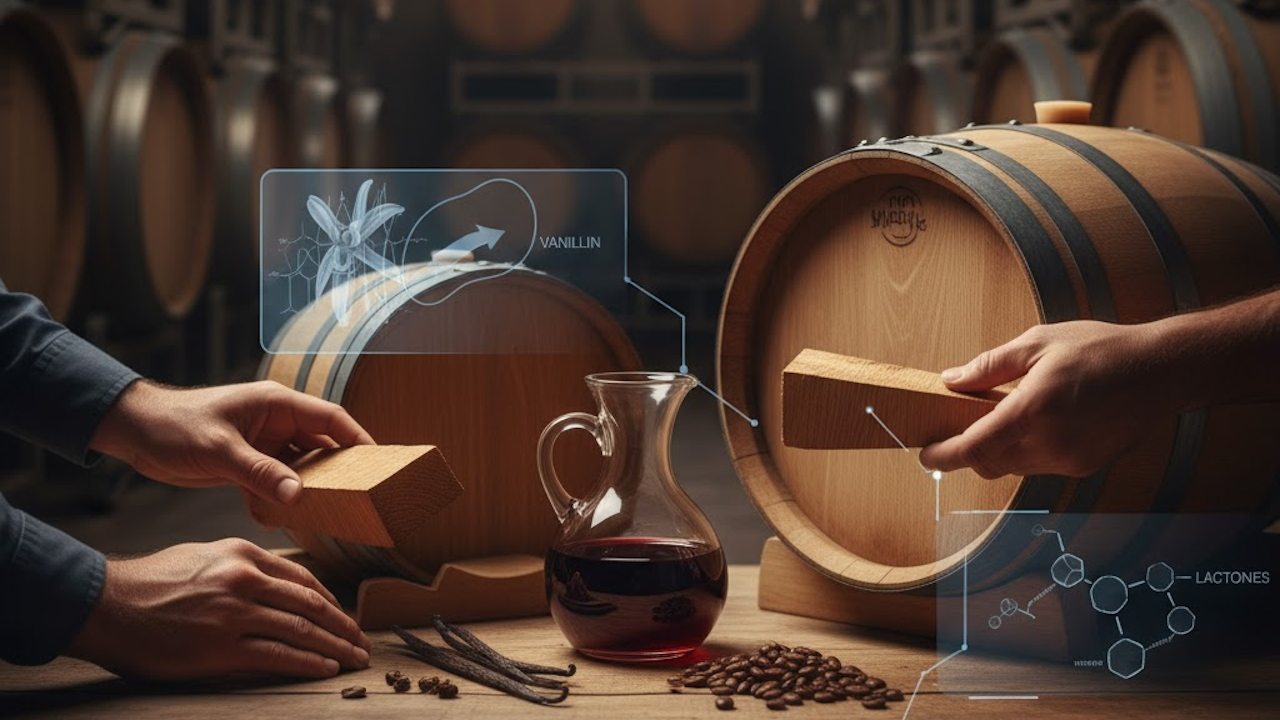
The wood itself contains cellulose, hemicellulose, and lignin. During barrel construction, toasting breaks down these components. Hemicellulose yields furans that evoke caramel and almond. Lignin releases vanillin and related phenolic compounds. Ellagitannins, a class of hydrolysable tannins unique to oak, contribute structure, antioxidant protection, and subtle astringency. These substances do not simply overlay the wine. They react with existing fruit, acid, and alcohol components, generating new aroma molecules over time. The result is greater complexity rather than a simple addition of wood notes. Used barrels impart far less flavor because most extractable compounds have already leached out, shifting their primary benefit to maturation through oxygen exchange alone.
Distinguishing Oak Varieties: French, American, and Beyond
Oak species and growing conditions create distinct flavor signatures. American white oak, primarily Quercus alba, grows quickly across the eastern United States. Its coarser grain allows faster extraction and higher porosity. This leads to pronounced vanilla, coconut, and sometimes dill like aromas from elevated levels of oak lactones, also called whisky lactones. The profile tends toward sweeter, bolder, and more immediate impact, making American oak a traditional choice for full bodied reds such as Cabernet Sauvignon, Zinfandel, or Petite Sirah in California and Australia.
French oak, drawn from Quercus petraea and Quercus robur, generally features finer grain and slower growth. Extraction proceeds more gradually, yielding subtler contributions. Winemakers often describe French oak as elegant, with spicy notes of clove, nutmeg, and cinnamon from eugenol, along with integrated toast and tea like nuances. Tannin levels can run higher in some forests, lending firm structure that integrates beautifully over long aging. Specific forests matter: Tronçais and Allier supply tight grain for refined results, while Limousin offers coarser texture and more aggressive tannins suited to certain robust styles or even spirits.
Other origins have gained attention. Hungarian oak bridges American boldness and French finesse at a lower price point. Slovenian and Russian oaks provide additional options with their own grain and compound profiles. Many producers blend barrels from multiple sources and forests within a single cuvée to achieve layered complexity. The choice depends on grape variety, desired style, and budget, with no single type universally superior.
The Craft of Barrel Production and Toasting
Barrel making remains a skilled trade combining forestry, woodworking, and fire. After felling and splitting, staves undergo lengthy seasoning, traditionally outdoors, to mellow tannins and stabilize the wood. Coopers then shape and bend the staves using heat and moisture, forming the characteristic bulge that strengthens the vessel. The interior receives toasting over open flame or through modern steam and infrared methods. Toast level dramatically alters the chemical output.
Light toasting preserves more natural wood sweetness and vanilla while adding gentle toast character. Medium toasting, the most common choice, balances caramelization with spice and integrates well with many fruit profiles. Heavy or charred toasting generates intense smoky, coffee, chocolate, and roasted notes from advanced pyrolysis of lignin and hemicellulose. It can also degrade some ellagitannins, softening astringency. Winemakers specify toast levels according to the wine’s needs. A delicate Pinot Noir might receive light or medium toast in fine grained French oak, while a powerful Syrah could benefit from heavier toast in American or coarser French wood. Different toast on the barrel heads versus staves allows further customization.
How Oak Imparts Specific Flavors and Aromas
The aromatic palette from oak is remarkably diverse. Vanillin delivers the classic vanilla bean scent, strongest in lightly toasted American oak. Oak lactones contribute coconut, woody, and creamy sensations, far more prominent in American varieties. Eugenol and related phenols supply clove, allspice, and cinnamon impressions, often more noticeable in French oak. Toasting produces furfural and related furans that suggest burnt sugar, almond, dried fruit, and toast. Guaiacol and syringol evoke smoke, bacon, or medicinal qualities in heavily toasted barrels.
These compounds interact dynamically. In red wines, oak tannins bind with anthocyanins for color stability and can paradoxically enhance perceived fruit purity by providing structural balance. In whites, oak adds body and richness that complement malolactic fermentation’s buttery diacetyl notes, creating layered impressions of hazelnut, creme brulee, or baking spice. Over time in bottle, many oak derived aromas evolve, integrating further with fruit and developing secondary nuances. Excessive or poorly matched oak, however, can dominate, drying the palate or masking varietal character. Skillful use enhances rather than overwhelms.
The Aging Process: Oxygen, Tannins, and Evolution
Barrel aging transforms wine through both addition and subtraction. Evaporation, the so called angel’s share, concentrates flavors and aromas while the wine loses volume. Smaller barrels, such as the standard 225 liter Bordeaux barrique, maximize surface to volume ratio and accelerate interaction. Larger formats or used barrels slow the process, favoring subtle maturation over intense flavor pickup. Temperature and humidity in the cellar affect extraction rates and evaporation speed. Warmer conditions hasten changes but risk over extraction or excessive loss.
Regular racking or lees stirring, known as batonnage in white winemaking, redistributes compounds and can increase mouthfeel. The duration varies widely. Some wines see only a few months in barrel to gain polish, while others remain for two or three years or more to develop profound complexity and aging potential. Oak tannins contribute to longevity by protecting against oxidation and providing a framework that evolves gracefully in bottle. Wines with well integrated oak often show greater capacity to improve over decades compared to those aged solely in inert vessels.
Oak’s Influence Across Wine Styles and Varieties
Different wines call for different oak strategies. Full bodied reds such as Cabernet Sauvignon, Merlot blends, and Syrah frequently benefit from new or mostly new French or American oak to supply structure and complementary vanilla spice layers that support black fruit and age. Lighter reds like Pinot Noir or Gamay usually receive subtler treatment, often a portion of new oak or neutral barrels, to preserve red fruit purity and earthy nuances without drying the palate.
White wines show equal variation. Chardonnay from Burgundy or California frequently sees barrel fermentation or aging in French oak to build texture and add vanilla toast dimensions that harmonize with malolactic character. In contrast, aromatic varieties such as Sauvignon Blanc, Riesling, or Albariño rarely encounter new oak, as their vibrant acidity and primary fruit aromas shine brightest in stainless steel. Premium rosés sometimes receive brief oak contact for added depth. Sparkling wines traditionally minimize new oak to maintain freshness, though some producers incorporate barrel fermented base wines for complexity. The guiding principle remains balance: oak should elevate the grape’s inherent qualities and the site’s expression rather than impose a uniform stamp.
Regional Traditions and Winemaker Choices
Winemaking regions have developed distinctive oak philosophies shaped by history, grape, and market. Bordeaux chateaux traditionally employ French oak barriques, adjusting the percentage of new wood according to vintage power and desired longevity. Burgundy producers emphasize French oak for both Pinot Noir and Chardonnay, often blending new and used barrels to respect terroir while adding finesse. In California, early reliance on American oak for bold Cabernet has shifted toward French oak or blends among many top estates seeking elegance. Australian Shiraz frequently pairs American oak’s coconut vanilla with its peppery fruit, though French oak appears in premium expressions.
Spain’s Rioja long favored American oak for Tempranillo, imparting vanilla spice that became a signature, yet modern producers increasingly incorporate French oak for fresher styles. Italy’s traditional Barolo and Barbaresco largely avoided new oak to highlight Nebbiolo’s tar, rose, and tar notes, though modernist approaches sometimes introduce judicious amounts. Emerging regions experiment freely, blending origins and formats to craft unique identities. Winemakers also decide barrel size, toast, and forest source, often working closely with coopers on custom specifications. These choices reflect both respect for tradition and responsiveness to evolving tastes.
Innovations: Oak Alternatives and Modern Practices
Traditional barrels command prestige and deliver nuanced results, yet their expense and variability have encouraged alternatives. Oak chips added during fermentation or aging deliver rapid flavor at low cost. Staves, cubes, or inserts suspended in stainless steel tanks provide greater surface area and control while allowing reuse. These formats extract faster than whole barrels and lack equivalent micro oxygenation, so producers often pair them with mechanical micro oxygenation systems to simulate barrel breathing.
Alternatives suit entry level and mid tier wines particularly well, enabling consistent oak character without tying up capital in inventory. Some high volume producers combine a portion of barrel aged wine with tank treated lots for balance. Experiments continue with different toast levels, particle sizes, and even non oak woods such as acacia for distinct nutty or floral notes. While purists maintain that nothing fully replicates the slow evolution inside a well made barrel, alternatives have matured into sophisticated tools that expand options for winemakers at every scale.
Sustainability and the Future of Oak in Wine
Forestry practices matter increasingly as demand grows. Many French forests operate under certified sustainable management, ensuring regeneration and biodiversity. American oak sources similarly emphasize responsible harvesting. Oak alternatives support sustainability by utilizing portions of the tree unsuitable for barrel staves, reducing waste and lowering overall wood consumption per liter of wine. Recycling programs for used barrels and efforts to minimize energy in cooperage further lessen environmental impact.
Climate change introduces new considerations. Warmer vintages often produce riper grapes with higher alcohol and softer tannins, sometimes requiring adjusted oak regimes to maintain freshness or structure. Consumer preferences fluctuate between oaky richness and fresher, less intervened styles. Natural wine movements frequently favor minimal or no oak to emphasize grape and place. Yet the finest examples across regions demonstrate that thoughtful oak use continues to produce wines of remarkable depth and longevity. Innovation in both traditional cooperage and alternatives ensures oak’s relevance persists.
Conclusion
Oak’s role in wine flavor encompasses far more than simple wood notes. Through centuries of refinement, it has become integral to structure, aroma development, color stability, and graceful aging. The interplay of species, forest origin, toasting, barrel age, and contact time allows winemakers extraordinary expressive range. While modern alternatives offer efficiency and accessibility, the traditional barrel retains unmatched capacity for subtle transformation. As the industry balances heritage with innovation and sustainability, oak remains a vital bridge between vine, wood, and glass. Appreciating its contributions deepens understanding of what makes wine one of the world’s most captivating beverages, connecting drinkers to both ancient craft and ongoing creativity in the cellar.