

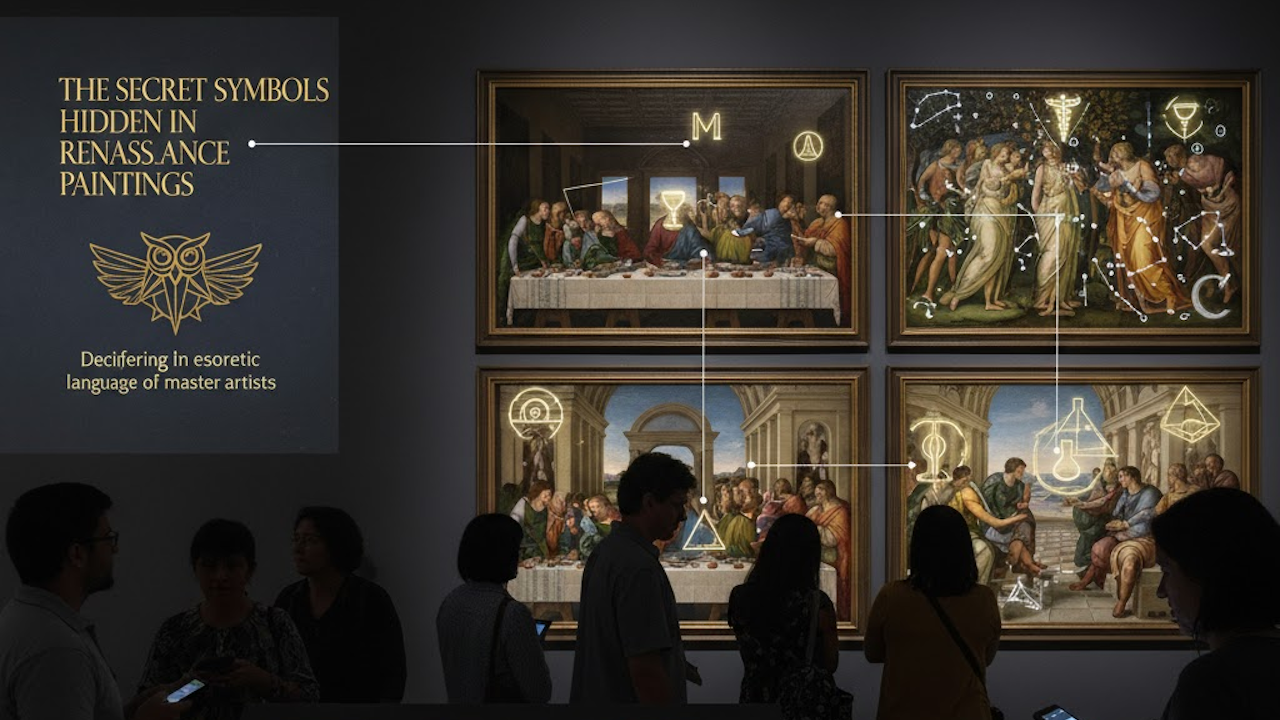
The Renaissance, spanning roughly the fourteenth to the seventeenth centuries, transformed European art through a revival of classical antiquity, the rise of humanism, and profound shifts in religious and intellectual life. Artists of this period rarely created purely decorative or literal images. Instead, they embedded layers of meaning that rewarded educated viewers with theological insights, philosophical ideas, political commentary, and personal messages. These symbols drew from Christian iconography, classical mythology, Neoplatonic philosophy, scientific observation, and contemporary events. Patrons such as the Medici family in Florence or popes in Rome expected works that flattered their status while conveying complex ideas. Direct statements sometimes risked censorship, so painters used attributes, allegories, mathematical structures, gestures, and visual puns to communicate on multiple levels.
This symbolic language made paintings function like visual texts. A single canvas could satisfy a devout viewer with its surface narrative, a humanist scholar with classical allusions, and an initiate with esoteric depths. Techniques such as linear perspective symbolized divine order and focused attention on sacred figures. Chiaroscuro and sfumato added mystery and emotional resonance. Colors carried traditional associations: blue for heavenly purity and the Virgin Mary, red for passion and the blood of Christ or martyrs, gold for divinity and earthly wealth. Animals and objects served as attributes: dogs for fidelity, lambs for Christ as the sacrificial Lamb of God, lilies for purity in Annunciation scenes, apples for original sin, pomegranates for resurrection and fertility, and peacocks for immortality because their flesh was thought incorruptible.
Neoplatonism, revived in Florence by thinkers like Marsilio Ficino, proved especially influential. It reconciled Platonic ideals of divine love and beauty with Christian theology, portraying earthly love as a ladder to spiritual contemplation. Artists and their humanist advisors wove these ideas into mythological scenes. In Northern Europe, painters developed disguised symbolism in which everyday objects carried profound spiritual weight, making the ordinary sacred. The result was art that invited prolonged contemplation rather than quick glances.
Leonardo da Vinci exemplified the integration of science, psychology, and symbolism. His fresco The Last Supper, painted between 1495 and 1498 for the refectory of Santa Maria delle Grazie in Milan, captures the dramatic moment when Jesus announces that one apostle will betray him. Leonardo arranged the twelve apostles in four groups of three, evoking the Trinity while allowing vivid interactions that reveal individual characters and emotional responses. Linear perspective draws every line of the ceiling, walls, and table toward a vanishing point near Christ’s head or right temple, making him the undeniable spiritual and compositional center. The window behind Jesus floods the scene with natural light, serving in place of a traditional halo and emphasizing both his divinity and his impending human suffering.
Judas appears in the group to Christ’s right, clutching a money bag containing the thirty pieces of silver, reaching for the same dish as Jesus in a gesture identifying the betrayer according to the Gospels, and having spilled a salt cellar. Spilled salt traditionally signified bad luck or broken trust, reinforcing the theme of betrayal. A knife rests in the hand of the apostle often identified as Peter, possibly foreshadowing violence during the Passion or Peter’s impulsive defense of his master. The bread and wine on the table clearly prefigure the Eucharist that Jesus institutes moments later. Some scholars have noted possible wordplay in the fish on the table. In Italian dialects of the period, words for eel or herring sounded similar to terms for indoctrination or denial of faith, perhaps alluding subtly to heresy or the gravity of the announcement. Leonardo avoided conventional halos and relied on naturalistic drama, gesture, and light to convey sanctity. The painting’s experimental oil technique on dry plaster led to rapid deterioration, yet its psychological depth and symbolic density remain unmatched.
Leonardo’s Mona Lisa, begun around 1503, presents a more intimate mystery. The subject’s smile, softened by sfumato blending, suggests inner serenity and the “motions of the mind” that Leonardo sought to portray. The winding landscape behind her, with its paths, bridges, and atmospheric haze, may evoke the journey of life or the harmony between human experience and natural cycles. While popular modern theories have proposed hidden codes or androgynous readings, scholarly interpretations emphasize the portrait’s masterful balance of realism and idealization.
The Vitruvian Man drawing of around 1490 distills Renaissance ideals into geometric symbolism. Leonardo based the figure on the ancient Roman architect Vitruvius, inscribing a perfectly proportioned male body within both a circle and a square. The circle represents the divine, celestial, and infinite; the square stands for the earthly, material, and stable. Man becomes the microcosm that mirrors the macrocosm, bridging heaven and earth through harmonious proportions that include the golden ratio. This image encapsulates the era’s belief that mathematical beauty reveals universal order and that the human form embodies divine proportion.
Sandro Botticelli brought Neoplatonic philosophy vividly to life under Medici patronage. His Birth of Venus, painted in the mid-1480s, transforms the classical myth into an allegory of divine love and beauty. The goddess stands nude on a large scallop shell, born from sea foam after Uranus’s castration. The shell serves both as her miraculous vehicle and, in allegorical terms, as a symbol of generative and spiritual rebirth. Zephyrus, the west wind, and the nymph Chloris embrace on the left, blowing Venus toward shore while scattering roses that represent love and spring’s renewal. On the right, one of the Horae awaits with a cloak embroidered with flowers to clothe the goddess, symbolizing the welcoming of divine beauty into the world. The orange grove in the background, heavy with golden fruit, directly references the Medici emblem and their self-image as patrons of a new golden age. Contemporary viewers steeped in Neoplatonism would have seen Venus as both earthly and celestial love, lifting the soul toward contemplation of the divine.
Botticelli’s Primavera, or Spring, painted slightly earlier, offers an even richer tapestry of meaning within another orange grove. Mercury stands at the left, using his caduceus to dispel clouds and bring clarity. The Three Graces dance gracefully in the center, embodying beauty, charm, and the creative virtues celebrated in Neoplatonic thought. Venus presides beneath a myrtle tree sacred to her, while blindfolded Cupid hovers above, shooting an arrow of love. On the right, Zephyrus pursues Chloris, who transforms into the flower-crowned Flora scattering blossoms. This progression illustrates love’s civilizing journey from raw desire through beauty to fertile abundance. Scholars interpret the painting as celebrating marriage, the Medici golden age, or the soul’s ascent through love and reason. Every botanical detail carries layered significance tied to seasons, virtues, and classical texts.
Michelangelo Buonarroti infused his vast frescoes with anatomical knowledge, emotional intensity, and occasional personal commentary. The Sistine Chapel ceiling, painted between 1508 and 1512 for Pope Julius II, presents a sweeping Genesis narrative framed by prophets, sibyls, and powerful ignudi. In the celebrated Creation of Adam, God the Father reaches dynamically toward the reclining first man, their fingers nearly touching to convey the spark of life and divine intellect. The swirling drapery and attendant figures around God have prompted some observers, including medical researchers, to note a resemblance to the human brain, with the extended arm suggesting neural pathways. Whether intentional or not, the resemblance underscores Michelangelo’s deep anatomical study as a means of symbolizing the animation of matter by spirit. The ignudi represent ideal human form and prelapsarian perfection. Prophets and sibyls blend biblical and classical wisdom, embodying the Renaissance synthesis of traditions.
On the altar wall, the Last Judgment fresco completed between 1536 and 1541 contains a famous act of artistic revenge. Biagio da Cesena, the papal master of ceremonies who protested the nudity in the work, appears as Minos, the judge of the underworld, complete with donkey ears symbolizing foolishness and a serpent biting his genitals. This personal insertion within a scene of universal resurrection and damnation demonstrates how Michelangelo used symbolism to comment on contemporary figures while advancing the larger theological drama. The flayed skin held by Saint Bartholomew has sometimes been read as a veiled self-portrait, evoking the suffering artist or the soul stripped bare before God.
Raphael’s School of Athens, frescoed between 1509 and 1511 in the Vatican’s Stanza della Segnatura for Pope Julius II, personifies Philosophy as a harmonious gathering of ancient thinkers within a grand architectural setting inspired by Bramante. At the center, Plato, often given the features of Leonardo da Vinci and holding the Timaeus, points upward to the realm of ideal forms. Beside him, Aristotle points downward to the empirical world while holding his Ethics. This visual contrast celebrates the complementary strengths of idealism and realism in Renaissance thought. Surrounding figures include Socrates, Pythagoras with a tablet of harmonic proportions, Euclid demonstrating geometry (possibly portrayed with the features of Bramante), Ptolemy and Zoroaster with a celestial globe, and Diogenes the Cynic lounging casually. The melancholy figure of Heraclitus, seated in the foreground, is widely identified as a portrait of Michelangelo, paying tribute to his intense rival. On the far right, Raphael inserted his own self-portrait among the group, gazing outward and claiming his place among the intellectual giants. The fresco functions as both a celebration of classical revival and a statement of the living Renaissance as its worthy heir.
Northern European masters developed their own sophisticated symbolic systems. Jan van Eyck’s Arnolfini Portrait of 1434 stands as a masterpiece of disguised symbolism. The double portrait of Giovanni Arnolfini and his wife, possibly recording a marriage or betrothal, fills an ordinary interior with sacred meaning. The couple’s joined hands and the man’s raised right hand suggest a formal vow. A loyal dog at their feet represents fidelity. A single lit candle burns in the chandelier, signifying God’s all-seeing presence and the sanctity of the union. The convex mirror on the rear wall reflects the room and two entering figures who serve as witnesses, possibly including the artist himself; its frame contains ten scenes from the Passion of Christ, linking the earthly contract to Christ’s sacrifice. The Latin inscription above the mirror states that “Jan van Eyck was here” in 1434, positioning the painter as a legal witness. The man’s removed wooden clogs indicate either holy ground or the intimate domestic sphere made sacred by the ceremony. Oranges and luxurious furnishings speak of wealth, fertility, and status. Every seemingly mundane detail elevates the scene to a sacramental statement about marriage, fidelity, and divine witness.
Hans Holbein the Younger’s The Ambassadors of 1533 balances worldly achievement with a stark reminder of mortality. Two French diplomats stand amid globes, scientific instruments, books, and a lute with a broken string symbolizing discord or death interrupting harmony. Yet an anamorphic skull stretches distorted across the foreground, legible only when viewed from a sharp side angle or with optical aid. This memento mori asserts that death ultimately claims even the most learned and powerful, tempering Renaissance pride in knowledge with Christian humility.
These examples illustrate broader techniques that amplified symbolism across the period. Linear perspective created convincing space while directing the viewer’s gaze and evoking rational, divine order. Geometric proportions and musical ratios reflected beliefs in cosmic harmony. Hidden portraits of patrons, artists, or contemporaries added layers of flattery or commentary. Political symbols, such as David or Hercules representing Florentine republican strength, appeared alongside religious narratives.
Interpretations have evolved and sometimes sparked controversy. Many symbols rest on firm ground documented in contemporary treatises, contracts, and iconographic traditions. Others remain more speculative. Popular works of fiction have promoted ideas such as Mary Magdalene seated beside Jesus in the Last Supper or elaborate secret codes, yet most art historians find little supporting evidence in primary sources and view such readings as modern projections. Technical analyses, including studies of the crystal orb in Leonardo’s Salvator Mundi or possible anatomical references in Michelangelo’s work, add fascinating dimensions without overturning established meanings. Restorations have sometimes clarified details and colors, while damage has obscured others.
The legacy of these hidden symbols endures because they transform viewing into an active, intellectual engagement. A Renaissance painting was never meant to be consumed at a glance. It invited the beholder to recognize attributes, trace allegorical narratives, appreciate mathematical harmonies, and ponder contemporary allusions. In doing so, the artworks embodied the era’s central tensions and achievements: the reconciliation of faith and reason, the revival of antiquity, the celebration of human potential, and the search for order amid profound change.
Today these paintings continue to reward close attention. They remind us that great art operates on multiple registers simultaneously and that meaning often lies beneath the surface, accessible to those willing to look deeply and think carefully. The secret symbols of the Renaissance thus remain alive, bridging centuries and inviting each new generation to unlock their enduring wisdom about beauty, knowledge, love, mortality, and the divine.