

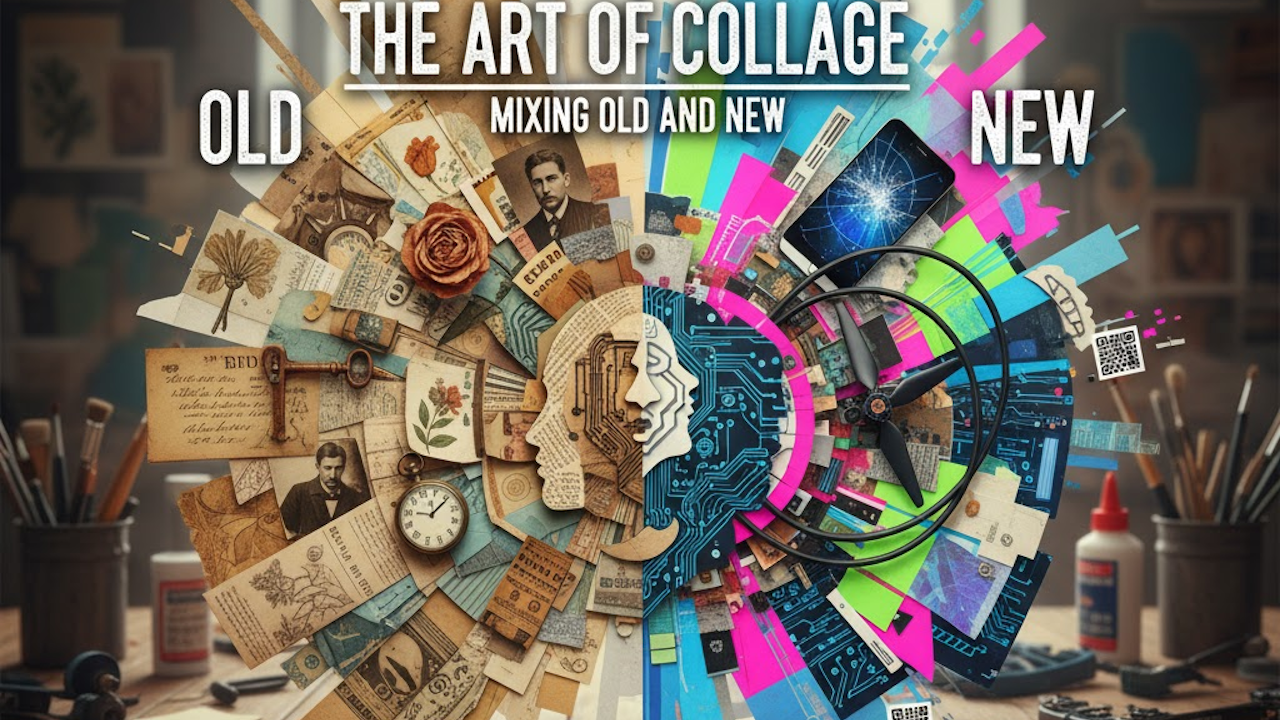
Collage occupies a unique position in the visual arts. It thrives on assembly rather than invention from scratch. Artists gather fragments, whether physical or digital, and arrange them into compositions that speak across time. The practice gains much of its strength from the deliberate mixing of old and new. Yellowed newspaper clippings sit beside crisp contemporary photographs. Faded fabric swatches share space with freshly printed graphics. This combination creates tension, harmony, and fresh meaning. Viewers encounter not a single era but a conversation between eras. The result feels alive because it refuses to belong to one moment alone.
The appeal of such mixing runs deep. Human experience itself layers past and present. Memories surface alongside current events. Personal objects from childhood rest near the tools of adult life. Collage externalizes this layering. It turns private reflection into public image. At the same time, the technique comments on culture at large. Mass media from earlier decades can be repositioned to critique the media of today. Vintage patterns can be disrupted by modern typography to question taste and progress. In every case, the old material gains new resonance through its new companions. The new material, in turn, acquires depth from its historical neighbors.
Early experiments with collage emerged in the years before the First World War. Cubist artists sought to break the illusion of a single viewpoint. They wanted to show objects from multiple angles at once. Pablo Picasso and Georges Braque began pasting real materials onto their canvases around 1912. Picasso included a piece of oilcloth printed with a chair caning pattern in one still life. The fabric was ordinary, yet it entered the realm of fine art. Braque used wallpaper and newspaper fragments. These additions introduced actual texture and text from daily life. The old craft of chair making met the new language of modern painting. The boundary between art and the surrounding world grew porous.
This step mattered enormously. Traditional painting had aimed for seamless representation. Collage declared that seams could be visible and meaningful. The pasted elements reminded viewers that art is constructed. It also brought the street into the studio. Newspapers carried reports of current politics and culture. When artists cut them into shapes and glued them down, they mixed the immediacy of journalism with the slower pace of artistic contemplation. The result challenged viewers to read the work on several levels at once. Visual form and verbal content interacted. The old technique of still life painting absorbed the new reality of printed mass media.
Dada artists pushed the approach further during and after the war. They rejected the values that had led to global conflict. Photomontage became their weapon. Hannah Hoch cut photographs from illustrated magazines and rearranged them into dense, unsettling scenes. Her large work from 1919 combined images of dancers, politicians, and industrial machinery. The old photographs, already circulating in popular culture, acquired new power through unexpected pairings. A woman’s face might float above a machine part. A child’s body could appear beside a military helmet. These juxtapositions exposed contradictions in Weimar society. Gender roles, technology, and authority clashed within single frames.
John Heartfield took photomontage into direct political battle. He created posters and magazine covers that attacked rising fascism. One famous image placed Adolf Hitler’s head on a body whose chest was an x ray revealing a spine made of coins. The old documentary power of photography served new satirical ends. Heartfield reused existing pictures of leaders and crowds. He mixed them with symbols of greed and violence. The technique required no drawing skill, only scissors, glue, and sharp observation. Anyone could, in principle, make such work. This accessibility became part of its radical message.
Surrealist artists explored the unconscious through similar means. Max Ernst developed methods that treated collage as a form of automatic writing. He cut engravings from nineteenth century books and combined them into dreamlike sequences. His collage novels presented Victorian domestic scenes invaded by impossible creatures. A drawing room might contain a giant bird. A family gathering could feature a floating skeleton. The old illustrative style carried the authority of tradition. When Ernst placed it in new, illogical contexts, the authority dissolved into wonder and unease. Viewers experienced the shock of the familiar turned strange.
Joseph Cornell worked in three dimensions. He filled shallow wooden boxes with small objects and images. Old maps, marbles, and photographs shared space with new arrangements that suggested travel, astronomy, or childhood memory. The boxes mixed the intimacy of private collections with the scale of museum display. Cornell’s work showed that collage need not remain flat. It could become architecture for the mind. Viewers peered into the boxes as if looking through windows into other times.
After the Second World War, Pop artists embraced the flood of commercial imagery. Eduardo Paolozzi assembled collages from American magazines that had reached Britain. His 1947 piece combined pin up photographs, military aircraft, and product advertisements. The old world of European art met the new consumer culture arriving from across the Atlantic. Richard Hamilton created a famous interior scene in 1956. He gathered images of a muscular man, a television, a canned ham, and a vacuum cleaner. The composition mixed the language of fine art with the language of advertising. Viewers recognized both and saw how they shaped each other.
Peter Blake took the approach to a monumental scale for the cover of the Beatles album Sgt. Pepper’s Lonely Hearts Club Band. He gathered dozens of figures, some historical and some contemporary, into a crowd scene. Wax museum figures stood beside living musicians. The old and the new mingled as if at a single gathering. The cover became an icon of the 1960s precisely because it refused to choose one era. It celebrated the pleasure of mixing.
Digital technology transformed collage once again. Scanners and software allowed artists to capture fragile old materials without damaging them. A nineteenth century botanical print could be layered with a photograph taken yesterday. Blending modes in editing programs created effects impossible with physical glue. Transparency let old text show through new images. Color adjustments could make a modern photograph feel aged or a vintage one feel current. Artists began working across platforms. Some scanned physical collages and continued refining them on screen. Others printed digital experiments and added hand drawn marks or additional physical layers.
This hybrid practice suits the present moment. Archives of public domain images grow larger every year. Old magazines and books enter the digital realm through scanning projects. At the same time, new creation tools multiply. Artists can generate elements with code or combine personal photographs with stock imagery. The mixing of old and new becomes both easier and more deliberate. An artist might begin with a background of aged ledger paper. Over it, they place a digital rendering of a city skyline from this year. The contrast between the paper’s texture and the clean lines of the skyline creates visual rhythm. It also raises questions about how cities and records endure or change.
Contemporary artists continue to explore these possibilities in diverse ways. Some build large scale works from layered posters and advertisements collected over years. The old posters carry the patina of time and weather. New additions comment on current events. Other artists work at intimate scale. They place a single old family snapshot beside a new drawing that reimagines the scene. The personal past meets the present act of reinterpretation. Still others incorporate sound or moving images. An old film clip might play inside a physical collage frame while new graphics animate across a screen. The boundaries between media grow less important than the act of combination itself.
Practical techniques for mixing old and new remain rooted in simple actions. An artist begins by gathering materials. Old sources might include magazines from past decades, family letters, maps, sheet music, or fabric remnants. New sources might include recent photographs, printed screenshots, hand drawn elements, or digitally designed shapes. The key is variety in age, texture, and origin. Once materials are collected, the artist cuts or tears them into workable pieces. Tearing produces softer edges that can feel organic against the sharp lines of printed graphics.
Arrangement comes next. Many artists lay pieces out without adhesive first. They shift elements until relationships emerge. An old portrait might gain new meaning when a modern building rises behind it. A fragment of text from an old advertisement might comment on a new photograph of consumer goods. Scale matters. A small vintage image can be surrounded by larger new shapes to create focus. Or a large old background can support many small new details. Color and value guide the eye. Warm tones from aged paper can be balanced by cool tones from recent prints. Contrast in texture keeps the surface lively. Rough paper against smooth photographic paper creates tactile interest even when viewed from a distance.
Adhesion requires care. Glue should not wrinkle delicate old paper. Some artists use archival adhesives that remain reversible. Others accept slight distortion as part of the work’s character. After the main elements are down, further additions can unify or disrupt. Paint, pencil, or digital marks can bridge gaps between old and new sections. A final layer of medium can protect the surface while slightly altering sheen. Throughout the process, the artist remains alert to the dialogue between eras. The goal is not to hide the seams but to make them eloquent.
The deeper significance of this mixing extends beyond technique. Collage mirrors how memory works. We do not recall events in isolation. We remember them through fragments that arrive out of order. An old song triggers a recent conversation. A childhood object appears in a dream alongside current worries. Collage gives visual form to this nonlinear experience. It also models cultural memory. Societies carry forward images, stories, and objects from earlier times. These inheritances are constantly reinterpreted. By placing old and new side by side, collage artists make that process visible and open to question.
Sustainability adds another layer of meaning. Physical collage often reuses what would otherwise be discarded. Old magazines, damaged books, and leftover paper find new purpose. The act of rescue itself becomes part of the statement. In a culture of rapid replacement, collage insists on continuation. Digital collage can extend the same principle. Artists can work with scans of fragile items rather than the originals, preserving the source while still creating something fresh. The mixing of old and new thus carries an ethical dimension. It suggests that value lies not only in novelty but in thoughtful recombination.
Accessibility remains one of collage’s greatest strengths. The basic tools, scissors, glue, and a surface, cost little. Source material surrounds most people. Old calendars, postcards, and packaging arrive in daily life. New images arrive through phones and computers. Anyone can begin. Classrooms use collage to teach visual thinking and historical awareness. Students might combine images from a studied period with their own contemporary additions. The exercise makes history feel active rather than distant. Community workshops bring people together to share materials and stories. The resulting works reflect collective memory as well as individual vision.
In professional contexts, collage continues to influence graphic design, illustration, and fine art. Album covers, book jackets, and advertising campaigns often employ layered imagery that mixes periods. The approach signals richness and complexity. Viewers sense that the message draws from multiple sources. In galleries, collage appears in solo exhibitions and group shows. Artists push the form with new materials such as resin, metal leaf, or projected light. The core impulse, however, stays constant. Something from before meets something from now. The meeting generates surprise and insight.
The psychological rewards of making collage deserve attention. The process encourages slow looking. An artist must examine each fragment for its potential. This attention can feel meditative. Decisions about placement involve both intuition and analysis. The work rewards patience. It also allows for play. Mistakes can become discoveries. A piece that seemed wrong in one position may prove perfect in another. This flexibility suits the theme of mixing old and new. Nothing is fixed until the artist decides it is. Even then, further layers can alter the whole.
For viewers, the rewards are equally rich. A successful collage invites extended attention. The eye travels across the surface, assembling relationships. Each discovery changes the overall impression. An old element might first seem nostalgic. When seen next to its new companions, it may appear critical or ironic. The work resists quick summary. It asks for time and rewards it. In an age of rapid image consumption, this demand for sustained looking feels valuable.
Collage also offers a model for thinking about tradition and innovation more broadly. Every field inherits materials from the past. Science builds on earlier experiments. Literature rewrites earlier stories. Music samples earlier recordings. Collage makes this process literal and visible. It shows that originality often consists of new arrangements rather than entirely new elements. The courage to mix what others keep separate becomes a creative act in itself.
Looking ahead, the possibilities continue to expand. New technologies will offer fresh ways to capture and combine old materials. Artificial intelligence tools already assist in generating elements that can be integrated with historical sources. Yet the fundamental choice remains human. The artist decides which old fragment deserves new life and which new element gains meaning from historical company. That decision carries responsibility and freedom.
The art of collage, at its best, celebrates connection. It refuses the isolation of any single moment. By mixing old and new, it creates spaces where different times can speak to one another. The resulting works remind us that the past is not sealed away. It remains available for reinterpretation. The present, likewise, gains perspective when placed in dialogue with what came before. In this ongoing exchange lies the enduring vitality of collage. It is an art of fragments that becomes an art of wholeness through the very act of assembly. Each new piece adds to a tradition that is itself a continuous mixing of what has been and what is yet to come.