

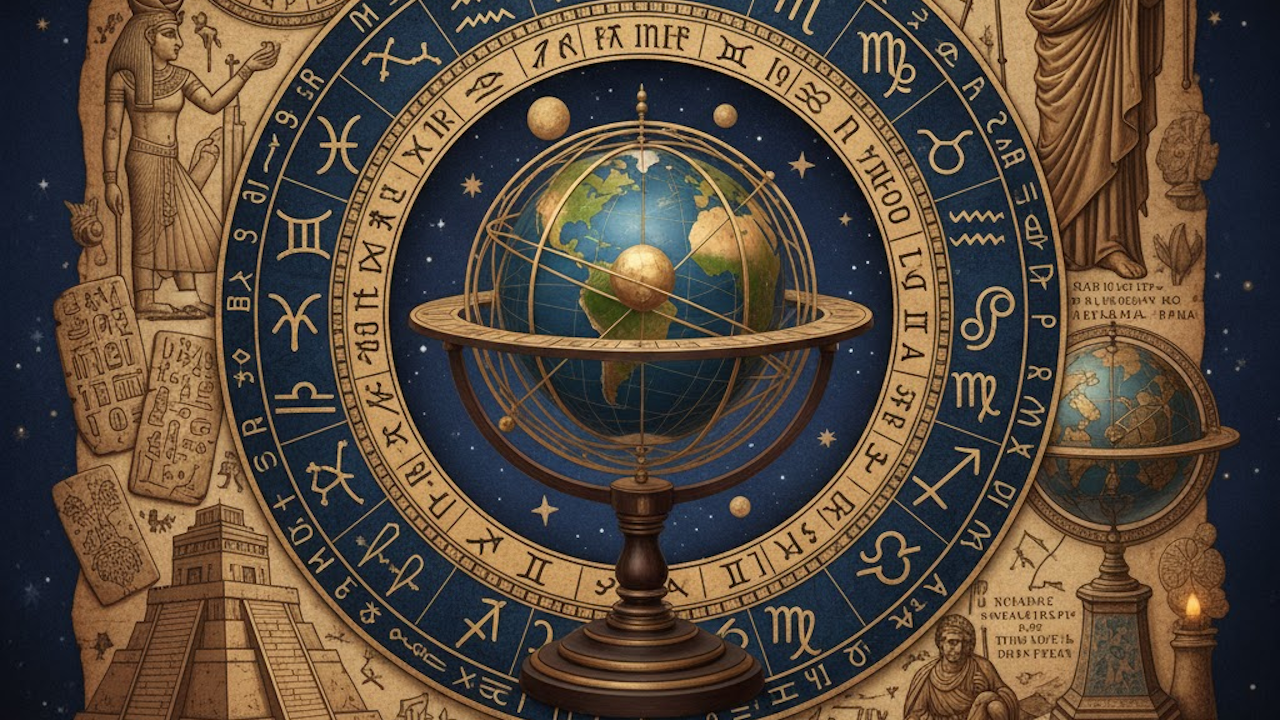
Astrology represents one of humanity’s earliest systematic attempts to understand the relationship between the heavens and life on Earth. Ancient peoples observed the predictable yet awe-inspiring movements of the sun, moon, planets, and stars. They wove these observations into myths, calendars, and divination practices. Far from mere superstition, astrology served practical purposes across civilizations. It guided agriculture, medicine, politics, warfare, religious rituals, and personal decisions. It offered a sense of order in a world full of uncertainty. The practice began in Mesopotamia and spread, adapted, and evolved as cultures exchanged ideas through trade, conquest, and scholarship.
The earliest organized system emerged in ancient Mesopotamia, particularly among the Babylonians. Roots trace to Sumerian omen traditions in the third millennium BCE, but the first clear evidence of structured celestial divination appears in the Old Babylonian period around 1800 BCE. By the sixteenth century BCE, scribes had compiled the monumental Enuma Anu Enlil, a series of roughly seventy cuneiform tablets containing about seven thousand omens. This text formed the core reference for interpreting celestial events as divine messages from the gods. Planets represented specific deities: Jupiter stood for Marduk, Venus for Ishtar, Mars for Nergal, and so on. The sun and moon also carried divine significance as Shamash and Sin.
Babylonian astrology focused initially on mundane concerns, meaning predictions for the state, the king, weather, harvests, and major events rather than individual lives. Astrologers, often priest-scribes known as bārû or inspectors, watched the skies nightly from temple towers. They recorded positions, eclipses, conjunctions, and unusual phenomena. They cross-referenced these against the omen collections using rules built from centuries of observed correlations and sometimes wordplay or symbolic associations. For example, a new moon rising under a cloudy sky might foretell victory or abundant rain, while an unexpectedly early new moon could signal defeat, cattle deaths, or poor crops. Lunar eclipses carried especially heavy weight. One report to King Esarhaddon around 672 BCE linked an eclipse to an impending flood and recommended a ritual substitute: the king would symbolically cut a dike in the night to avert real disaster.
The welfare of the king equaled the welfare of the nation. High-ranking officials, including the king himself, received regular astrological reports. Kings such as Ashurbanipal in the seventh century BCE maintained teams of astrologers who sent daily updates on planetary movements to inform political and administrative choices. When omens appeared unfavorable, the court performed apotropaic rituals, substitute sacrifices, or other magical countermeasures to neutralize the threat. Astrology intertwined deeply with religion because celestial events reflected the gods’ moods and intentions toward humanity.
Over time, Babylonian practice advanced. By the fourth century BCE, mathematical astronomy allowed accurate predictions of planetary positions, producing ephemerides or tables of future locations. The twelve-sign zodiac took shape as a division of the ecliptic into twelve equal thirty-degree segments, each associated with a constellation along the sun’s apparent path. This innovation, refined after the fall of the Babylonian empire, enabled more precise horoscopic techniques. Natal astrology, or genethlialogy, emerged around the sixth or fifth century BCE. Scribes cast charts for individuals based on the positions of planets at birth or conception. While state concerns remained paramount, personal horoscopes became available even to ordinary people in later periods.
Agriculture benefited directly. Celestial cycles helped time planting, harvesting, and water management in the flood-prone Tigris and Euphrates valleys. Seasonal symbols in early omen lists reminded communities of appropriate tasks such as sowing crops, gathering shellfish, fishing, hunting, and protecting young animals. Eclipse predictions and planetary warnings allowed preparation for potential disruptions to food supplies. Astral medicine also developed, with remedies sometimes timed to specific zodiacal days or involving symbolic substances linked to planets and signs.
Ancient Egypt developed its own astral traditions independently, though later interactions occurred. From the third millennium BCE, Egyptians tracked stars to create a 365-day civil calendar and to predict the annual Nile inundation, which was vital for agriculture. The heliacal rising of Sirius, called Sopdet or Sothis and associated with the goddess Isis, marked the flood’s expected arrival and reset the calendar. Star clocks or diagonal star tables appeared on coffin lids and tomb ceilings as early as the First Intermediate Period. These charts divided the night into hours using thirty-six decans, groups of stars that rose sequentially every ten days or so. Priests used simple instruments like the merkhet (a plumb line) and bay (a sighting tool) to observe when certain stars culminated or crossed the meridian.
Decans served timekeeping for rituals and temple duties more than personal prediction in early periods. Astronomy held profound religious meaning. Pyramids aligned with stars, and temple axes sometimes oriented toward solstices or important risings. The dead, especially kings, were believed to join the imperishable stars or become associated with specific celestial bodies. The Book of Nut described cosmic movements, and temple libraries contained texts on fixed stars, planetary positions, and conjunctions used to schedule festivals and determine auspicious moments.
After the Persian conquest of Egypt in 525 BCE and especially under Ptolemaic rule following Alexander the Great’s arrival in 332 BCE, Egyptian decanic astrology merged with Babylonian zodiacal and planetary systems in the cosmopolitan environment of Alexandria. This synthesis contributed to the birth of horoscopic astrology. The famous Dendera Zodiac, carved in the first century BCE, reflects this blended tradition with its familiar signs and decans. Priests continued observing the skies, now incorporating more predictive elements alongside traditional timekeeping and religious functions. Agricultural planning remained tied to stellar and solar cycles, while medical practices occasionally drew on astral timing in later periods.
The Greeks encountered and transformed these Eastern traditions. Exposure increased dramatically after Alexander’s conquests opened pathways of cultural exchange. Around 280 BCE, the Babylonian priest Berossus taught astrology on the island of Kos, helping transmit cuneiform knowledge into Greek. Hellenistic astrology emerged as a sophisticated system combining Babylonian omen techniques and zodiac with Egyptian decans and Greek philosophical frameworks. Key texts such as the Yavanajataka later reflected this Indo-Greek synthesis, but the foundational Western codification came from Claudius Ptolemy in the second century CE. His Tetrabiblos organized astrology into a coherent body of knowledge covering planets, zodiac signs, houses, and aspects.
Hellenistic astrologers practiced several branches. Genethlialogy interpreted birth charts to describe character, career prospects, health, and major life events. Catarchic astrology selected auspicious times to begin enterprises. Horary astrology answered specific questions based on the chart cast at the moment of inquiry. Mundane astrology addressed collective events such as wars, plagues, or dynastic changes. Astrologers served at royal courts; Thrasyllus advised Emperor Tiberius, and Augustus used astrological symbolism to bolster his legitimacy. In the broader Roman world, astrology influenced daily decisions among elites and commoners alike. Women consulted Chaldeans (a term for astrologers) for personal matters, a practice satirized by writers like Juvenal.
Medical astrology flourished. The system of melothesia assigned zodiac signs or planets rulership over body parts, guiding diagnosis and treatment timing. Galen incorporated astrological ideas into humoral medicine. Philosophically, Stoics embraced astrology as evidence of cosmic determinism and fate, while skeptics like Cicero critiqued it in De divinatione. Despite occasional imperial bans when astrologers seemed to threaten the throne, the practice remained widespread. Court astrologers helped emperors choose military campaigns or successors, and ordinary people sought guidance on marriages, journeys, and business ventures.
Indian astrology, known as Jyotisha or Vedic astrology, possesses ancient indigenous roots within the Vedas and the auxiliary Vedanga sciences. Early texts tracked solar and lunar motions for calendrical purposes, including a five-year intercalation cycle preserved in the Vedanga Jyotisha. The Bhrigu Samhita, attributed to the sage Bhrigu, one of the Saptarishis linked to the stars of Ursa Major, became a vast repository of horoscopic knowledge.
Systematic horoscopic astrology in India shows clear influence from Hellenistic sources transmitted through Indo-Greek contacts around the second century BCE or later. Texts such as the Yavanajataka of Sphujidhvaja represent translations and adaptations of Greek works. Indian astrologers developed distinctive features including the twenty-seven nakshatras or lunar mansions, planetary periods called dashas, and elaborate systems for assessing compatibility in marriage through kundli matching. Jyotisha formed an integral part of Hindu life. It determined muhurtas, or auspicious timings, for rituals, weddings, house construction, and journeys. Predictions covered health, wealth, career, children, and longevity. Remedies often involved gemstones, mantras, charitable acts, or pujas to mitigate unfavorable planetary influences. Astrology aligned with broader concepts of karma and dharma, providing a map of one’s destined path while allowing for remedial action.
Chinese astrology developed largely independently, rooted in native observations and cosmology rather than direct borrowing from the West, although some later exchanges occurred. The system matured during the Han dynasty (206 BCE to 220 CE) but drew on earlier traditions visible in Shang dynasty oracle bones from the second millennium BCE. These bones record divinations that sometimes referenced celestial phenomena. The Chinese zodiac of twelve animals, the ten heavenly stems, and twelve earthly branches combined to form a sixty-year cycle. The five elements or phases (wood, fire, earth, metal, water) known as Wu Xing interacted dynamically with these cycles.
Imperial astrologers held high status. The emperor alone possessed the right to consult the stars for major decisions affecting harvests, warfare, or dynastic legitimacy. Heaven sent auspicious or inauspicious signs; wise rulers responded accordingly. Astrology helped determine the mandate of heaven and predict or explain the rise and fall of dynasties. Personal fate analysis, later formalized as the Four Pillars of Destiny or Bazi, examined the year, month, day, and hour of birth to assess character and life trajectory. Auspicious dates governed nearly every significant activity: marriages, business launches, burials, military campaigns, and festivals. Traditional Chinese medicine incorporated astrological timing and elemental correspondences between organs, seasons, and celestial influences. Farmers and officials used lunar and solar cycles to plan agricultural work, while court astronomers maintained detailed records that supported both practical calendars and divinatory interpretations.
Mesoamerican cultures, especially the Maya, created extraordinarily sophisticated calendrical and divinatory systems. The Maya refined calendars used across the region by earlier peoples such as the Olmecs and Zapotecs. Two primary cycles dominated: the 365-day Haab solar calendar for agricultural and civil matters, and the 260-day Tzolk’in sacred calendar for rituals and divination. These meshed in the 52-year Calendar Round. A Long Count tracked extended historical periods.
Daykeepers or Ajq’ij interpreted the Tzolk’in. Each day carried a specific sign and number that influenced events and personalities. On the fifth day after a child’s birth, priests cast a horoscope to determine the infant’s likely profession, such as soldier, priest, or even sacrificial victim. Venus held particular importance; its cycles, meticulously recorded in codices like the Dresden Codex, helped time military campaigns known as “star wars.” Eclipses and other phenomena carried prophetic weight. Astrology guided maize planting and harvesting through alignment with solar and stellar cycles. Rituals, including offerings and ceremonies for rain and fertility, followed precise calendrical schedules. Rulers consulted diviners before major undertakings, and celestial events helped legitimize or challenge political authority. The integration of astronomy, divination, and religion created a comprehensive worldview in which time itself possessed sacred power.
Across these diverse cultures, astrology functioned as more than prediction. It provided a shared language for discussing fate, divine will, and cosmic order. Priest-astronomers formed an educated elite responsible for observation, record-keeping, and interpretation. Their work demanded precision and accumulated empirical knowledge that later contributed to the separation of astronomy as a distinct science. Agriculture depended on celestial timing for survival in river valleys, monsoon regions, and rain-fed highlands alike. Medicine drew on astral correspondences to diagnose and treat illness. Politics and warfare incorporated omens and auspicious timings because leaders sought every possible advantage. Personal guidance helped individuals navigate marriage, career, health, and misfortune within culturally accepted frameworks.
Transmission occurred through conquest, trade, and scholarly migration. Babylonian techniques reached Egypt, Greece, India, and beyond. Hellenistic synthesis in Alexandria produced the system that shaped Western astrology for centuries. Chinese traditions remained more self-contained yet influenced neighboring regions. Mesoamerican systems evolved in isolation until European contact. In every case, astrology adapted to local myths, philosophies, and social structures while retaining core ideas of celestial influence.
By late antiquity, astrology had become a global intellectual tradition. It survived the rise of monotheistic religions, occasional persecutions, and the gradual emergence of empirical science. Its history demonstrates humanity’s enduring desire to find meaning and predictability in the stars. Ancient cultures used astrology not only to foretell the future but to organize time, sustain life, legitimize power, heal the sick, and connect the earthly realm with the divine. The practice reflected both profound observation of nature and the creative human impulse to interpret the cosmos. Its legacy continues to echo in calendars, seasonal festivals, and cultural attitudes toward fate and free will even today.