

The beauty industry has never stood still. It evolves through breakthroughs in chemistry, shifts in cultural attitudes, technological advances in application, and bold business moves that expand access and representation. Certain products did more than sell well. They redefined categories, solved longstanding problems, influenced competitors, and altered consumer expectations for decades. From the matte foundations that rescued Technicolor films to serums that put clinical ingredients in everyone’s bathroom cabinet and foundations that finally matched a full spectrum of skin tones, these innovations turned beauty from an elite or theatrical pursuit into a daily ritual of self-expression and care. This article examines the landmark products that reshaped makeup, skincare, hair care, and the very way the industry operates.
Max Factor’s Pan-Cake Makeup: Solving Hollywood’s Color Problem and Creating Modern Foundation
In the late 1930s, the arrival of three-strip Technicolor film created a crisis for makeup artists. Traditional greasepaint reflected the intense studio lights and picked up unwanted color casts, turning actors’ faces red, blue, or unnaturally tinted on screen. Max Factor, already a leading Hollywood makeup supplier, spent nearly two years developing a solution with his son Frank. The result was Pan-Cake, a water-based cake makeup first used on the 1937 film Vogues of 1938.
The formula combined highly pigmented powder with a soap-like emulsifier, lanolin, and minimal oils. Applied with a moist sponge, it reconstituted into a thin layer that dried to a matte, water-repellent finish. It resisted perspiration under hot lights and eliminated the sheen that plagued earlier products. Studios adopted it rapidly, and it displaced rival stage makeups. When actresses began taking it home for personal use, Max Factor released it to the public in 1938. It quickly became the brand’s top seller.
Pan-Cake changed more than film sets. It introduced consumers to buildable, matte coverage in a portable compact form. The application technique, using a damp sponge for seamless blending, influenced how women applied makeup at home. Its success accelerated research into new foundation formats. Competitors rushed to create their own cake makeups and, later, liquid and cream versions. Post-war preferences moved toward richer textures for everyday skin, leading directly to the liquid foundations and pressed powders that dominated the 1950s and beyond. Pan-Cake proved that a product born from technical necessity could transform consumer habits and spawn an entire category of modern complexion products.
Revlon’s Pigment-Based Nail Enamel and Matching Lipsticks: Color That Lasted and Matched
In 1932, during the Great Depression, brothers Charles and Joseph Revson teamed with chemist Charles Lachman to found Revlon. Their key innovation was a new manufacturing process for nail enamel that used pigments rather than dyes. The result was richer, more opaque, and longer-wearing color that did not fade or chip as quickly as earlier formulas. Revlon paired the nail enamels with matching lipsticks, creating coordinated looks that felt modern and complete.
The timing was perfect. Women still wanted glamour despite economic hardship, and affordable color cosmetics offered an accessible luxury. Revlon grew rapidly into a multimillion-dollar company within six years. By the 1940s and 1950s, it dominated the nail and lip categories. The “lipstick wars” of the early 1950s, when competitors launched indelible formulas, only highlighted how central color coordination had become. Revlon responded with improved wear and shade variety, ultimately prevailing.
This matching system changed how women shopped for and thought about color cosmetics. It turned nails and lips into coordinated fashion statements rather than afterthoughts. The emphasis on vibrant, long-lasting pigment formulas pushed the entire industry toward better performance and wider shade ranges. Revlon’s approach helped normalize bold color in everyday life and established color cosmetics as a major profit driver that continues today.
Maybelline’s Cake Mascara: Making Eye Makeup Everyday and Affordable
Before the 1910s, mascara was largely a theatrical product, often messy and reserved for performers. In 1915, chemist T.L. Williams created a simple cake mascara for his sister Mabel, who wanted to enhance her lashes without visiting a beauty parlor. Marketed as Maybelline (a blend of Mabel and Vaseline), the product launched commercially around 1917. It consisted of a pressed cake of pigments and waxes that users applied with a small brush after moistening.
The cake format was inexpensive to produce and simple to use at home. It brought defined lashes into the realm of everyday grooming for ordinary women. As flapper styles of the 1920s embraced darker eyes, Maybelline benefited from the trend. The brand continued innovating, eventually moving to wand applicators and cream formulas, but the original cake mascara established eye cosmetics as a mass-market category.
Its lasting impact lies in accessibility and normalization. Eye makeup shifted from stage necessity to personal enhancement available at drugstores. This democratization paved the way for the explosion of mascaras, eyeliners, and eyeshadows in subsequent decades. Modern formulas still owe a debt to the idea that eye definition should be simple, affordable, and wearable for everyone.
Estée Lauder and the Birth of Scientific Skincare Marketing
Estée Lauder built her company on the belief that skincare could be both effective and aspirational. In 1953 she introduced Youth-Dew, a bath oil that doubled as a fragrance and skin treatment. Women bought it in large quantities, and it became a phenomenon that funded further innovation. The brand later popularized the idea of nighttime repair with products that emphasized recovery and technology.
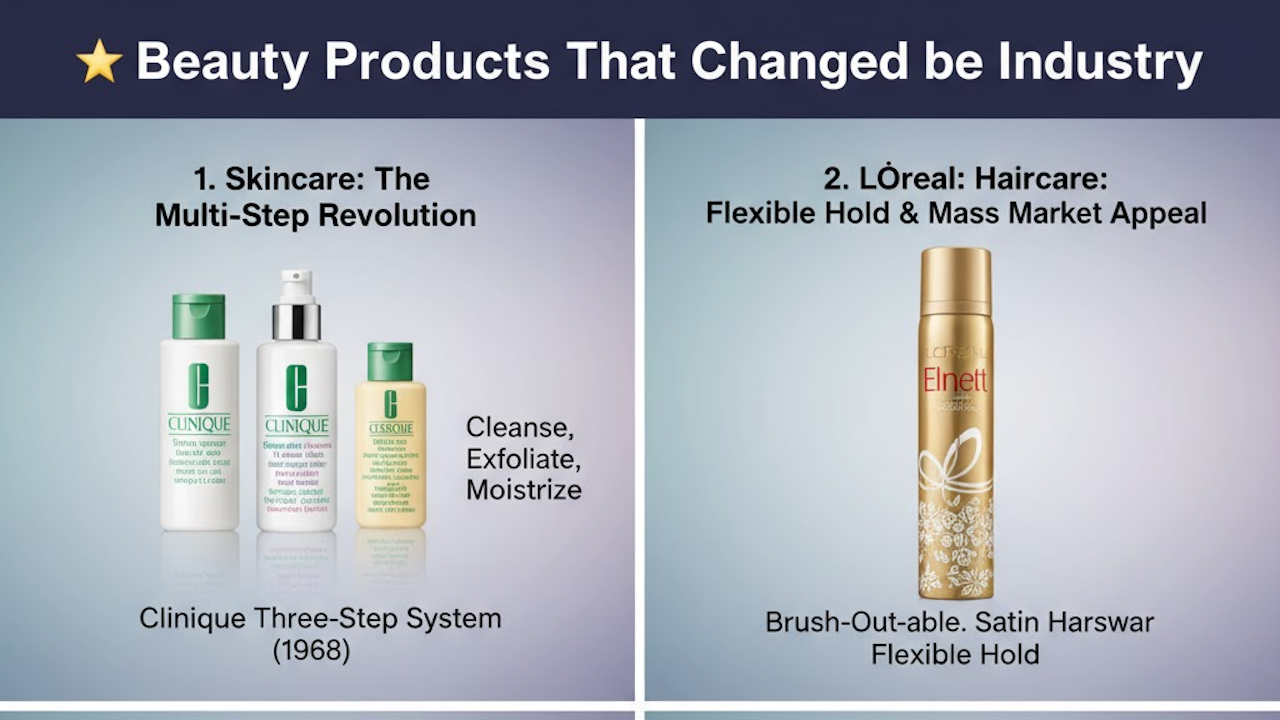
Clinique, launched in 1968 under the Estée Lauder umbrella, took a more clinical route. It positioned itself as allergy-tested and fragrance-free, with dermatologist-developed formulas. The Dramatically Different Moisturizing Lotion became a staple for its lightweight texture and suitability across skin types. These efforts helped shift skincare from vague “creams and lotions” to products backed by claims of science and testing.
Estée Lauder’s influence extended beyond individual formulas. The company demonstrated that storytelling around technology and results could command premium prices and build loyalty. It also expanded the notion of a complete routine, encouraging women to layer products rather than rely on a single cream. This approach influenced countless brands and helped skincare become a larger share of beauty industry revenue.
Retinoids: From Acne Prescription to Anti-Aging Powerhouse
In 1971, tretinoin (Retin-A) received approval as a topical treatment for acne. Dermatologist Albert Kligman later observed its ability to increase cell turnover and improve fine lines and pigmentation. What began as a prescription acne medication became one of the most studied and recommended ingredients for photoaging.
Once the anti-aging benefits became widely known, tretinoin and later over-the-counter retinoids transformed skincare. Consumers learned that consistent use could visibly smooth texture and fade discoloration. The ingredient moved from dermatologist offices into mainstream routines, often under guidance or in gentler forms like retinol.
Retinoids raised the bar for what skincare could achieve. They proved that topical products could deliver measurable structural changes to skin, not just temporary hydration or occlusion. This scientific credibility encouraged further investment in actives such as alpha-hydroxy acids, vitamin C, and peptides. Today, retinoids remain a cornerstone recommendation for both acne and aging concerns, illustrating how a single compound can redefine an entire category.
The Ordinary: Transparent Pricing and Ingredient-First Skincare for Everyone
Launched in 2016 under Deciem, The Ordinary disrupted the skincare market with radical simplicity. Products carried names like “Niacinamide 10% + Zinc 1%” or “Hyaluronic Acid 2% + B5,” listed ingredients and concentrations clearly, and sold for a fraction of traditional clinical brands, often between four and fifteen dollars.
The brand rejected heavy marketing, fancy packaging, and inflated claims. It focused on single or minimal-ingredient formulas backed by science and made them accessible. Consumers responded enthusiastically. Many learned to build customized routines based on specific concerns rather than buying complete systems from one brand. The approach exposed how much traditional skincare pricing relied on branding rather than formulation costs.
The Ordinary’s success forced the industry to confront transparency and value. Larger companies expanded their own affordable lines and became more explicit about ingredients. The brand proved that effective, clinical-level skincare did not require luxury markups. It empowered a generation of consumers to understand and experiment with actives, shifting power from marketing departments to ingredient lists and results.
Olaplex: Creating the Bond-Building Category in Hair Care
Chemical treatments, heat styling, and bleaching break disulfide bonds inside the hair shaft, leading to weakness and breakage. In 2014, Olaplex introduced a patented technology using bis-aminopropyl diglycol dimaleate to relink those broken bonds during and after chemical services.
Initially a professional-only treatment used in salons, Olaplex quickly expanded to at-home products. It created an entirely new category: bond-building or bond-repair hair care. Stylists and consumers reported dramatically healthier hair after treatments that previously caused damage. The brand grew from salon staple to global phenomenon, with strong performance on social media as users shared before-and-after transformations.
Olaplex’s impact went beyond its own sales. It changed how the hair care industry thinks about damage. Competitors developed their own bond-repair technologies, and the concept became a standard talking point in product development. Hair health moved from surface conditioning to structural repair, raising expectations for what treatments could achieve. The brand demonstrated that addressing the root molecular cause of damage could create a lasting new segment in a mature category.
Beautyblender: The Sponge That Changed How Foundation Looks and Feels
Traditional foundation application relied on fingers, brushes, or flat sponges that could streak or absorb too much product. In the early 2000s, makeup artist Rea Ann Silva developed the Beautyblender, an egg-shaped, non-latex sponge designed for bouncing and pressing product into the skin.
The unique shape and material allowed for precise placement and seamless blending with minimal product waste. It produced an airbrushed, skin-like finish rather than a heavy or cakey appearance. When the sponge launched to consumers, it quickly became a cult favorite and spawned countless imitations.
Beautyblender shifted industry standards for foundation finish. It popularized the dewy, natural look that dominated the 2010s and encouraged lighter application techniques. Makeup artists adopted it widely, and consumers learned that tools matter as much as formulas. The success also highlighted how small innovations in application could transform results and create new best-seller categories in tools and accessories.
Fenty Beauty: Forcing the Industry to See Every Skin Tone
When Rihanna launched Fenty Beauty in 2017, the Pro Filt’r Soft Matte Foundation debuted with 40 shades. At the time, many major brands offered far fewer options, often clustered around light to medium tones with limited undertone variety. Deeper shades frequently sold out immediately, revealing pent-up demand.
The launch generated over 100 million dollars in sales in its first month. More importantly, it exposed a long-ignored gap in the market. Fenty’s success, backed by inclusive marketing and diverse imagery, made broad shade ranges a competitive necessity rather than an optional gesture. Competitors rapidly expanded their offerings, some adding dozens of new shades within months or years.
Fenty changed the conversation around inclusivity from niche concern to core business strategy. It proved that serving previously underserved consumers was not only ethical but highly profitable. The brand’s influence extended to product development, visual merchandising, and advertising across the industry. Shade inclusivity became a baseline expectation rather than a differentiator.
Social Media Virality and the Rise of Influencer-Led Products
The 2010s brought platforms that allowed products to reach millions overnight. Kylie Jenner’s Lip Kits, launched in 2015, combined a matching lip liner and liquid lipstick in highly pigmented, long-wearing formulas. Social media posts created instant sell-outs and turned the kits into cultural moments. The success demonstrated the power of direct-to-consumer influencer brands and accelerated the liquid lipstick trend.
Glossier, founded in 2014, took a different but equally influential path. Its minimalist “skin first” philosophy, community engagement, and products like Boy Brow and Cloud Paint emphasized enhancement over heavy coverage. The brand built loyalty through transparency and relatability rather than traditional advertising.
These examples showed that virality and community could launch and sustain brands without decades of retail presence. They also accelerated trend cycles and raised the importance of social proof. The industry adapted by investing in influencer partnerships, limited drops, and rapid response to online buzz. Products no longer needed traditional gatekeepers to achieve massive scale.
Conclusion: Innovation Continues to Redefine Beauty
The products that changed the industry share common traits. They solved real problems, whether technical limitations in film, limited shade options, or damaged hair bonds. They made beauty more accessible, either through lower prices, broader availability, or inclusive design. They influenced competitors and raised standards across categories. From Pan-Cake’s matte revolution to The Ordinary’s ingredient transparency and Fenty’s shade expansion, each breakthrough reflected and shaped the culture of its time.
Looking ahead, the pace shows no sign of slowing. Personalized formulations, sustainable packaging, advanced actives, and technology-enhanced tools continue to emerge. Yet the lessons from these landmark products remain relevant: true industry changers combine genuine performance improvements with a deep understanding of what consumers need and want. They do not merely follow trends. They create new possibilities for how people care for and present themselves. The beauty industry will keep evolving, but these foundational innovations will continue to inform what comes next.