

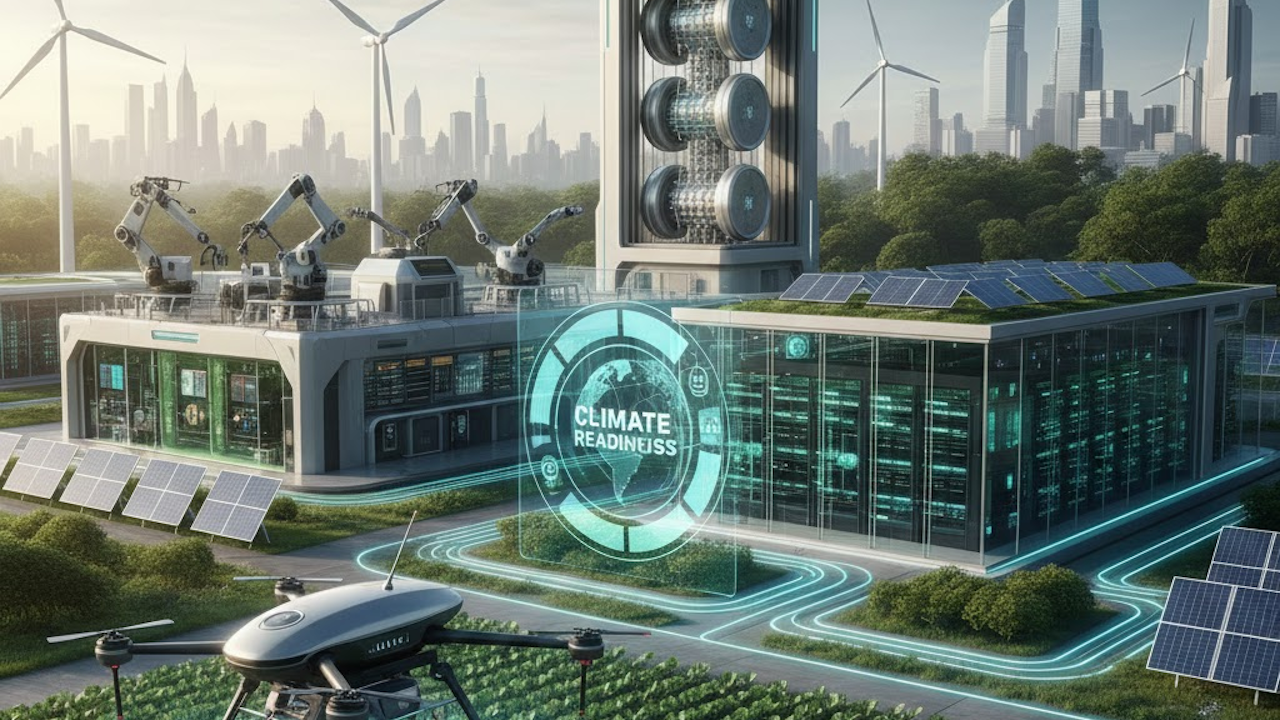
As we move through 2026, the global conversation around technology has shifted from pure capability to critical accountability. The twin forces of an AI boom and an escalating climate crisis have created a paradox: we are building the most power-hungry infrastructure in history while simultaneously racing to meet net zero targets.
This tension is driving a new era of “Climate Readiness.” Innovation is no longer just about flashy gadgets but about the invisible, heavy-duty systems that keep our world running without burning it down.
The AI-Energy Nexus: Efficiency at the Edge
The explosive growth of Generative AI has turned energy into a front-office priority. In 2026, data centers are projected to consume roughly the same amount of electricity as the entire nation of India. To solve this, the tech sector is pivoting from “growth at all costs” to “profit-first efficiency.”
Energy-Orchestrated Computing
Modern AI platforms now use real-time energy orchestration. These systems analyze grid carbon intensity and congestion to schedule heavy model-training runs when renewable energy is most abundant. By shifting workloads to hours when the wind is blowing or the sun is shining, companies are reducing carbon footprints without upgrading a single piece of hardware.
Physical AI and Edge Processing
There is a massive push toward Physical AI, where intelligence moves out of giant, power-hungry data centers and onto the “edge.” Devices like smart sensors, drones, and factory robots are now equipped with application-specific semiconductors. These chips allow for real-time processing with sub-10ms response times while using a fraction of the power required by cloud-based models.
Long-Duration Energy Storage (LDES)
Renewable energy has a famous “intermittency” problem: the sun sets and the wind dies down. While lithium-ion batteries are great for phones and cars, they struggle to power whole cities for days at a time. 2026 has become the year of Long-Duration Energy Storage.
High-Density Hydro and Gravity
Traditional hydropower requires massive dams and mountains. New High-Density Hydro systems, however, use a mineral-rich fluid that is 2.5 times denser than water. This allows for energy storage on gentle hills rather than steep mountains. Similarly, Gravity-Based Storage uses surplus electricity to lift massive weights. When power is needed, the weights are lowered, spinning a turbine and releasing clean energy back into the grid.
Alternative Battery Chemistries
Beyond lithium, Sodium-ion and Iron-air batteries are scaling internationally. Sodium is abundant and cheap, making it ideal for stationary grid storage where weight is not a factor. These “rust batteries” (iron-air) can discharge energy for up to 100 hours, providing the seasonal backup needed to phase out coal and gas plants entirely.
The AI-Driven Circular Economy
The “take-make-waste” model is being replaced by a circular strategy where waste is treated as a resource. This shift is powered by two main innovations: Digital Product Passports and AI-powered sortation.
Digital Product Passports (DPP)
Beginning in mid-2026, the European Union has mandated Digital Product Passports for various sectors. Every product carries a digital record of its material composition, repair history, and recycling instructions. This transparency ensures that when a product reaches its end of life, recyclers know exactly which chemicals and metals are inside, preventing contamination and maximizing material recovery.
Robotic Disassembly and Sortation
Recycling facilities are no longer just conveyor belts and manual labor. AI-powered computer vision systems can now identify and sort up to 80 items per minute with 95% purity. Advanced robotics are even being used for “automated disassembly,” where machines carefully take apart complex electronics like smartphones to recover rare earth minerals like neodymium and dysprosium.
| Technology | Sustainability Impact | Primary Use Case |
| Digital Twins | 30% reduction in building energy costs | Smart city and factory optimization |
| Green Hydrogen | Decarbonizes heavy industry (steel/shipping) | Seasonal energy storage and fuel |
| Plant Cell Cultivation | 90% less land and water than traditional farming | Sustainable food production |
| Grid-Forming Inverters | Stabilizes grids with 100% renewable input | Modernizing aging electrical grids |
Precision Agriculture and Climate-Resilient Food
Agriculture is both a victim and a cause of climate change. Tech innovations in 2026 are focusing on “Climate-Resilient Agriculture” to secure the global food supply.
- Autonomous Irrigation: AI-powered agronomical platforms use satellite data and soil sensors to deliver water only where it is needed, reducing waste by up to 50%.
- Drought-Resistant Bio-Engineering: CRISPR and other gene-editing tools are being used to create “climate-ready” seeds that can thrive in higher temperatures and saline soils.
- Plant Cell Cultivation: Instead of growing entire plants or animals, laboratories are now cultivating specific plant cells to create cocoa, coffee, and oils. This avoids the deforestation and water intensity of traditional tropical farming.
Looking Ahead
The theme for the rest of 2026 is Execution over Ambition. We have moved past the era of vague net-zero promises and into a period where the technologies mentioned above are being woven into the very fabric of our economy. Sustainability is no longer a “green” department in a corporation; it is the operating system for the next industrial revolution.