

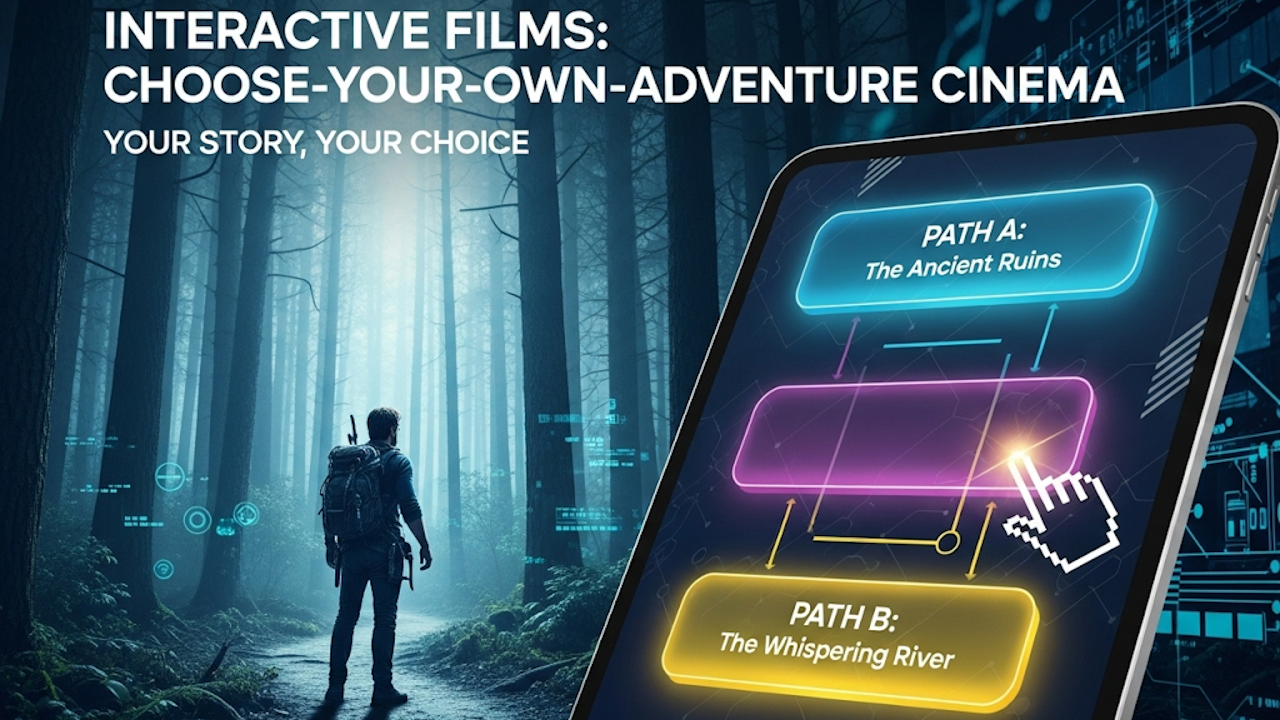
The cinema experience has long invited viewers to lose themselves in stories told on screen. Yet for decades audiences sat passively as directors dictated every twist and resolution. Interactive films challenge that tradition. They transform viewers into active participants who shape the narrative through choices made in real time. Known also as choose-your-own-adventure cinema, these works borrow from the branching structure of popular books that let readers decide a protagonist’s fate. On screen the format delivers filmed scenes that diverge based on decisions, creating multiple pathways and endings. The result feels less like watching a movie and more like steering one.
This approach redefines storytelling. It blends the emotional pull of traditional cinema with the agency of video games. Production demands grow exponentially because filmmakers must shoot and edit far more content than a linear film requires. Viewers gain the thrill of influence but also confront the weight of consequences. In an age of on-demand streaming and personalized media, interactive films tap into a deeper desire for control. They reflect how technology reshapes entertainment, turning passive consumption into collaborative creation.
The roots of interactive cinema stretch further back than many realize. Long before digital platforms, storytellers experimented with audience involvement. Choose-your-own-adventure books gained massive popularity in the 1980s, but the concept appeared earlier in literature and theater. Cinema adopted the idea in the 1960s. The landmark example arrived in 1967 with Kinoautomat, a Czechoslovak film directed by Radúz Činčera. Screened at Expo 67 in Montreal, it paused at key moments so audiences could vote between two outcomes using buttons at their seats. A moderator sometimes guided the process. The satire followed an ordinary man whose day spiraled into chaos based on collective decisions. It became a sensation and drew interest from Hollywood studios, though Cold War politics prevented widespread licensing.
Even earlier experiments hinted at the format. In 1961 director William Castle released Mr. Sardonicus, a horror film that paused near the end for a theatrical vote. Audience members held up glow-in-the-dark thumbs to decide the villain’s fate. The gimmick proved more novelty than revolution, yet it planted seeds. The 1990s brought bolder theatrical attempts. I’m Your Man, released in 1993, used joysticks in select theaters to let viewers steer a short interactive story. Mr. Payback followed in 1995, billing itself as the first feature-length interactive movie. It mixed action and comedy while audiences in specially equipped cinemas voted on plot turns. Both efforts struggled commercially. Bulky technology, limited distribution, and uneven storytelling kept them from catching on broadly.
Laserdisc technology in the 1980s and 1990s enabled another wave. Full-motion video games such as Dragon’s Lair used pre-recorded footage with branching paths triggered by player inputs. These hybrids leaned more toward gaming than pure cinema, yet they demonstrated how random-access media could support nonlinear narratives. Home video formats like VHS offered rudimentary interactivity through instructions to fast-forward or rewind to specific timestamps. None achieved seamless integration, but they kept the idea alive.
The true breakthrough arrived with streaming. Netflix released Black Mirror: Bandersnatch in December 2018. Created by Charlie Brooker and directed by David Slade, the film dropped as a standalone interactive special within the Black Mirror anthology. Set in 1984, it followed a young programmer adapting a choose-your-own-adventure novel into a video game. Viewers made decisions for the protagonist via simple on-screen prompts with time limits. The story meta layer examined free will, creativity, and the illusion of choice. Netflix reported trillions of possible permutations, though most paths converged or looped cleverly. Bandersnatch reached massive audiences and sparked global conversation. It proved interactive film could thrive at home without special hardware.
Other Netflix experiments followed, though many targeted younger viewers or lighter fare. Titles such as You vs. Wild with Bear Grylls and interactive episodes of Carmen Sandiego invited choices in adventure or educational contexts. The platform also offered specials tied to existing series. These releases expanded the library of interactive content and normalized the format for casual streaming. They showed that branching stories could suit various genres, from survival challenges to animated escapades.
Beyond Netflix, independent and hybrid projects advanced the medium. Late Shift, released around 2016 by CtrlMovie, positioned itself as a cinematic interactive thriller. Audiences in equipped theaters or at home used controls to guide a protagonist through a heist gone wrong. It featured live-action footage, multiple endings, and high production values. The company later developed tools for collective audience voting via smartphones, opening doors for theatrical revivals. Erica, The Complex, and similar full-motion video titles blurred lines between film and game, often distributed on consoles or PCs. They emphasized psychological tension and moral dilemmas, proving interactive cinema could deliver emotional depth.
Recent years have seen renewed theatrical interest. In 2025 and 2026 projects such as The Run and Slay Day emerged. The Run, a horror entry, lets viewers influence events in a tense chase narrative. Slay Day, slated for fall 2026 release from Kino Industries and CtrlMovie, promises an interactive slasher experience. Audiences will vote collectively via smartphone apps during screenings, altering the story on the fly. These efforts revive the communal thrill of early experiments like Kinoautomat while leveraging modern mobile technology. They suggest interactive film may carve out a niche in theaters once again, blending social viewing with personal agency.
Producing an interactive film demands meticulous planning. Writers map branching narratives like trees, ensuring every decision leads to coherent, engaging scenes. Directors film multiple versions of key sequences, often requiring actors to perform the same lines with subtle variations in tone or action. Editors stitch footage seamlessly so transitions feel natural. The volume of material multiplies quickly. A two-hour film with five major choice points might require filming the equivalent of four or five full features. Budgets swell accordingly, and scheduling becomes complex when the same cast must cover parallel realities.
Storytelling presents equal hurdles. Creators must craft satisfying arcs for every path while avoiding filler or dead ends. Weak branches risk frustrating viewers who feel their choices led nowhere meaningful. Pacing matters too. Frequent decision prompts can interrupt immersion, pulling audiences out of the story. Yet when executed well, the format heightens tension. Knowing a choice could doom a character raises stakes in ways linear films rarely match. Meta elements, as in Bandersnatch, add layers by commenting on interactivity itself.
Audience reception has been largely positive but mixed. Many praise the replay value. Watching once leaves viewers curious about alternate outcomes, encouraging multiple viewings. Engagement rises because people invest emotionally in decisions they made. Families or friends gather to debate choices together, turning viewing into a shared event. Critics note downsides. Some argue interactivity fragments the director’s vision, diluting artistic intent. Others feel the constant prompts break emotional flow, reducing the hypnotic pull of traditional cinema. Research into narrative immersion suggests conscious decision-making can weaken the subconscious absorption viewers experience in linear stories. Despite these critiques, the format resonates with younger audiences raised on games and personalized media. It satisfies a cultural shift toward participation.
Interactive films also carry cultural weight. They mirror broader societal changes. In a world of algorithms that tailor news, shopping, and entertainment, audiences expect influence over their experiences. Branching stories explore themes of consequence, regret, and alternate realities with unusual intimacy. They question determinism, much as Kinoautomat satirized it decades ago. At their best these works foster empathy by forcing viewers to confront difficult choices and live with outcomes.
Challenges remain technical and creative. Seamless delivery across devices requires robust platforms. Older experiments suffered from clunky interfaces or hardware limitations. Modern streaming solves many issues, yet bandwidth and compatibility still matter. Creative teams must balance accessibility with depth. Too many branches overwhelm production. Too few limit the sense of freedom. Marketing poses another hurdle. Audiences need clear expectations that the film will pause for input and reward exploration.
As of 2026 the landscape shows promise. Streaming services continue experimenting, though Netflix scaled back after early successes. Theatrical interactive releases like Slay Day signal renewed ambition. Independent developers and smaller studios use affordable tools to produce ambitious projects. Full-motion video games on consoles demonstrate commercial viability, influencing film producers. Cross-pollination between cinema and gaming grows stronger each year.
The future looks even more dynamic. Advances in artificial intelligence could generate additional branches or personalize stories based on viewer preferences. Virtual reality and augmented reality promise deeper immersion, placing audiences inside the action rather than watching from afar. Imagine stepping into a scene and influencing events through gestures or voice. Brain-computer interfaces might one day read subconscious reactions to adjust narratives without explicit choices. These technologies raise ethical questions about manipulation and data privacy, yet they also expand creative possibilities.
Collaborative production ecosystems may emerge where global teams contribute scenes to vast narrative webs. Persistent virtual worlds could host ongoing interactive stories that evolve over time. Cinema might evolve into hybrid experiences blending film, game, and social media. Directors could become world-builders rather than sole authors, guiding frameworks while audiences co-create.
Interactive films have traveled a long path from button-equipped theaters in the 1960s to smartphone-voting in 2026. They have survived technological limitations, commercial flops, and critical skepticism. Each wave builds on the last, refining the balance between story and choice. What began as novelty has matured into a legitimate storytelling form. It challenges filmmakers to rethink authorship and invites viewers to embrace responsibility for the tales they help tell.
The appeal lies in possibility. Interactive cinema reminds us that stories need not be fixed. They can flex and respond, reflecting the complexity of real life where every decision ripples outward. As technology advances and audiences demand more involvement, choose-your-own-adventure films stand poised to claim a larger share of the screen. They do not replace traditional cinema. Instead they expand it, offering new ways to feel, think, and connect through moving images. The next chapter waits for viewers to write it, one choice at a time.