

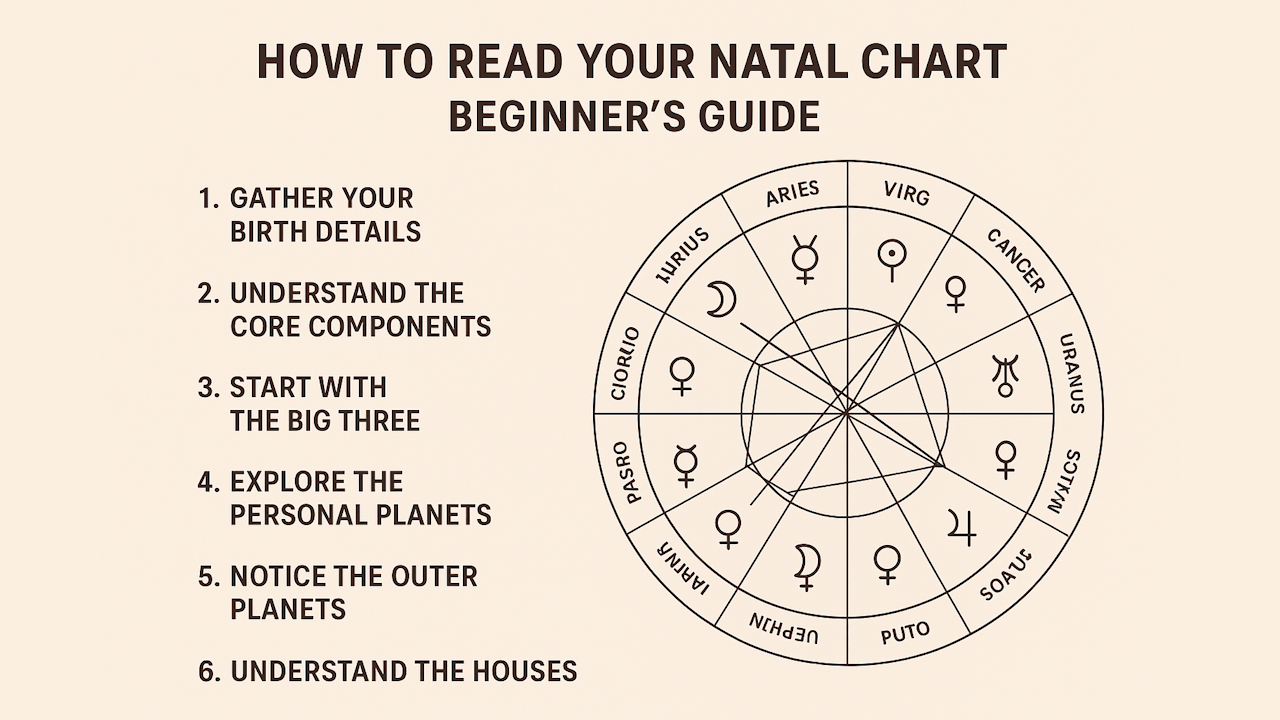
A natal chart, also known as a birth chart, is a snapshot of the sky at the exact moment and location of your birth. In astrology, it serves as a cosmic blueprint that astrologers use to understand personality traits, life patterns, strengths, challenges, and potential paths. Reading your natal chart can feel overwhelming at first because it combines symbols, numbers, and geometric relationships. This guide breaks everything down step by step for complete beginners. By the end, you will have the tools to start interpreting your own chart with confidence.
Getting Your Natal Chart
Before reading anything, you need your chart. Free websites such as Astro.com, Astro-Seek, or Cafe Astrology allow you to generate one instantly. You will need:
- Exact date of birth (day, month, year)
- Exact time of birth (as accurate as possible; even a one-hour window matters)
- Place of birth (city and country)
The chart appears as a circular wheel divided into twelve segments. Around the wheel you will see planetary symbols, zodiac signs, and numbers representing houses. Some charts also show aspect lines connecting planets.
If you do not know your exact birth time, you can still work with a chart using a noon birth time, but house placements and the Ascendant will be less reliable. Many astrologers recommend rectifying the chart later through life events if the time is uncertain.
The Three Main Building Blocks
Every natal chart consists of planets, signs, and houses. Think of them as ingredients in a recipe:
- Planets represent energies or drives.
- Signs describe how those energies express themselves.
- Houses show which areas of life those energies focus on.
The Planets
The planets in your chart are the Sun, Moon, Mercury, Venus, Mars, Jupiter, Saturn, Uranus, Neptune, and Pluto. Each has a core meaning:
- Sun: Your core identity, ego, and life force. It shows what motivates you at a fundamental level.
- Moon: Emotions, instincts, needs for security, and how you process feelings. It often relates to your relationship with your mother or early home life.
- Mercury: Communication, thinking style, learning, and how your mind works.
- Venus: Love, relationships, values, beauty, and what brings you pleasure.
- Mars: Action, drive, anger, courage, and how you pursue desires.
- Jupiter: Growth, luck, expansion, philosophy, and where you seek meaning.
- Saturn: Structure, discipline, limitations, responsibilities, and long-term lessons.
- Uranus: Innovation, rebellion, sudden changes, and originality.
- Neptune: Imagination, spirituality, dreams, illusions, and compassion.
- Pluto: Transformation, power, intensity, and deep psychological forces.
The faster-moving planets (Sun through Mars) describe your personal, everyday personality. The slower ones (Jupiter through Pluto) relate to generational influences and deeper life themes.
The Zodiac Signs
There are twelve zodiac signs, each with distinct qualities. They are grouped into four elements and three modalities:
Elements:
- Fire (Aries, Leo, Sagittarius): Energetic, enthusiastic, visionary.
- Earth (Taurus, Virgo, Capricorn): Practical, grounded, reliable.
- Air (Gemini, Libra, Aquarius): Intellectual, social, communicative.
- Water (Cancer, Scorpio, Pisces): Emotional, intuitive, empathetic.
Modalities:
- Cardinal (Aries, Cancer, Libra, Capricorn): Initiators, leaders, starters.
- Fixed (Taurus, Leo, Scorpio, Aquarius): Stabilizers, persistent, resistant to change.
- Mutable (Gemini, Virgo, Sagittarius, Pisces): Adaptable, flexible, versatile.
When a planet is in a sign, it takes on the flavor of that sign. For example, Mars in Aries is direct and impulsive, while Mars in Capricorn is strategic and patient.
The Houses
The twelve houses represent different life departments. The exact size and starting point of each house depend on the house system used (Placidus is most common for beginners).
- 1st House (Ascendant): Self-image, physical appearance, first impressions.
- 2nd House: Money, possessions, self-worth, values.
- 3rd House: Communication, siblings, short trips, early education.
- 4th House (IC): Home, family, roots, emotional foundation.
- 5th House: Creativity, romance, children, self-expression, fun.
- 6th House: Work, health, daily routines, service.
- 7th House (Descendant): Partnerships, marriage, one-on-one relationships.
- 8th House: Shared resources, intimacy, transformation, death and rebirth.
- 9th House: Higher education, travel, philosophy, beliefs.
- 10th House (Midheaven): Career, public image, reputation, achievements.
- 11th House: Friends, groups, communities, hopes and wishes.
- 12th House: Subconscious, secrets, solitude, spirituality, hidden matters.
A planet in a house shows where that planetary energy plays out most strongly.
The Angles and Chart Rulers
Four key points on the chart are the angles:
- Ascendant (Rising Sign): The sign rising on the eastern horizon. It colors your entire personality and how others see you.
- Midheaven (MC): The highest point, related to career and public life.
- Descendant: Opposite the Ascendant, shows what you seek in partners.
- Imum Coeli (IC): Opposite the Midheaven, relates to private life and roots.
The planet that rules your Ascendant sign (the chart ruler) is especially important. For example, if you have Leo Rising, the Sun is your chart ruler.
Aspects: The Relationships Between Planets
Aspects are the angles planets make to each other. They show how energies interact. The most important ones for beginners are:
- Conjunction (0 degrees): Planets blend their energies powerfully.
- Sextile (60 degrees): Harmonious, opportunities for cooperation.
- Square (90 degrees): Tension, challenges that force growth.
- Trine (120 degrees): Easy flow, natural talents.
- Opposition (180 degrees): Polarity, awareness through relationships.
Look at the orb (allowed degree difference). Tighter orbs (under 5-8 degrees) are stronger. Major aspect patterns like Grand Trines, T-Squares, or Stelliums (three or more planets in one sign or house) add extra emphasis.
Step-by-Step Guide to Reading Your Chart
- Start with the Big Three: Sun sign, Moon sign, and Rising sign. These form the core of your personality. Write down their elements and modalities to see your overall balance. For instance, many fire placements suggest an energetic, outgoing nature, while dominant water might indicate high sensitivity.
- Examine Planetary Placements: Go through each planet and note its sign and house. Ask:
- What does this planet want?
- How does the sign modify it?
- In which life area (house) does it operate?
- Identify Dominant Patterns:
- Which element or modality is strongest?
- Are planets clustered in one hemisphere (upper/lower, left/right)?
- Any stelliums or empty houses? Empty houses are not empty of activity; they are simply ruled by the planet that governs that sign.
- Analyze the Angles: Look at the signs and rulers of the Ascendant and Midheaven. These set the tone for self-presentation and life direction.
- Study Aspects: Focus first on aspects to the Sun, Moon, and chart ruler. Note any planets in their own sign (in dignity) or opposite sign (in detriment), or in the sign of their exaltation or fall. These conditions strengthen or weaken planetary expression.
- Synthesize: Combine everything. A person with Sun in Virgo in the 10th house might be detail-oriented and ambitious in career, especially if supported by harmonious aspects. If squared by Mars, there could be stress around perfectionism and impatience.
Interpreting Specific Areas
Personality and Identity: Combine Sun, Moon, Rising, and any planets in the 1st house.
Emotional Needs: Moon placement and aspects reveal what makes you feel safe. A Moon in Taurus craves stability, while Moon in Aquarius needs freedom within emotional bonds.
Love and Relationships: Look at Venus for what you find attractive, Mars for passion style, and 7th house planets for partnership dynamics. The Descendant sign shows complementary qualities you seek.
Career and Purpose: Midheaven sign, 10th house planets, and Saturn show vocational paths. Jupiter indicates areas of potential success.
Challenges and Growth: Saturn shows where you face restrictions and build mastery. Squares and oppositions highlight areas requiring effort.
Generational Influences: Outer planets (Uranus, Neptune, Pluto) in signs affect entire generations, but their house placements and aspects to personal planets make them personal.
Common Beginner Mistakes to Avoid
- Over-focusing on Sun sign alone. The full chart gives a much richer picture.
- Taking interpretations too literally. Astrology describes potentials and tendencies, not fixed fate.
- Ignoring the whole chart for isolated parts. Always look for repeating themes.
- Using outdated or overly simplistic descriptions. Modern astrology incorporates psychological insights.
- Forgetting that free will matters. The chart shows energies you can work with consciously.
Tips for Deeper Practice
Keep a journal. Note how transits (current planetary movements) interact with your natal planets. Over time you will see patterns confirming interpretations.
Study one section at a time rather than trying to absorb everything immediately. Many beginners start with the Big Three and houses, then add aspects.
Consider the chart as a whole mandala. Look for balance or imbalance. A chart heavy in one element might benefit from consciously developing the opposite.
Remember that different house systems or even different astrologers may emphasize slightly different things. Stick with one approach until you are comfortable, then explore others.
Conclusion
Reading your natal chart is both an art and a skill that improves with practice. It offers a compassionate framework for self-understanding, helping you recognize why you react certain ways, where your natural gifts lie, and which areas might need extra attention. Approach it with curiosity rather than seeking definitive predictions. Many people find that working with their chart fosters greater self-acceptance and intentional living.
Start simple. Generate your chart today, identify your Sun, Moon, and Rising, and explore their basic meanings. Over weeks and months, layer in more details. The cosmic map is there for you to read whenever you are ready. With patience, you will move from confusion to insight, turning symbols on a wheel into a meaningful guide for your unique life journey.