

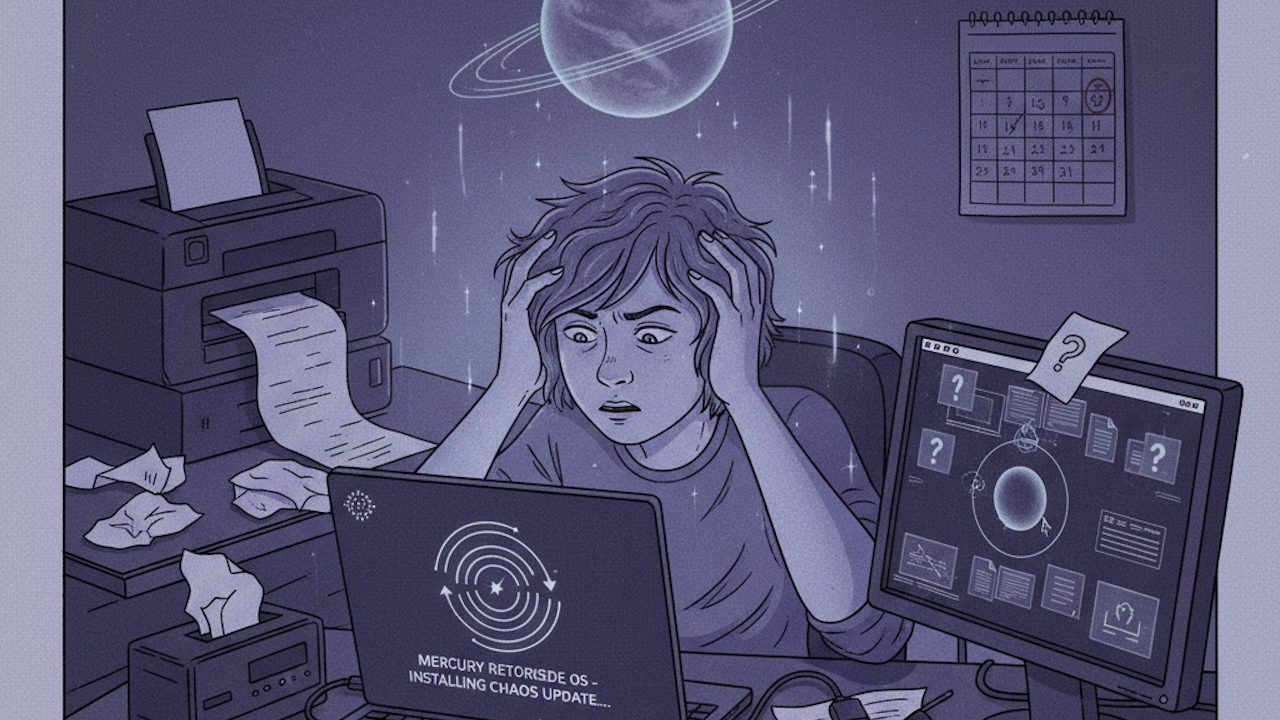
Mercury retrograde stands out as one of the most discussed astrological events in modern culture. People frequently blame it for a wide range of technological disruptions. From sudden computer crashes to lost emails and malfunctioning smartphones, the period when Mercury appears to move backward in the sky draws complaints about gadgets, software, and digital communications going awry. This belief has grown alongside the rise of personal computers, the internet, and smartphones. It offers a convenient explanation for the frustrations that come with living in a tech-saturated world.
Astrologers trace the idea to Mercury’s traditional role as the messenger planet. In mythology, Mercury governed communication, travel, commerce, and intellectual pursuits. In contemporary interpretations, this extends to all forms of technology that facilitate information exchange. When Mercury enters retrograde motion, astrologers suggest these areas experience delays, reversals, and breakdowns. The phenomenon occurs three or four times each year and typically lasts about three weeks. In 2026, the periods fall roughly from late February to mid March, late June to late July, and late October to mid November.
The Astronomical Reality Behind the Name
Mercury retrograde begins as an optical illusion rather than a true reversal of direction. Mercury orbits the Sun much faster than Earth does. From our perspective on Earth, the inner planet sometimes appears to slow down, stop, and move backward against the background of stars. This effect resembles watching a slower car seem to drift backward when a faster vehicle overtakes it on a highway. Astronomers have understood this relative motion for centuries. No actual change occurs in Mercury’s orbit or speed. The planet continues its steady path around the Sun without interruption.
Despite this clear astronomical explanation, the cultural interpretation persists. Astrologers maintain that the apparent backward motion symbolically disrupts the smooth flow of information and mechanical systems. They advise caution with new purchases, important digital communications, software updates, and contracts during these windows. Many followers report heightened awareness of problems that might otherwise pass unnoticed.
Common Claims About Technological Disruptions
Believers describe a familiar pattern of tech troubles during retrograde periods. Electronic devices supposedly crash without warning. Computers freeze, overheat, or produce strange sounds that require restarts. Smartphones lose battery life suddenly or refuse to charge properly. Smart home systems, including lights, thermostats, and security cameras, behave erratically.
Data loss ranks among the most cited issues. Important files vanish from desktops or cloud storage. Photos disappear from phones. Documents saved moments earlier cannot be located. Software updates stall in endless loops or install with unexpected bugs. Operating systems that ran smoothly for months suddenly demand troubleshooting.
Communication technologies face particular scrutiny. Text messages arrive late, duplicate, or reach the wrong recipients. Emails bounce back or land in spam folders. Video calls drop mid conversation. Social media posts publish with errors or fail to appear. Wi Fi connections weaken or drop entirely, even when signal strength indicators show strong coverage. Some people claim GPS navigation gives incorrect directions or reroutes unnecessarily.
Hardware failures extend beyond personal devices. Office printers jam repeatedly. Servers experience unexplained downtime. Point of sale systems in stores glitch during transactions. Even newer technologies such as electric vehicle charging networks or streaming services report temporary outages that users attribute to the retrograde influence. In professional settings, these problems compound stress during already demanding periods of remote work or digital collaboration.
Personal Stories and Widespread Anecdotes
Countless individuals share experiences that reinforce the belief. One person described a laptop that functioned perfectly until the start of a retrograde period, then refused to boot for days. Another recounted purchasing a new tablet only to watch it develop a persistent screen flicker within hours. Stories circulate about important presentations ruined by projector failures or client emails that never arrived despite being sent repeatedly.
Social media amplifies these accounts. During active retrograde windows, hashtags and posts flood timelines with complaints about phones acting possessed or internet service providers failing at critical moments. Some users joke that Mercury retrograde serves as a universal scapegoat for any digital inconvenience. Others treat it seriously and postpone major tech decisions until the period ends.
Astrologers and spiritual practitioners often advise clients to back up all data beforehand, avoid signing digital agreements, and delay electronics purchases. They suggest reviewing old projects rather than launching new ones. Some recommend simple rituals such as cleaning digital spaces or meditating on clear communication. These practices provide psychological comfort even when the underlying mechanism remains unproven.
The Scientific Perspective and Lack of Evidence
Scientists and astronomers consistently state that Mercury retrograde exerts no measurable influence on technology or human affairs. Planetary positions produce gravitational effects far too weak to affect electronic circuits, data transmission, or software code. No known physical force links the apparent motion of Mercury to the behavior of silicon chips or radio waves. Extensive observations of technology performance show no statistically significant correlation with retrograde periods.
Technology fails for well documented reasons unrelated to celestial events. Billions of devices operate simultaneously across the globe. Hardware degrades over time. Software contains bugs introduced during development. Networks experience congestion, weather interference, and maintenance outages. Human error accounts for many reported problems, from accidental deletions to mistyped commands. During any given three week window, the sheer volume of digital activity guarantees numerous glitches somewhere in the world.
Confirmation bias offers the most plausible explanation for perceived patterns. When people expect problems during Mercury retrograde, they notice and remember every minor inconvenience. They overlook similar failures that occur outside retrograde periods. Media coverage and social sharing further reinforce the narrative. Articles and posts highlighting tech mishaps during these times create a feedback loop that strengthens belief without requiring evidence.
Psychologists note that humans naturally seek simple explanations for complex or random events. Attributing a crashed computer to planetary motion feels more satisfying than accepting random hardware failure or an overlooked software update. This tendency appears across many superstitions and does not require any actual causal link.
Historical Context and Modern Adaptations
The association between Mercury retrograde and technology represents a relatively recent development. Traditional astrology placed less emphasis on the retrograde phase and rarely connected it specifically to mechanical devices. The modern focus emerged alongside widespread adoption of personal computers in the 1980s and 1990s. As technology became central to daily life, astrologers expanded Mercury’s domain to include digital tools.
Today the belief adapts quickly to new innovations. During periods of heavy remote work, complaints center on video conferencing platforms and cloud collaboration tools. With the growth of artificial intelligence, some observers claim chatbots produce more hallucinations or nonsensical responses while Mercury moves retrograde. Electric vehicles and autonomous driving systems join the list of technologies supposedly prone to glitches. The pattern remains consistent even as the specific devices change.
Cultural impact extends beyond personal anecdotes. Major publications publish guides on surviving Mercury retrograde with tech in mind. Retailers sometimes see shifts in electronics sales around these dates as cautious consumers delay purchases. Memes and humor soften the frustration while keeping the concept alive in public discourse.
Practical Steps That Help Regardless of Belief
Whether one accepts astrological interpretations or views them as cultural folklore, certain habits reduce technology related stress at any time. Regular data backups to multiple locations prevent catastrophic loss when failures occur. Maintaining updated software and security patches minimizes vulnerabilities. Testing new devices thoroughly before relying on them for important tasks avoids unpleasant surprises.
Clear communication practices benefit everyone. Double checking recipient lists before sending group emails prevents awkward mistakes. Saving work frequently and confirming that messages have sent successfully reduces anxiety. Keeping alternative communication channels available, such as phone numbers alongside email, provides backup when digital systems falter.
For those who follow astrological guidance, the periods offer opportunities for reflection and maintenance. Reviewing existing systems, cleaning up digital clutter, and revisiting old projects align with the introspective tone many astrologers associate with retrograde motion. Postponing non essential purchases and major launches provides a structured approach to decision making.
Looking Ahead in an Increasingly Digital World
As technology continues evolving, the conversation around Mercury retrograde will likely persist. Quantum computing, advanced satellite networks, and brain computer interfaces may join the catalog of systems supposedly influenced by planetary positions. At the same time, scientific literacy and critical thinking tools become more accessible. More people encounter clear explanations of optical illusions and confirmation bias.
The enduring popularity of Mercury retrograde reveals something important about human psychology. In a world of constant connectivity and rapid change, people appreciate frameworks that impose order on chaos. Technology delivers immense benefits yet introduces new forms of vulnerability. Blaming a distant planet for occasional malfunctions offers temporary relief from the reality that complex systems occasionally break for ordinary reasons.
Ultimately, the effects attributed to Mercury retrograde appear rooted in perception rather than planetary causation. Technology will continue to experience glitches, data will occasionally vanish, and communications will sometimes fail. These events happen throughout the year for predictable engineering and human reasons. Awareness of the cultural narrative can help individuals respond calmly and prepare effectively without assigning supernatural blame.
By focusing on reliable backups, cautious communication, and regular maintenance, anyone can navigate periods of technological frustration more smoothly. Whether Mercury appears to move forward or backward in the sky, preparedness remains the most effective strategy for keeping digital life running as intended. The stars may provide entertainment and tradition, yet the practical solutions lie firmly in human hands and sound engineering practices.