

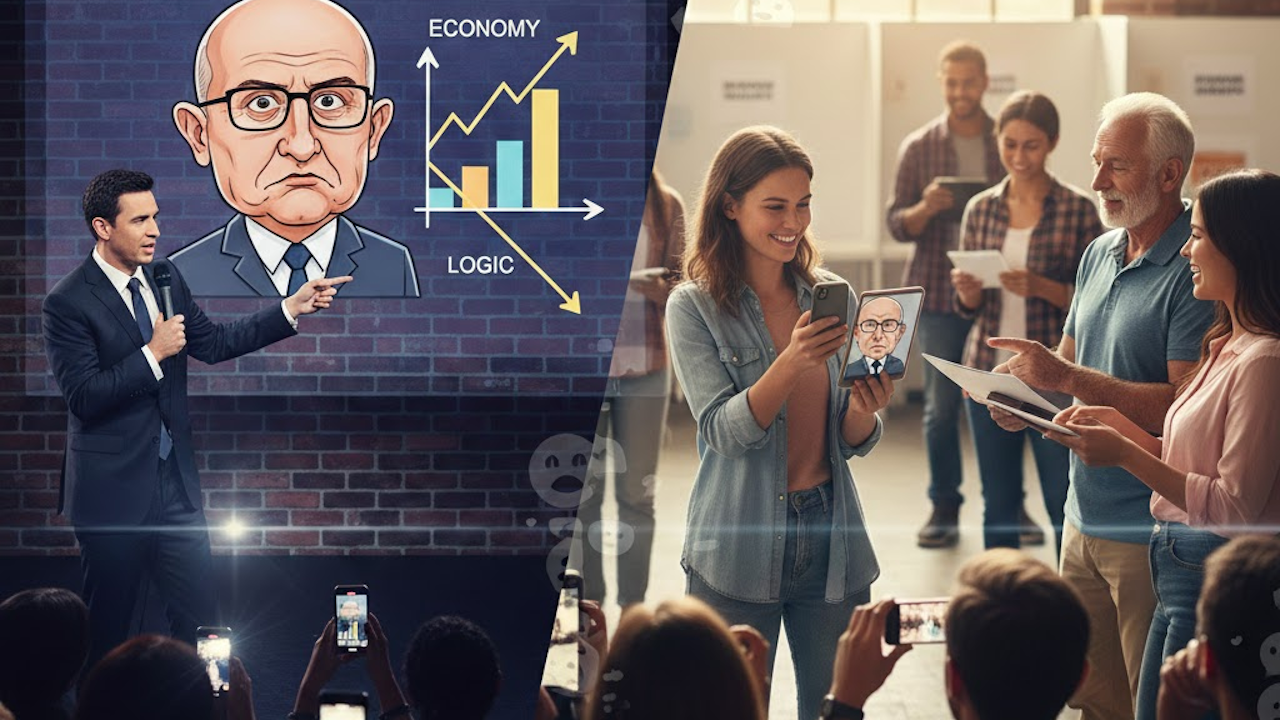
Humor has long been a quiet force in politics, often underestimated yet profoundly effective at molding how people think about candidates, policies, and the very idea of voting itself. A well-timed joke, a sharp satire, or even a clumsy attempt at levity can slip past the usual defenses that voters put up against serious arguments. It can make an idea stick, soften hostility, or deepen divisions. Understanding how humor shapes voter opinions requires looking at psychology, history, media, and the everyday ways people process political information.
At its core, humor works because it lowers resistance. When someone is presented with a straight policy brief or a stern campaign speech, the natural response for many is skepticism or boredom. The brain evaluates claims carefully, checks them against existing beliefs, and often rejects anything that feels threatening or inconvenient. Humor changes that dynamic. A joke invites the audience to drop its guard. Laughter creates a moment of shared feeling, a sense that the speaker and the listener are on the same side, even if only for a few seconds. Psychologists have long noted that this emotional opening makes people more receptive to the underlying message. The idea carried by the joke does not have to fight as hard for acceptance. It arrives wrapped in pleasure, and pleasure is persuasive.
This effect is not limited to positive messages. Mockery can be just as powerful. Ridiculing an opponent or a policy can plant doubts more efficiently than a detailed critique. Once a candidate becomes the punchline of repeated jokes, the association hardens. Voters begin to see that person through the lens of the laughter. Competence, seriousness, or trustworthiness can erode not because of new evidence but because the figure has been made to look foolish. The reverse is also true. A candidate who can laugh at themselves or deliver humor that feels authentic often gains an advantage in likability, and likability is a strong predictor of electoral support.
History offers many examples of this process at work. Political cartoons in the nineteenth century shaped public views of leaders long before radio or television existed. Thomas Nast’s drawings of Boss Tweed helped turn public opinion against corruption in New York by making the political machine look ridiculous and grotesque. The images were not neutral reports. They were arguments delivered through exaggeration and wit, and they reached people who might never have read a lengthy editorial. In the twentieth century, radio and film brought new forms of political humor. During the Great Depression and the Second World War, comedians and satirical sketches helped define how ordinary citizens felt about presidents and policies. Franklin Roosevelt’s fireside chats were not humorous in the conventional sense, yet the warm, conversational tone created a similar lowering of defenses that pure formality would have blocked.
Television intensified the effect. Late-night comedy shows became informal classrooms for millions of viewers. Programs that mixed news with jokes taught audiences which issues mattered and which politicians deserved scorn or sympathy. Studies of viewers of such shows have repeatedly found that regular exposure increases political knowledge among people who otherwise pay little attention to traditional news. The humor acts as a delivery system. Facts that would feel dry in a newspaper become memorable when attached to a punchline. At the same time, the framing is rarely neutral. The choice of targets and the tone of the jokes guide viewers toward particular conclusions about who is competent, who is dangerous, and which policies are absurd.
Social media has accelerated and democratized the process. Memes, short video clips, and viral jokes now travel faster than any campaign advertisement. A single image with a clever caption can reach tens of millions of people within hours. Because these pieces of content are designed to be shared, they reward emotional impact over careful nuance. Humor that confirms existing prejudices spreads most easily. Supporters of one side circulate jokes that make the other side look stupid or extreme. The result is not always deeper understanding. Often it is stronger tribal loyalty. People laugh with their in-group and at the out-group, and the laughter reinforces the boundary between them.
Yet humor does not only polarize. It can also humanize. When a candidate appears on a comedy program and handles questions with genuine wit rather than scripted talking points, voters often update their impressions in a positive direction. The politician becomes less of an abstract figure and more of a person who can think on their feet. This effect has been observed across different countries and political systems. Leaders who master the art of light self-deprecation tend to score higher on measures of approachability. Those who seem unable to laugh, or who laugh only at others, risk appearing rigid or insecure.
The risks of political humor are real and sometimes underappreciated. Not every joke clarifies. Some obscure. Complex policy questions about taxation, foreign affairs, or public health can be reduced to slogans that sound clever but leave the actual trade-offs unexamined. When humor becomes the primary way a large portion of the public encounters politics, the appetite for detailed argument may shrink. Voters may feel they already “get” an issue because they have laughed at a related meme, even if the underlying facts remain poorly understood. In extreme cases, humor can serve as a vehicle for falsehoods. A joke that embeds a misleading claim can travel widely because the entertainment value outweighs the impulse to fact-check.
Different groups of voters respond to humor in distinct ways. Younger people, who consume more digital content, are often more influenced by meme culture and short-form video satire. Older voters may still rely more on traditional late-night shows or printed cartoons. Education level also matters. Those with stronger prior knowledge of politics are better able to separate the joke from the argument and evaluate both. Those with less background knowledge may absorb the emotional cue more completely. Personality plays a role as well. People high in openness to experience tend to enjoy and be swayed by ironic or complex humor, while those who prefer clear moral boundaries may respond more strongly to straightforward ridicule of opponents.
Campaign strategists have long understood these dynamics, even if they rarely admit it in public. Opposition research teams look not only for policy contradictions but for moments that can be turned into lasting jokes. Advertising agencies test humorous spots because data often shows that funny ads are more likely to be remembered and shared. At the same time, campaigns must tread carefully. Humor that lands poorly can backfire spectacularly, making the candidate appear mean-spirited or out of touch. The line between sharp and cruel is thin, and public tolerance for that line shifts with cultural mood.
Cross-cultural comparisons reveal that the power of humor is not universal in form, though the underlying mechanism is widespread. In some countries, satire is tightly restricted and therefore carries extra weight when it appears. In others, a freewheeling tradition of political comedy makes humor an expected part of public discourse. Wherever it exists, the core pattern remains: laughter changes how information is processed. It makes messages stickier, reduces the effort required to accept them, and attaches emotional color to otherwise abstract judgments about candidates and parties.
Looking ahead, the influence of humor on voter opinions is likely to grow rather than shrink. Artificial intelligence tools now generate jokes, memes, and satirical videos at scale. The volume of humorous political content will increase, and the speed of its circulation will continue to rise. This development raises new questions about authenticity. When a joke is crafted by an algorithm rather than a human comedian or campaign staffer, does it retain the same persuasive force? Early evidence suggests that audiences still respond to the emotional content more than to the origin of the content. If the laugh feels genuine, the associated opinion shift can still occur.
The challenge for citizens is to remain aware of the process. Humor is not the enemy of serious politics. It is one of its oldest tools. Used well, it can expose hypocrisy, puncture pomposity, and make public life more accessible. Used carelessly or manipulatively, it can flatten complex choices into simple objects of ridicule and harden people against evidence that contradicts the joke. The healthiest response is neither to ban political humor nor to treat it as mere entertainment. It is to notice when a laugh is doing the work of an argument, and to ask whether the argument deserves the laughter it has received.
In the end, voters do not form opinions in a vacuum of pure reason. They form them in a world of stories, images, and feelings. Humor is one of the most efficient ways those elements combine. A candidate who understands this will never rely on jokes alone, but neither will that candidate ignore their power. A public that understands this will still enjoy the laughter, yet will also pause long enough to examine what the laughter is teaching them to believe. That pause, small as it is, remains one of the most important acts of democratic citizenship.