

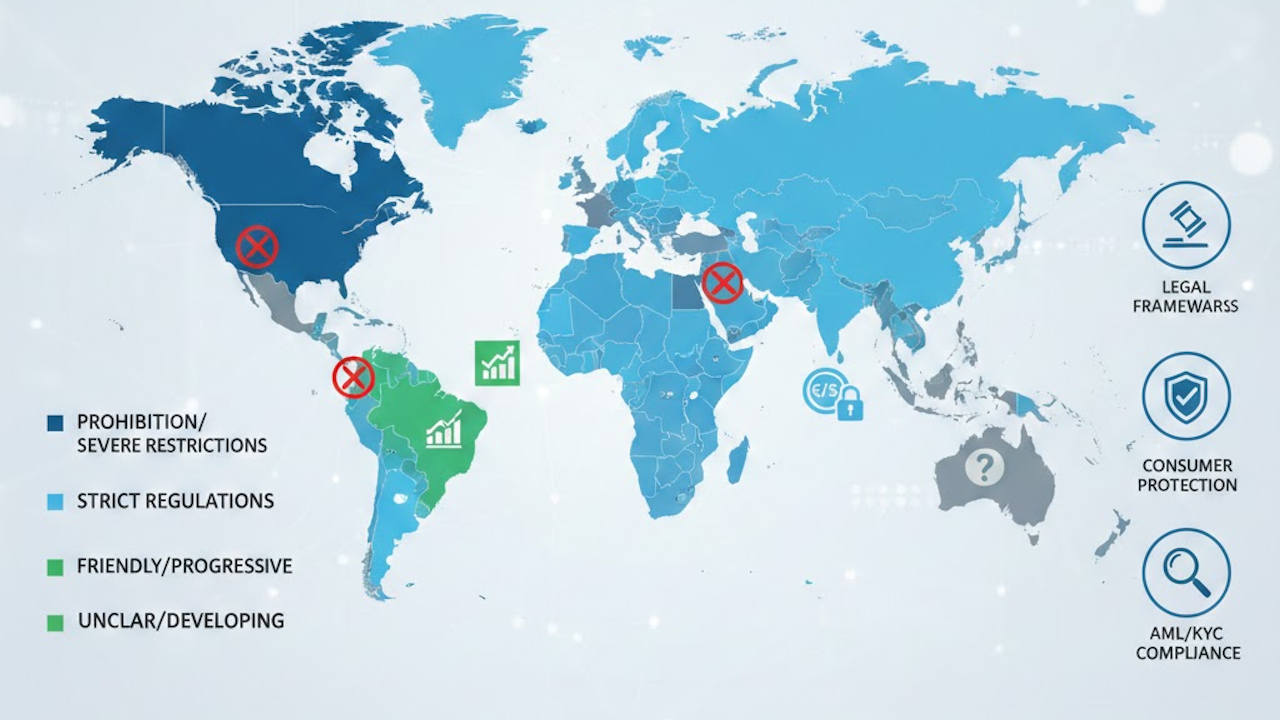
Cryptocurrencies have transformed from niche digital assets to a global financial phenomenon, prompting governments worldwide to develop regulatory frameworks to address risks like money laundering, consumer protection, and financial stability while fostering innovation. As of early 2026, the regulatory landscape varies significantly by region, with some countries embracing crypto as a tool for economic growth and others imposing strict bans or controls. In 2025, key trends included the implementation of comprehensive frameworks such as the European Union’s Markets in Crypto-Assets (MiCA) regulation, the United States’ GENIUS Act for stablecoins, and advancements in stablecoin oversight in Asia and the Middle East. Globally, over 70 percent of jurisdictions advanced stablecoin rules, reflecting a shift from enforcement to structured guidelines. This article explores how governments regulate crypto across regions, drawing on recent developments and outlooks for 2026.
North America
In North America, cryptocurrency regulation emphasizes integration with existing financial systems, with a focus on anti-money laundering (AML) compliance, taxation, and consumer safeguards. The United States leads with a complex, multi-agency approach, while Canada and Mexico adopt more centralized models.
The United States treats cryptocurrencies as legal, classifying them as property for tax purposes by the Internal Revenue Service (IRS) and as commodities by the Commodity Futures Trading Commission (CFTC). Money services businesses, including exchanges, must register with the Financial Crimes Enforcement Network (FinCEN) and implement AML programs. In 2025, the GENIUS Act established federal standards for stablecoin issuance, requiring full reserves, audits, and oversight, with implementation regulations expected by July 2026. The Securities and Exchange Commission (SEC) launched Project Crypto for rulemaking on tokens and trading, while the CFTC initiated a “crypto sprint” for regulatory alignment. Banking regulators, including the Office of the Comptroller of the Currency (OCC), reopened pathways for banks to offer custody and stablecoin services, reversing prior restrictions. States like New York (via the Department of Financial Services) and California enforced stringent requirements, with New York tightening capital and audit rules. Wyoming introduced a state-issued stablecoin, FRNT. For 2026, expect further clarity on market structure and potential revisions to bank crypto exposure rules under Basel standards.
Canada regulates crypto as legal, treating it as a commodity. Dealers must register as money services businesses with the Financial Transactions and Reports Analysis Centre (FINTRAC), maintaining compliance programs and reporting suspicious activities. In 2025, stablecoin rules under the Canadian Securities Administrators (CSA) permitted only fiat-backed CAD or USD stablecoins with full reserves, with Circle’s USDC becoming the first compliant one. Enforcement targeted unregistered platforms, and banks like Bank of Montreal banned credit card purchases of crypto. Quebec regulates exchanges and ATMs under its Money-Services Businesses Act. Outlook for 2026 includes expanded stablecoin regulations with allocated funding.
Mexico views crypto as legal but not legal tender, subjecting it to AML under the 2018 FinTech Law. In 2025, AML reforms expanded to virtual asset service providers (VASPs) and non-financial entities, requiring risk assessments and audits. Financial institutions remain cautious, with no broad approvals for crypto activities.
Europe
Europe has one of the most harmonized approaches to crypto regulation, driven by the European Union’s MiCA framework, which aims to balance innovation with risk mitigation. Individual countries adapt EU rules while adding national nuances.
The European Union classifies crypto as legal, with MiCA fully implemented in 2025, allowing crypto-asset service providers (CASPs) to passport authorizations across member states. Exchanges are VAT-exempt, but income taxes apply. The European Securities and Markets Authority (ESMA) issued supervisory briefings and registries, providing grace periods for non-compliant stablecoins until Q1 2026. The Digital Operational Resilience Act (DORA) addressed ICT risks, and the Anti-Money Laundering Authority (AMLA) prioritized crypto supervision. Bans on privacy coins like Monero are planned for 2027. National divergences persist, with Germany leading in CASP approvals (20 in 2025) and issuing the first euro stablecoin. France and the Netherlands also advanced MiCA onboarding with AML guidance. For 2026, MiCA supervision and tax reporting under DAC8 will clarify, reducing arbitrage.
The United Kingdom, post-Brexit, treats crypto as legal but not legal tender. In 2025, consultations covered market structure, stablecoins, and DeFi, with the Bank of England proposing caps on GBP stablecoin holdings. The Financial Conduct Authority (FCA) expanded beyond MiCA, addressing lending and staking. AML risks for crypto were upgraded, with sanctions assessments targeting evasion. Bitcoin ATMs were shut down in 2022 as illegal. 2026 expectations include finalized stablecoin and conduct rules.
Switzerland recognizes crypto as legal, focusing on blockchain in “Crypto Valley.” In 2025, it issued the first DLT trading license and proposed new licenses for stablecoin issuers. Tax reporting advanced under the Crypto-Asset Reporting Framework (CARF).
Other countries like Germany treat Bitcoin as private money with sales tax, while Turkey bans crypto payments since 2021.
Asia
Asia’s crypto regulations range from outright bans to supportive frameworks, reflecting diverse economic priorities. High-adoption countries like India and Vietnam are moving toward structured oversight.
China maintains a strict ban on crypto, prohibiting institutions from handling, trading, or mining since 2013-2021. Domestic use is illegal, with ongoing crackdowns.
Japan treats crypto as legal but not currency, regulating under the Payment Services Act since 2017 with AML requirements. In 2025, it proposed treating crypto as securities, issued stablecoin licenses, and planned tax cuts from 55 percent to 20 percent. Bank stablecoin pilots advanced. For 2026, expect reforms allowing banks to hold crypto investments.
South Korea allows crypto trading but prohibits minors and foreigners; real-name accounts are required on registered exchanges. In 2025, an institutional trading pilot launched, and stablecoin proposals circulated under a pro-crypto administration. Banks tested KRW stablecoins. 2026 outlook includes legalized spot ETFs and won stablecoins.
India legalized crypto in 2020 after lifting a banking ban, but it’s not legal tender. In 2025, VDA registration enforced, with 50 providers registered and offshore platforms notified. E-rupee pilots continued without a full framework. 2026 may see comprehensive legislation.
Hong Kong regulates virtual assets, with a 2022 framework embracing digital assets and finalized supervision by 2023. In 2025, the Stablecoin Ordinance launched with reserve and AML standards, tested in a sandbox. ASPIRe roadmap allowed staking and OTC dealing. Licenses expected in 2026.
Singapore treats crypto as legal, with tax guidelines since 2014 and oversight under the Payment Services Act. In 2025, licensing expanded to offshore services, with stablecoin consultations. Project BLOOM tested tokenized settlements. Final stablecoin regime in 2026.
Other nations: Vietnam legalized crypto in 2025 via new law, effective 2026, with pilots for licensed platforms. Thailand approved USD stablecoins and tax exemptions. Indonesia shifted oversight to OJK with 29 CASPs licensed. Pakistan formed a Crypto Council and authority, replacing bans. Bangladesh and Nepal maintain bans or restrictions.
Middle East and Africa
The Middle East focuses on innovation hubs, while Africa addresses high adoption with emerging frameworks.
In the United Arab Emirates, crypto is legal with banking bans lifted; licensing began in Dubai in 2018. In 2025, frameworks consolidated, with PTSR limiting payments to dirham stablecoins and approvals for AED stablecoins. VARA updated rulebooks and enforced against unlicensed operators. Removed from EU high-risk list.
Saudi Arabia has banking bans but advanced digital asset frameworks in 2025, aligning with FATF. Israel taxes crypto as assets with capital gains at 25 percent. Iran and Qatar maintain bans.
In Africa, South Africa classifies crypto as intangible assets, legal but not tender. In 2025, stablecoin diagnostics published, Travel Rule implemented, and progressed off FATF gray list. Nigeria has banking bans since 2017 but uses securities frameworks incrementally. Algeria, Egypt, and Morocco ban crypto. Central African Republic briefly adopted Bitcoin as tender in 2022 but repealed it. 2026 focus on stablecoins in trade.
Latin America
Latin America shows a mix of adoption and caution, with El Salvador as an outlier.
El Salvador made Bitcoin legal tender in 2021, issuing 60 DASP licenses in 2025 and making acceptance voluntary. Allowed regulated institutions to offer crypto to high-net-worth investors.
Brazil regulates crypto as legal, with licensing for VASPs since 2022. In 2025, finalized VASP regime with AML, capital requirements, and reporting for large transactions. Dropped blockchain from CBDC Drex. Authorization starts February 2026.
Argentina expanded VASP registrations in 2025, introducing AML and sandbox for tokenized assets. Banking ban since 2022.
Mexico’s 2025 AML reforms covered VASPs. Bolivia and Venezuela have partial bans, with Venezuela prohibiting mining since 2023.
Oceania
Oceania emphasizes AML and innovation, with Australia leading.
Australia regulates crypto as legal, requiring exchanges to register with AUSTRAC since 2018. In 2025, draft laws for digital assets and stablecoins published, with first stablecoin license granted. Tightened AML for ATMs. Travel Rule from March 2026.
New Zealand treats crypto as legal, with no specific approvals needed for storage.
Pacific islands like Tonga and Fiji plan Bitcoin as tender, with Vanuatu lifting bans in 2021.
Conclusion
Global crypto regulation in 2026 will likely emphasize stablecoin consistency, institutional adoption, and AML enhancements, driven by international bodies like FATF and FSB. While bans persist in some areas, most governments are shifting toward frameworks that integrate crypto into financial systems, balancing risks with opportunities for growth. As adoption rises, ongoing adaptations will shape the future of digital assets.