

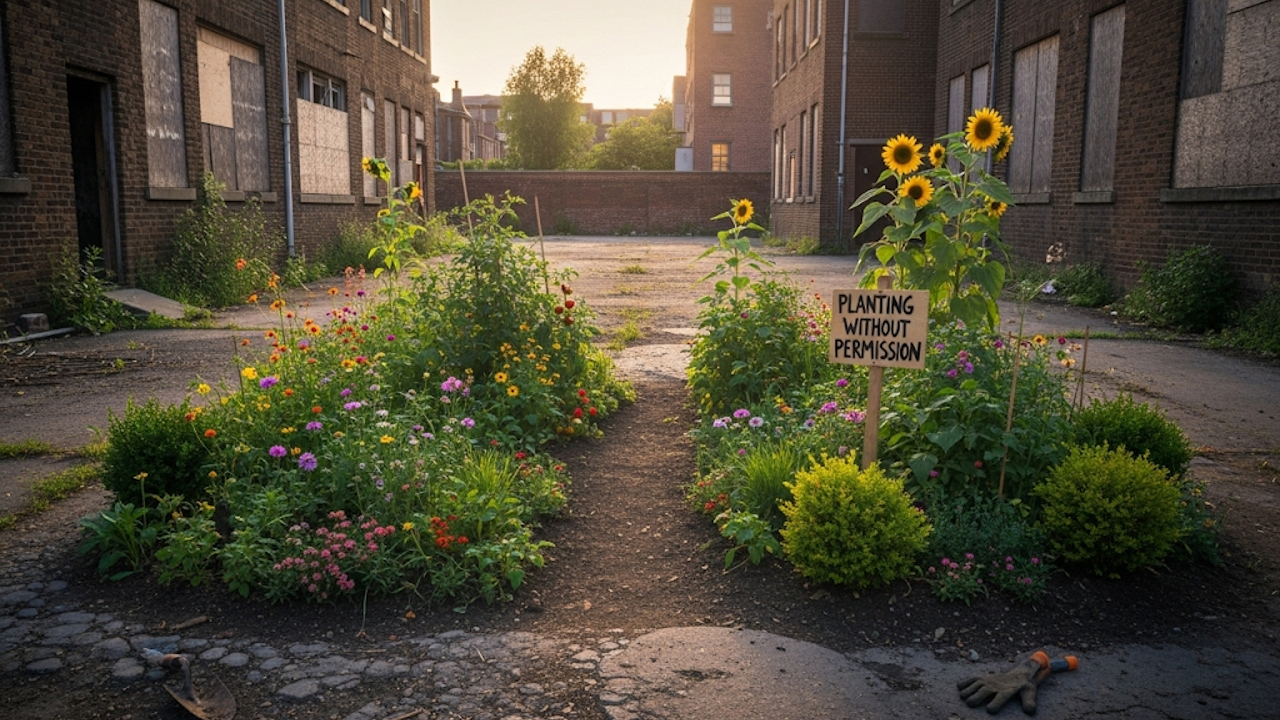
Guerrilla gardening is the act of cultivating plants in spaces where one does not have official permission to do so. It transforms neglected urban land, roadside verges, vacant lots, and other overlooked areas into gardens filled with flowers, vegetables, herbs, or trees. Practitioners, known as guerrilla gardeners, operate outside traditional boundaries of property ownership and municipal approval. Their motivation often stems from a desire to reclaim public space, combat urban blight, promote biodiversity, or address food insecurity. This practice blends environmental activism, community building, and quiet defiance against overly regulated cityscapes.
The term guerrilla gardening evokes images of stealthy operations under cover of darkness, with gardeners slipping into abandoned sites to sow seeds or plant seedlings. While some actions do occur at night for discretion, many take place openly during daylight hours. The core principle remains the same: planting without asking for permission first. This approach challenges conventional notions of land use and ownership, asserting that neglected spaces belong to the community that interacts with them.
Origins and Evolution
Guerrilla gardening has roots that stretch back decades, though its modern form gained prominence in the 1970s. In New York City, artist Liz Christy and her Green Guerrillas group began throwing seed bombs into derelict lots in the Bowery neighborhood in 1973. These seed bombs, a mixture of seeds, compost, and clay, allowed plants to take root in hard-to-reach or compacted soil. Their efforts eventually led to the creation of the Bowery Houston Community Farm and Garden, one of the first recognized community gardens in the city.
Similar movements emerged around the same time in other cities. In London, the practice took hold in the 1990s and early 2000s with groups targeting roundabouts, railway embankments, and neglected parks. One notable early figure was Richard Reynolds, who documented his own plantings on his website and in books, popularizing the concept globally through the internet. Reynolds started gardening in his own London neighborhood and expanded to public spaces, emphasizing beauty and accessibility.
Over time, guerrilla gardening evolved from small-scale flower plantings to larger efforts focused on food production. In the wake of economic crises, such as the 2008 financial downturn, community groups turned to vacant lots for vegetable gardens to supplement diets and foster self-reliance. The practice also intersected with environmental movements, as participants sought to increase green cover in cities to mitigate heat islands, improve air quality, and support pollinators.
Today, guerrilla gardening appears in various forms across continents. In Los Angeles, groups have transformed traffic islands into mini-orchards. In Berlin, community activists have claimed derelict sites for collective growing spaces. In developing nations, informal gardening on urban fringes often serves immediate survival needs rather than ideological statements. The rise of social media has amplified the movement, with hashtags and online forums allowing gardeners to share techniques, locations, and successes.
Motivations Behind the Movement
Participants cite multiple reasons for engaging in guerrilla gardening. Environmental concerns rank high. Urban areas often suffer from concrete dominance, which reduces biodiversity and exacerbates climate issues. Planting native species or pollinator-friendly flowers helps restore ecological balance. Food justice forms another pillar. Many low-income neighborhoods lack access to fresh produce, creating food deserts. Guerrilla gardens can provide free or shared vegetables, fruits, and herbs to residents.
Aesthetic and psychological benefits also drive the practice. Transforming a trash-strewn lot into a blooming garden improves neighborhood morale and deters crime through the broken windows theory in reverse. Some gardeners view their work as political protest against privatization of public space or neglect by local authorities. Others simply enjoy the thrill of creative rebellion and the satisfaction of seeing plants thrive where none existed.
Community building emerges as a key outcome. Gardening projects often draw neighbors together for planting days, maintenance sessions, and harvests. These interactions strengthen social ties in increasingly isolated urban environments. For immigrants and marginalized groups, guerrilla gardens can serve as cultural anchors, allowing cultivation of traditional crops that may not be available commercially.
Methods and Techniques
Guerrilla gardeners employ a range of low-tech, accessible methods suited to unauthorized settings. Seed bombing remains popular for its simplicity and minimal risk. A basic recipe involves mixing seeds with clay and compost into balls that harden when dry. These can be tossed into inaccessible areas like highway medians or fenced lots. The clay protects seeds from birds and drying out until rain activates them.
For sites with better access, direct planting or transplanting works well. Gardeners prepare soil by adding compost, mulch, or cardboard to suppress weeds. They select hardy, fast-growing species that require little ongoing care. Edibles like kale, beans, squash, tomatoes, and herbs such as basil and mint are common choices. Perennials including sunflowers, lavender, and berry bushes provide longer-term impact.
Watering presents a challenge in unauthorized spots. Some rely on rainfall, while others carry water in backpacks or use nearby sources discreetly. Drip irrigation from recycled bottles or soaker hoses can extend intervals between visits. Mulching with leaves, straw, or newspaper helps retain moisture and build soil health over time.
Stealth and adaptation are crucial. Gardeners often scout locations during the day, noting visibility, soil quality, sunlight exposure, and foot traffic. They return at optimal times for planting. Camouflage techniques include dressing as maintenance workers or blending with joggers. In some cases, gardeners seek tacit approval by informing nearby residents without alerting officials.
Advanced practitioners experiment with hugelkultur beds, which use buried wood to create self-fertilizing mounds, or no-dig methods that preserve soil structure. Others incorporate artistic elements, such as painted signs, sculptures from found objects, or mosaic pathways, turning gardens into public art installations.
Notable Examples and Projects
Several high-profile guerrilla gardening initiatives illustrate the movement’s diversity. In Detroit, following industrial decline and population loss, residents transformed thousands of vacant lots into gardens and orchards. While some secured land titles later, initial efforts operated without formal permission. These gardens now supply produce to local markets and food banks, contributing to urban agriculture revival.
Barcelona’s guerrilla gardeners have claimed rooftops, railway corridors, and empty plots. One group, the Banc Expropriat collective, maintained community spaces that combined gardening with social activism. Their work highlighted tensions between grassroots efforts and municipal redevelopment plans.
In Toronto, the Parkdale neighborhood saw residents plant fruit trees and vegetable plots in public parks and along streets. These projects emphasized sharing harvests with the community and educating children about food sources.
Smaller-scale actions abound. A single individual might plant daffodils along a forgotten fence line or herbs near a bus stop. These micro-interventions accumulate to create greener cities over years.
Benefits and Impacts
Guerrilla gardening delivers measurable advantages. It increases urban greenery, which cools temperatures, filters pollutants, and supports wildlife. Studies from various cities show that community gardens enhance mental health, reduce stress, and promote physical activity. They provide educational opportunities for all ages on ecology, nutrition, and sustainability.
Economically, free produce lowers food costs for participants. Surplus often reaches food-insecure households through informal networks. Property values in surrounding areas can rise as neighborhoods appear cared for and vibrant.
Socially, the practice fosters stewardship. Participants develop a sense of ownership over public space, leading to greater civic engagement. Gardens can deter illegal dumping and graffiti by making spaces feel claimed and valued.
Biodiversity gains are significant. Even small plots can host dozens of plant species, attracting bees, butterflies, and birds. Native plantings help preserve local ecosystems threatened by development.
Challenges and Risks
Despite its appeal, guerrilla gardening carries risks. Legal consequences vary by jurisdiction. In many places, planting on public land without permits constitutes trespass or vandalism, potentially leading to fines, removal of plants, or arrest. Private property actions risk civil lawsuits. Some cities have responded with ordinances specifically targeting unauthorized gardening.
Maintenance poses practical difficulties. Without official support, gardens may suffer from neglect if key volunteers move away or lose interest. Vandalism, theft of produce, or damage by vehicles and animals can undo months of work. Contaminated soil in former industrial sites presents health hazards if heavy metals or pollutants are present. Testing soil before planting edibles is advisable but not always feasible in stealth operations.
Public perception can be mixed. While many applaud the beautification, others view it as disorderly or infringing on municipal authority. Conflicts arise when gardens interfere with infrastructure, block sightlines, or attract unwanted activity.
Scalability remains limited. Most guerrilla projects stay small and temporary. Transitioning to sanctioned community gardens often requires negotiation with authorities, which some purists resist as contrary to the ethos.
Legal and Ethical Considerations
The legality of guerrilla gardening depends on context. Public land managed by cities may fall under parks department jurisdiction, where unauthorized alteration violates regulations. Railway or utility land carries additional safety and liability concerns. Private vacant lots raise trespass issues.
Ethically, practitioners debate the balance between individual initiative and collective rules. Proponents argue that unused land represents a moral waste when people need food and beauty. Critics counter that bypassing processes undermines democratic governance and can lead to inequitable outcomes if certain groups dominate spaces.
Many guerrilla gardeners advocate for policy changes. They push for easier permitting of community gardens, adoption of edible landscapes in public parks, and land banks for urban agriculture. Successful examples include cities like Portland, Oregon, and Vancouver, Canada, which have formalized some guerrilla efforts into official programs.
Getting Started: A Practical Guide
Aspiring guerrilla gardeners should begin small and local. Research local laws and identify low-risk sites such as neglected traffic circles, sidewalk strips, or corporate-owned vacant land where enforcement is lax. Start with seed bombing in truly inaccessible spots to test the waters.
Gather materials: seeds suited to the climate and soil, compost, tools like trowels or gloves, and water containers. Choose resilient plants. For flowers, consider marigolds, poppies, or cosmos. For food, opt for leafy greens, radishes, or pole beans that produce quickly.
Document progress with photos and notes, but avoid publicizing exact locations if continuing stealth operations. Connect with local groups through online forums or environmental meetups for support and knowledge sharing.
Focus on sustainability. Use organic methods, avoid invasive species, and plan for succession planting so the garden evolves naturally. Engage neighbors positively to build allies rather than adversaries.
The Future of Guerrilla Gardening
As urbanization accelerates and climate challenges intensify, guerrilla gardening offers a grassroots response. Technology aids the movement through mapping apps for potential sites, seed-sharing networks, and citizen science tools for monitoring biodiversity.
Integration with broader movements, such as permaculture, regenerative agriculture, and social justice, expands its reach. Youth involvement through school programs could normalize urban growing.
Challenges persist, including balancing spontaneity with responsibility. The most successful efforts often blend unauthorized beginnings with eventual official recognition, creating hybrid models that preserve the rebellious spirit while ensuring longevity.
Guerrilla gardening reminds us that cities are living systems shaped by their inhabitants, not just planners and developers. By planting without permission, individuals assert agency over their environment. Each seed sown represents hope for greener, more equitable, and more resilient urban futures. Whether a single flower on a roadside or a full community plot on a vacant lot, these acts accumulate into meaningful change. The soil awaits those willing to take the first step.