

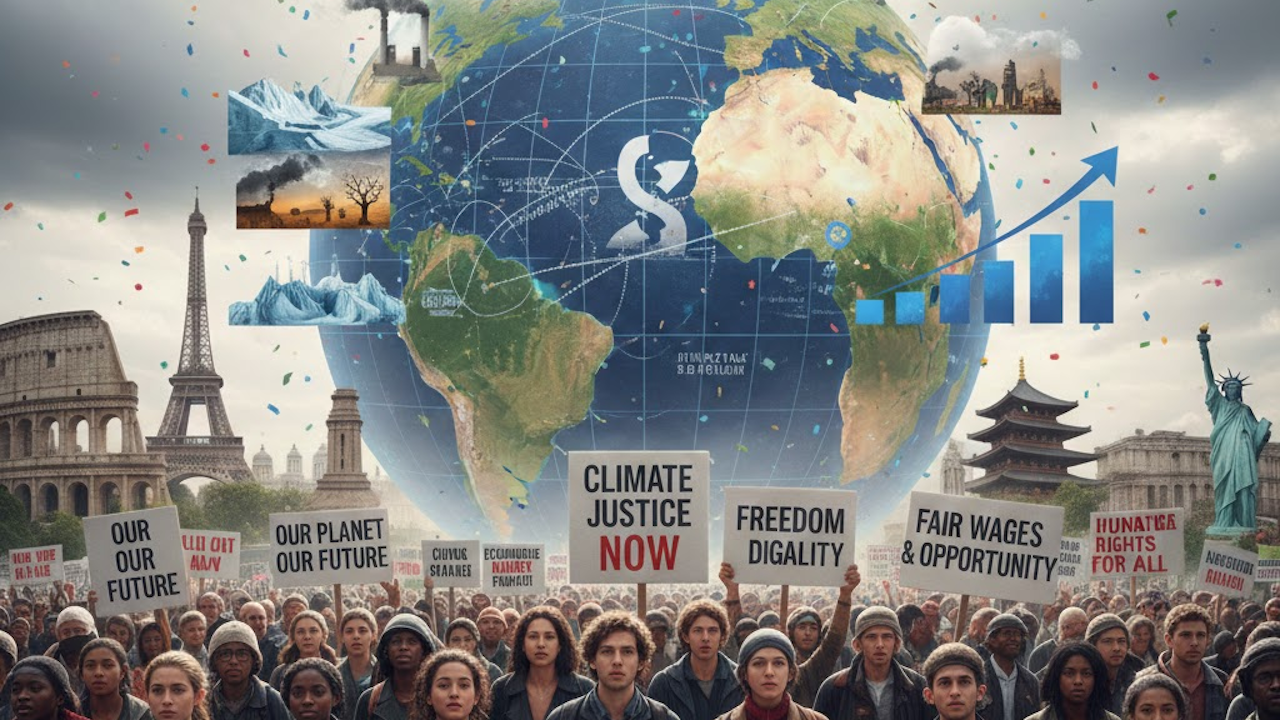
In recent years, streets across continents have filled with demonstrators voicing deep frustrations that transcend borders. From the youth-led uprisings in South Asia and Africa to labor marches in Europe and solidarity rallies tied to distant conflicts, a wave of protests has marked the mid-2020s as a period of heightened civic unrest. More than seventy countries saw significant antigovernment demonstrations in 2025 alone, according to tracking by the Carnegie Endowment for International Peace, with many continuing or reigniting into 2026.
These movements rarely share identical demands or political ideologies. A tax hike in one nation, a corruption scandal in another, or chronic shortages of basic services elsewhere can serve as the spark. Yet beneath the surface, common causes emerge that unite people who may never meet: economic hardship that squeezes daily life, perceptions of entrenched corruption that erode trust in leaders, democratic backsliding that closes off formal avenues for change, and a generational sense among younger cohorts that the systems they inherit no longer deliver opportunity or accountability. Social media amplifies these shared grievances, allowing tactics, symbols, and slogans to travel rapidly from one capital to another.
Understanding these unifying forces requires looking past the headlines of any single protest. The result is a clearer picture of why so many ordinary citizens, particularly the young, feel compelled to take to the streets even when facing risks of repression.
Economic Hardship as a Persistent Catalyst
Economic pressures form one of the most consistent threads linking protests worldwide. Rising costs of living, stagnant wages, youth unemployment, and austerity measures have repeatedly driven people into the streets. In 2025, demonstrations against unpopular fiscal reforms erupted in countries as varied as Belgium, Indonesia, France, Slovakia, Romania, and Argentina. Protesters argued that cuts to pensions, education funding, and worker benefits would deepen existing struggles rather than solve them.
Similar patterns appeared elsewhere. In Kenya, Gen Z-led protests that began in 2024 against a controversial tax bill and continued into subsequent years centered on the rising cost of living, joblessness, and the sense that government policies favored elites over ordinary citizens. In Madagascar, chronic power outages and water shortages in 2025 escalated into broader demands for better governance after years of economic strain. Indonesia saw repeated waves of unrest tied to unemployment, fuel price hikes, tax increases, and controversies over government spending programs that many viewed as mismanaged.
These economic grievances are not confined to lower-income nations. In wealthier countries, inflation, housing costs, and reforms affecting public services have similarly fueled discontent. May Day demonstrations in 2026 across Europe and Asia often blended traditional labor demands with anger over living costs, showing how workplace issues now intersect with wider economic anxiety.
What unites these cases is a widespread perception that the benefits of economic growth have been unevenly distributed. Many protesters describe a system in which a small elite prospers while the majority faces diminished prospects. Youth unemployment rates remain high in numerous countries, leaving large cohorts of educated young people without stable work or clear paths to independence. When governments respond with higher taxes or reduced services, the frustration intensifies. Economic hardship alone does not always produce mass mobilization, but when combined with visible inequality or policy decisions that appear disconnected from everyday realities, it becomes a powerful mobilizing force.
Corruption and the Demand for Accountability
Anger over corruption ranks alongside economic hardship as a primary driver. Carnegie’s analysis of 2025 protests identified government corruption as a sizeable fuel for demonstrations across multiple regions. Specific scandals often provide the immediate trigger. In North Macedonia, protests followed allegations of bribery linked to a deadly nightclub fire. In Spain, thousands marched over political and corruption scandals surrounding the administration. In the Gambia, persistent corruption issues prompted demands for greater accountability.
The Gen Z protests that spread through parts of Asia, Africa, and Latin America in 2025 frequently highlighted nepotism, elite privilege, and the misuse of public resources. In Indonesia, news that lawmakers would receive housing allowances many times higher than the local minimum wage sparked student-led demonstrations. In Nepal, corruption and censorship concerns contributed to rapid escalation that led to the resignation of top officials. Similar themes appeared in Morocco, Peru, the Philippines, and elsewhere.
Corruption matters because it undermines the social contract. When citizens believe leaders enrich themselves or their allies at public expense, trust collapses. This perception is especially acute among younger generations who see limited opportunities for themselves while witnessing ostentatious displays of wealth among those in power. Protests against corruption often evolve quickly into broader critiques of the political system, as demonstrators conclude that existing institutions cannot or will not police themselves.
Democratic Backsliding and Antidemocratic Overreach
A third major unifying cause involves concerns over democratic erosion and government overreach. Protests in 2025 and into 2026 frequently targeted measures that expanded executive power, restricted civil liberties, or appeared to manipulate electoral processes. In Indonesia, students and activists opposed revisions to military law that allowed officers greater roles in civilian government. In Georgia, sustained protests followed disputed elections and the suspension of European Union accession talks. Other examples include demonstrations against laws expanding surveillance or limiting assembly rights.
These movements reflect a shared anxiety that formal democratic mechanisms are failing. When elections are viewed as unfair, when independent institutions are weakened, or when authorities respond to dissent with excessive force, people turn to the streets as an alternative channel. The Carnegie tracker noted that antidemocratic overreach remained a major theme continuing from previous years.
Youth-led movements have been particularly vocal on this front. Many participants describe a sense of political exclusion: formal politics appears dominated by older elites unresponsive to younger priorities. In several cases, the protests themselves became tests of democratic resilience, as governments faced choices between dialogue and repression. Police brutality, including deaths in custody or during demonstrations, has repeatedly reignited anger and expanded participation beyond the original core of activists.
The Generational Dimension: Gen Z and Shared Discontent
One of the most striking features of recent global protests is the prominent role of Generation Z, those born roughly between the late 1990s and early 2010s. In 2025, youth-led uprisings cascaded across countries including Indonesia, Nepal, Kenya, Madagascar, Morocco, Peru, the Philippines, and others. While local triggers differed, the movements shared a consistent set of grievances: political corruption, economic exclusion, police repression, and the feeling that young people lack a meaningful political voice.
Observers have noted the decentralized, digitally coordinated nature of these protests. Social media platforms allow rapid organization without traditional hierarchical leadership. Symbols, such as the pirate flag from the anime series One Piece, appeared across multiple countries as a marker of resistance to authority and corruption. Tactics and messaging crossed borders with remarkable speed, creating a sense of transnational solidarity even when national contexts varied widely.
This generational wave builds on earlier youth mobilizations, including climate strikes and earlier democracy movements. Yet the 2025 surge stood out for its scale and its focus on immediate governance failures rather than solely long-term issues. Young protesters often framed their actions as necessary because institutional channels felt blocked. High youth populations in many of the affected countries, combined with digital literacy and exposure to global information flows, created conditions ripe for rapid mobilization.
Importantly, these movements were rarely exclusively youth affairs. Successful cases often drew in older generations, labor groups, and civil society organizations. The common thread remained a belief that current systems were failing to deliver basic fairness and opportunity.
Geopolitical Conflicts and Broader Solidarity
Not all unifying causes are purely domestic. Ongoing conflicts, particularly the war in Gaza, have sustained monthly protests across continents for years. Demonstrations in Italy, Morocco, Malaysia, Australia, and many other places have expressed solidarity, demanded ceasefires, or criticized related foreign policies.
May Day events in 2026 illustrated how labor protests increasingly intertwined with geopolitical anger, including critiques of foreign policy and broader anti-capitalist or anti-imperialist narratives. In some cities, rising living costs were explicitly linked by demonstrators to distant wars or international power dynamics.
Anti-globalization and anti-summit actions, such as large gatherings opposing the G7 in Geneva in June 2026, further show how local mobilizations can connect to critiques of international institutions and perceived imperialism.
These transnational elements do not erase national differences. They do, however, provide additional layers of shared language and purpose. Protesters in one country can draw moral energy from events elsewhere, reinforcing the idea that their local struggles form part of larger patterns of injustice.
The Role of Technology and Contagion Effects
Digital connectivity has transformed how protests form and spread. Platforms enable leaderless coordination, rapid information sharing, and the viral dissemination of images and slogans. Contagion effects are visible: successful or highly visible mobilizations in one country have inspired similar actions in others within weeks or months. The Gen Z wave of 2025 demonstrated this clearly, with movements influencing one another across significant distances.
Technology also carries risks. Governments can monitor, disrupt, or counter online organizing. Misinformation can distort narratives. Yet the overall effect has been to lower barriers to participation and to create a sense of global audience that emboldens local actors.
Underlying Structural Pressures
Beyond immediate triggers, longer-term structural factors help explain the persistence of protest waves. Rising inequality in many societies has left large segments of the population feeling that economic systems primarily serve elites. Trust in government remains low in numerous countries, according to various surveys. Climate pressures, while not always the dominant protest theme in 2025-2026, continue to interact with economic and governance failures, especially where environmental degradation worsens living conditions or resource scarcity.
The COVID-19 pandemic left lasting scars on economies, education systems, and public finances. Subsequent inflation, debt burdens, and policy responses have compounded those effects. In this environment, even relatively modest policy missteps can ignite broader discontent.
Impacts and Limitations
The outcomes of these protests vary widely. Some have forced policy reversals, resignations, or even changes in government. Others have been met with repression that temporarily quiets the streets without resolving underlying issues. Lasting institutional change remains uncertain in many cases. What is clearer is that the frequency and geographic spread of protests signal widespread dissatisfaction with the status quo.
Protests can also fragment. Different groups within a movement may pursue competing goals. External actors sometimes seek to co-opt or discredit mobilizations. Sustained success often requires translating street energy into durable political organization, a step many movements struggle to complete.
Conclusion: Shared Human Concerns in a Connected World
The causes uniting people in global protests are neither mysterious nor uniquely modern. Economic insecurity, corruption, the erosion of accountable governance, and the desire for a fairer distribution of opportunity have driven collective action throughout history. What distinguishes the current period is the speed with which these grievances can connect across continents and the demographic energy of a large, digitally fluent younger generation that refuses to accept diminished prospects as inevitable.
As of mid-2026, the surge that defined 2025 has not fully subsided. Movements continue, adapt, or reappear under new triggers. Whether they produce deeper reforms or merely episodic pressure depends on the responses of governments and the capacity of protesters to maintain focus beyond the initial outburst of anger.
At their core, these demonstrations express a fundamental human demand: that political and economic systems serve the many rather than the few, that leaders remain accountable, and that ordinary people retain meaningful avenues to shape their collective future. In that sense, the protests of recent years reveal not only division and discontent but also a persistent, worldwide aspiration for systems that better match the expectations of those who live under them.