

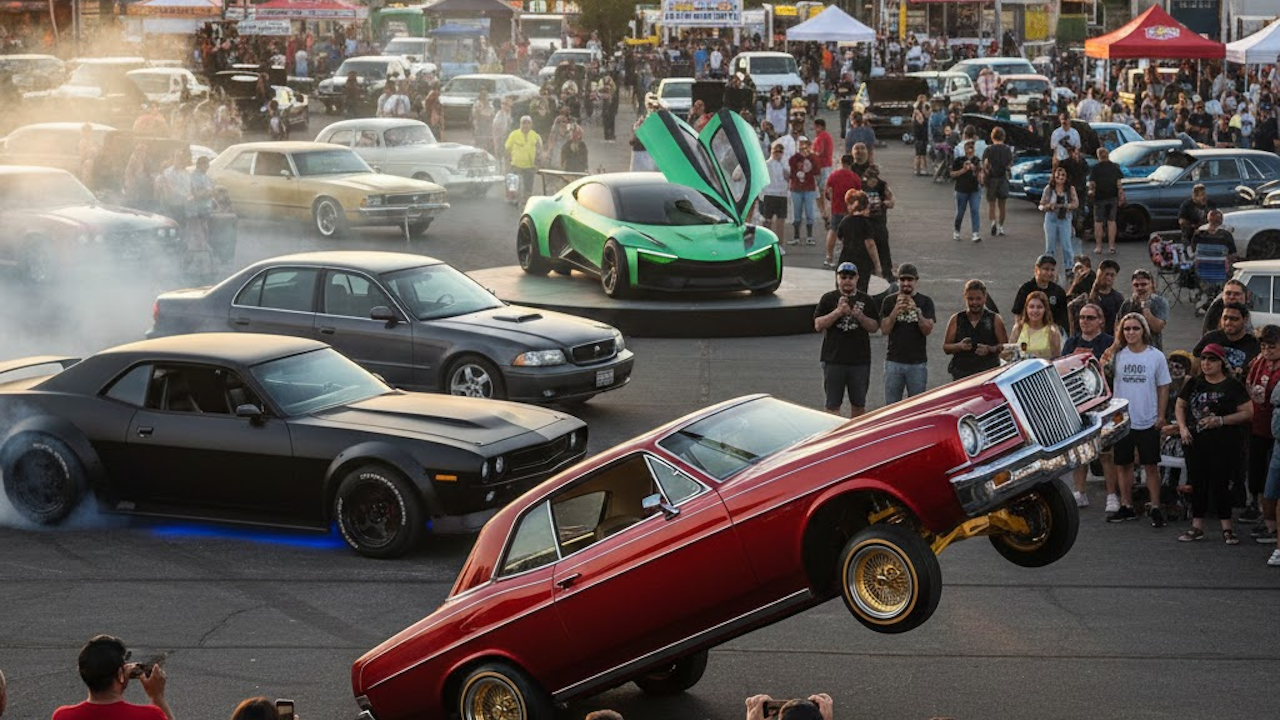
For decades, the biggest crowds at major automotive events like SEMA, Goodguys, and even Pebble Beach gathered around pristine factory restorations or ultra-rare supercars that rolled off the assembly line costing seven figures. A perfect 1969 Camaro ZL1 or a brand-new Bugatti Chiron once guaranteed center-stage attention. Today, something has shifted dramatically. The vehicles now stopping foot traffic dead in its tracks are rarely stock, rarely original, and almost never subtle. Custom rides, once relegated to fringe gatherings or late-night cruise spots, have stormed the main arenas of the car world and, in many cases, completely stolen the show.
This takeover did not happen overnight. It built slowly through the 2000s on television screens with shows like Overhaulin’, Pimp My Ride, and Monster Garage, then accelerated through social media in the 2010s. Builders who once worked in relative obscurity suddenly had global audiences. A single well-timed Instagram post or YouTube premiere could bring more eyes than a magazine cover ever did. The result is a new generation of enthusiasts who value creativity, engineering audacity, and personal expression over historical purity or factory perfection.
At the 2024 SEMA Show in Las Vegas, the trend reached an unmistakable tipping point. The central feature vehicles in the main halls included a 1963 split-window Corvette restomod with a twin-turbo LSX making 1,200 horsepower, a widebody 1970 Dodge Charger on air suspension with a Hellcat Redeye drivetrain, and a 1955 Chevrolet Bel Air convertible riding on a full Art Morrison chassis with carbon-fiber panels. None of these cars could ever be called “original,” yet each drew lines longer than most manufacturer displays. Toyota even handed its own booth centerpiece duties to a custom shop that built a Supra with a 2JZ swapped into a 1960s Datsun roadster body. The message was clear: even the OEMs now recognize that custom culture drives excitement.
The reasons behind this shift are both cultural and technological. Modern manufacturing has made factory cars remarkably competent. A base-model Civic Si today outperforms many 1990s exotics on track, and reliability has reached the point where a daily-driven Lamborghini often needs less maintenance than a classic muscle car. When everything coming out of showrooms is already fast, comfortable, and electronically sophisticated, the only frontier left for true differentiation is individual vision.
Enter the custom builder armed with tools that simply did not exist twenty years ago. Computer-aided design lets a one-man shop in rural Nebraska design parts that once required an entire engineering department. Affordable CNC machining and 3D printing mean those designs can become reality in weeks instead of years. Tube-frame chassis companies like Roadster Shop and Art Morrison sell bolt-in solutions that transform handling without destroying originality (or at least the appearance of it). And perhaps most crucially, the aftermarket has caught up to OEM power levels. A crate engine from Chevrolet Performance or Ford Performance can deliver 1,000-plus horsepower with a full warranty, something unthinkable a decade ago.
The result is a golden age of “restomods,” pro-touring builds, and outright customs that look vintage but drive like modern supercars. Ringbrothers, a small shop out of Wisconsin, has become the perfect example. Their 1948 Chevrolet “Madam V” pickup took home the 2023 SEMA Battle of the Builders title with a carbon-fiber body, 1,200-horsepower quad-turbo V8, and suspension geometry that would make a GT3 RS engineer nod in approval. The truck looks like a slammed 1940s hauler until you notice the 20-inch forged wheels, massive brakes, and the fact that it corners harder than most new Corvettes.
Similar stories play out across the country. SpeedKore in Wisconsin builds full carbon-fiber 1970 Dodge Chargers that weigh less than a Mazda Miata yet pack demon-swapped power. Kindred Motorworks sells turnkey electric 1960s Volkswagen buses with Tesla drivetrains and modern interiors while keeping every exterior detail perfect. Icon reimagines old Broncos and FJ Cruisers with handcrafted perfection that often exceeds original build quality. These are not cheap hacks; many of these vehicles trade hands for half a million dollars or more, sometimes rivaling the cost of actual hypercars.
Even the traditional concours world has begun bending. The Pebble Beach Concours d’Elegance, long the bastion of untouched classics, introduced a dedicated post-war custom class in recent years. At the 2025 event, a 1932 Ford roadster built by Troy Ladd of Hollywood Hot Rods won Best in Class against original Duesenbergs and Delahayes. The car featured a hand-formed aluminum body, a supercharged flathead V8, and paintwork that took over a thousand hours. Judges praised its “artistic merit” and “technical excellence,” words rarely used for hot rods in that setting a decade earlier.
Goodguys and the Triple Crown of Rodding have seen similar evolution. Where once a perfect paint job and a big-block Chevy were enough to win, today’s top awards go to vehicles with independent rear suspensions, six-speed manuals, and interiors that look lifted from a Bentley. The 2024 Goodguys Top 12 “Street Machine of the Year” went to a 1967 Camaro with a full carbon-fiber tub, twin-turbo LS, and a chassis so sophisticated the builder claimed it could out-handle a C8 Corvette on track. Spectators spent more time studying the suspension geometry than the candy paint.
This custom dominance has created tension in some circles. Purists argue that chopping, channeling, and modernizing destroys automotive history. They point to cars that were once numbers-matching originals now cut apart for wider wheels and bigger engines. Yet the counterargument grows stronger each year: many of these vehicles would have rusted away in fields without the custom treatment. A 1970 Chevelle saved by a full rotisserie restoration and LS swap is still on the road, still loved, still turning heads. Is that worse than letting it disappear entirely?
The market has already voted. Hagerty reports that restomods and pro-touring builds have become the fastest-appreciating segment of the collector car world. A high-end custom that cost $400,000 to build five years ago now routinely sells at auction for $600,000 or more. Compare that to many 1970s muscle cars that have flattened or declined in value after the initial boom. The money follows attention, and attention now follows creativity.
Younger enthusiasts, particularly those under forty, show little interest in pure preservation. They grew up with Need for Speed, Gran Turismo, and Rocket Bunny kits. To them, a car is a canvas first and a historical artifact second. The rise of events like the Players Classic, Hoonigan gatherings, and the Mooneyes shows in Japan reinforces this mindset globally. Stance culture, drift cars, and over-fendered JDM classics share space with American pro-touring builds under the same big custom tent.
Manufacturers have taken notice and begun partnering directly with custom shops. Ford sells turnkey supercharged Coyote crate engines specifically marketed to restomod builders. Dodge offers the Direct Connection catalog with everything needed to Hellcat-swap virtually anything. Chevrolet Performance has an entire “Connect & Cruise” program pairing modern LT and LS engines with transmission and electronics packages designed for older chassis. These are not grudging concessions; they are calculated moves to capture the enthusiasm custom culture generates.
Looking ahead, the trend shows no signs of slowing. The integration of electric and hybrid powertrains into classic bodies promises the next frontier. Companies like Charge Cars (electric 1960s Mustangs) and Everrati (electric Porsche 911s) already command waiting lists and six-figure deposits. A silent, instant-torque 1930s hot rod or a battery-powered 1970s Ferrari Daytona may sound sacrilegious to some, but the first examples turning wheels at shows draw crowds just as large as any V12 classic.
What started as kids in garages with Sawzalls and spray paint has matured into a multi-billion-dollar industry blending art, engineering, and outright performance. The custom ride is no longer the sideshow; in many venues, it has become the main event. The cars stealing shows today are louder, faster, wilder, and far more personal than anything rolling off a factory floor. And for a growing segment of the automotive world, that is exactly the point.