

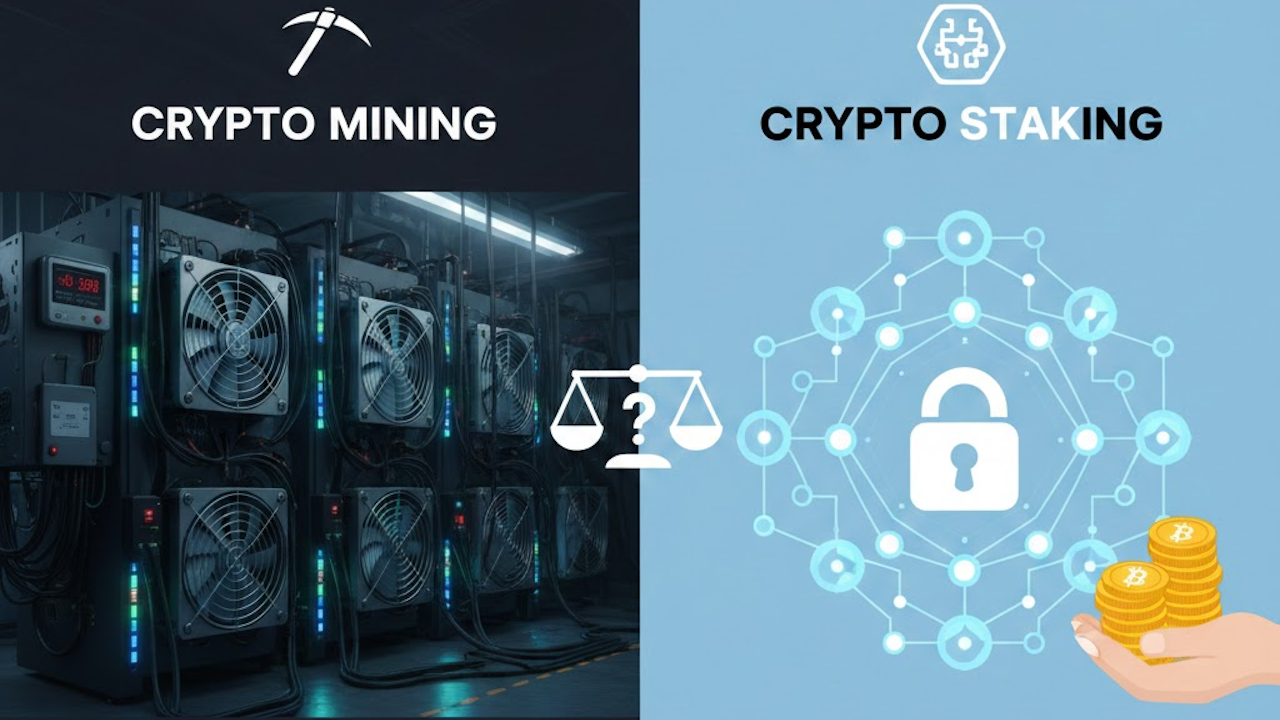
In the ever-evolving world of cryptocurrency, two prominent methods for earning rewards and supporting blockchain networks stand out: mining and staking. Both approaches allow participants to contribute to the security and functionality of decentralized systems while potentially generating passive income. However, they differ significantly in their mechanics, requirements, and outcomes. As of 2026, with blockchain technology advancing rapidly, understanding these differences is crucial for investors, enthusiasts, and newcomers alike. This article delves into the intricacies of crypto mining and staking, compares their pros and cons, and explores which might be better suited to various scenarios. Ultimately, the “better” option depends on individual circumstances, such as available resources, risk tolerance, and long-term goals.
What Is Crypto Mining?
Crypto mining is the process of validating transactions and adding them to a blockchain ledger using computational power. It primarily operates on Proof-of-Work (PoW) consensus mechanisms, which are used by networks like Bitcoin. Miners compete to solve complex mathematical puzzles, and the first to succeed gets to add a new block to the chain and receive rewards in the form of newly minted coins plus transaction fees.
How Mining Works
The mining process begins with specialized hardware, such as Application-Specific Integrated Circuits (ASICs) or Graphics Processing Units (GPUs), which perform trillions of calculations per second. These devices connect to mining software that links them to the blockchain network. Transactions from users are bundled into blocks, and miners must find a specific hash value that meets the network’s difficulty criteria a task that requires immense energy and computing resources.
For example, Bitcoin mining involves solving puzzles based on the SHA-256 algorithm. As more miners join the network, the difficulty adjusts upward to maintain a consistent block time (about 10 minutes for Bitcoin). Rewards halve periodically in events known as “halvings,” which occurred most recently in 2024, reducing the block reward to 3.125 BTC. In 2026, with increased competition and advanced hardware like next-generation ASICs, individual miners often join pools to combine resources and share rewards proportionally.
Cloud mining has emerged as an alternative, where users rent hashing power from remote data centers without owning hardware. This lowers entry barriers but introduces risks like provider reliability and potential scams.
Pros of Mining
Mining can offer substantial rewards, especially for those with access to cheap electricity and efficient setups. In favorable conditions, profitability can exceed staking yields, with some miners reporting returns based on market prices and operational efficiency. It enhances network security by making attacks prohibitively expensive, as altering the blockchain would require controlling over 50% of the hashing power (a 51% attack). Additionally, mining decentralizes control, as anyone with hardware can participate, though large operations dominate in practice.
From a financial perspective, mining rewards are often treated as income upon receipt, which can be advantageous in bull markets when crypto prices soar. It also allows for hardware resale or repurposing, providing some asset liquidity.
Cons of Mining
The downsides are significant. Mining requires high upfront costs for equipment, which can range from thousands to millions of dollars for large-scale operations. Energy consumption is enormous; Bitcoin’s network alone uses more electricity annually than some countries, leading to environmental concerns and high operational bills. In 2026, with rising global energy prices and regulatory scrutiny on carbon footprints, profitability has become volatile.
Noise, heat, and maintenance add to the challenges, making it unsuitable for home setups without proper infrastructure. Moreover, as networks mature, small-scale mining becomes less viable due to competition from industrial farms. Tax implications vary by jurisdiction; in places like Canada, mining income may be classified differently from staking, potentially increasing compliance burdens.
What Is Crypto Staking?
Staking involves locking up cryptocurrency holdings to support a blockchain’s operations, typically on Proof-of-Stake (PoS) networks like Ethereum, Solana, or Cardano. Participants, known as validators or stakers, commit their tokens to validate transactions and create new blocks, earning rewards in return.
How Staking Works
In PoS, the network selects validators based on the amount of crypto they stake and sometimes other factors like randomization to prevent centralization. Staked tokens act as collateral; if a validator behaves maliciously, they risk “slashing,” where a portion of their stake is forfeited.
Users can stake directly by running a validator node, which requires a minimum amount (e.g., 32 ETH for Ethereum) and technical know-how, or delegate to staking pools for easier participation. Rewards are distributed periodically, often as additional tokens, with Annual Percentage Yields (APYs) varying by network. In 2026, Ethereum staking yields are around 3-6%, while newer chains like Sei might offer higher rates to attract participants.
Liquid staking derivatives (LSDs), such as stETH on Ethereum, allow users to stake while retaining liquidity through tokenized representations of their locked assets.
Pros of Staking
Staking is far more accessible than mining, requiring no specialized hardware just a wallet and compatible tokens. It’s energy-efficient, consuming minimal power compared to PoW, making it environmentally friendly and cost-effective. Rewards are predictable and passive, providing steady income even during market downturns, as APY compounds over time.
In 2026, with PoS dominating new blockchains, staking promotes decentralization by encouraging widespread participation. It also hedges against volatility, as staked assets earn more tokens regardless of price fluctuations. Tax treatments can be favorable in some regions, often classified as capital gains rather than immediate income.
Cons of Staking
While rewards are consistent, they are generally lower than mining’s potential highs, with APYs ranging from 3% to 18% depending on the network. Lock-up periods can reduce liquidity, and slashing risks exist for poor validator performance. Centralization is a concern if large holders dominate staking, potentially compromising network security.
Market risks apply; if the token’s value drops significantly, rewards may not offset losses. In 2026, regulatory changes could impact staking pools or yields.
Key Differences Between Mining and Staking
To summarize the distinctions in a structured way:
| Aspect | Mining (PoW) | Staking (PoS) |
|---|---|---|
| Consensus Mechanism | Proof-of-Work: Solve puzzles with hardware | Proof-of-Stake: Lock tokens as collateral |
| Entry Requirements | High: Expensive hardware, electricity | Low: Tokens and a wallet |
| Energy Use | High: Equivalent to national grids | Low: Minimal computational needs |
| Rewards | Variable, potentially high | Steady, 3-18% APY |
| Risks | Operational costs, hardware failure | Slashing, lock-up periods |
| Environmental Impact | Negative due to energy demands | Positive, eco-friendly |
| Accessibility | Technical expertise needed | Beginner-friendly |
This table highlights why staking has gained traction in 2026, with many networks transitioning from PoW to PoS for sustainability.
Profitability Comparison in 2026
Profitability varies by market conditions. Mining can yield higher returns in bull markets with low energy costs; for instance, Bitcoin miners with efficient setups might see profits if BTC prices remain above $100,000. However, small-scale mining is rarely profitable anymore, pushing users toward cloud options.
Staking offers more stable returns. Ethereum stakers earn 3-6% APY, while high-reward chains like those with 10-15% yields attract risk-tolerant investors. In volatile periods, staking acts as a hedge, compounding holdings. Overall, for passive income, staking often edges out mining due to lower barriers and risks.
Environmental and Regulatory Impact
Mining’s energy intensity has drawn criticism, contributing to carbon emissions and prompting bans in some regions. Staking, by contrast, aligns with global sustainability goals, making it preferable in eco-conscious jurisdictions.
Regulations in 2026 emphasize transparency; mining faces scrutiny over energy use, while staking pools must comply with anti-money laundering rules.
Which Is Better: Mining or Staking?
There’s no one-size-fits-all answer. Mining suits those with technical skills, capital for hardware, and access to affordable power, offering potential for higher rewards but with greater volatility and costs. Staking is ideal for passive investors seeking low-maintenance, eco-friendly income, especially in PoS-dominant ecosystems.
Factors to consider include:
- Budget: Mining demands thousands; staking starts with hundreds.
- Risk Tolerance: Mining’s highs and lows vs. staking’s steadiness.
- Technical Comfort: Mining requires setup; staking is plug-and-play.
- Long-Term View: Staking supports holding; mining can involve active management.
- Market Trends: In 2026, PoS networks proliferate, boosting staking opportunities.
For most users, staking provides a better balance of accessibility, sustainability, and returns.
Conclusion
Crypto mining and staking represent foundational pillars of blockchain participation, each with unique strengths. Mining upholds the original decentralized ethos but at a high cost, while staking offers a modern, efficient alternative that’s gaining dominance in 2026. Whether you’re drawn to the computational challenge of mining or the passive rewards of staking, both can enhance your crypto portfolio. Research thoroughly, consider your resources, and diversify to mitigate risks in this dynamic space.