

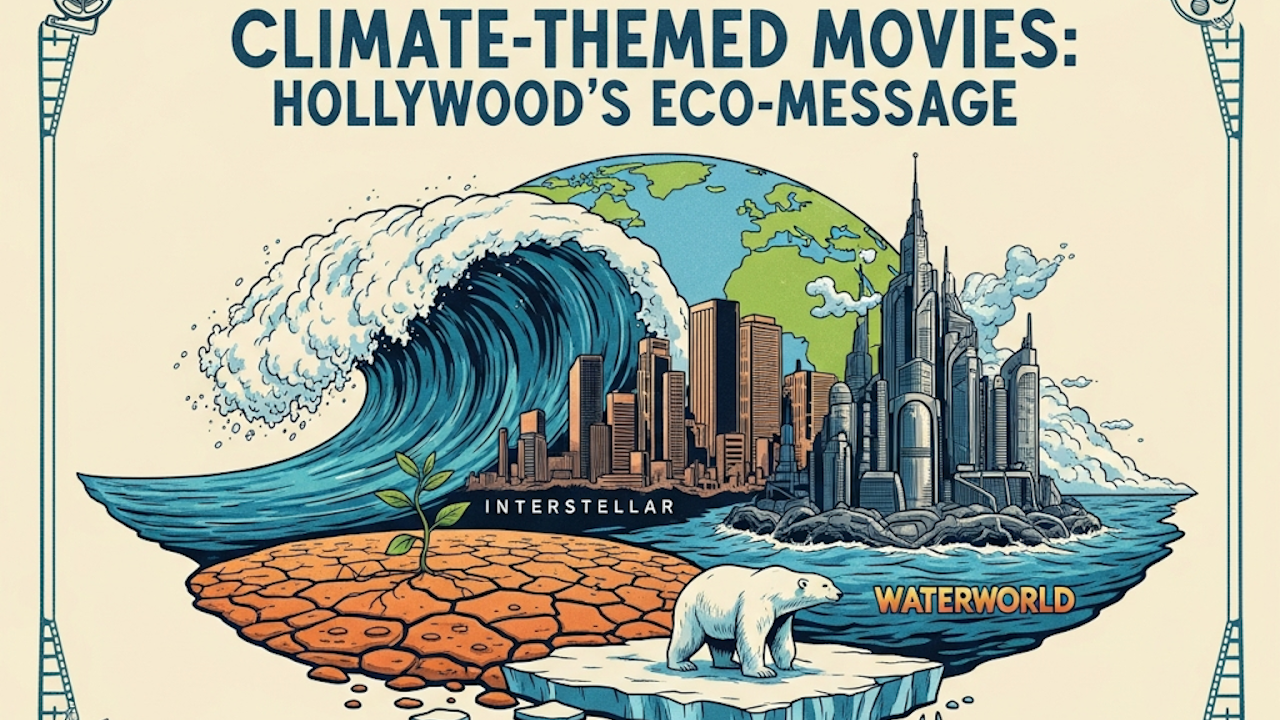
Hollywood has long served as a mirror to society’s anxieties, hopes, and moral dilemmas. In recent decades, one of the most pressing global challenges, climate change and environmental degradation, has found its way into the fabric of numerous films. From big-budget spectacles depicting apocalyptic disasters to intimate documentaries urging personal action, climate-themed movies have become a vehicle for Hollywood to deliver an eco-message. These productions aim not only to entertain but also to educate, provoke thought, and sometimes inspire behavioral change. Yet their effectiveness, sincerity, and artistic merit remain subjects of ongoing debate.
This article explores the rise of environmental storytelling in mainstream cinema, examines landmark films, assesses their cultural impact, and considers the contradictions within an industry that both promotes green themes and contributes significantly to carbon emissions.
The Evolution of Environmental Themes in Film
Environmental concerns in cinema predate the modern climate crisis discourse. Early films like Bambi (1942) highlighted human encroachment on nature through the lens of a young deer’s loss. In the 1970s, as the environmental movement gained momentum, movies such as Soylent Green (1973) portrayed a dystopian future marked by overpopulation, resource scarcity, and pollution. These narratives often blended science fiction with cautionary tales about unchecked industrial growth.
The late 20th century saw a surge in disaster films that implicitly or explicitly tied environmental collapse to human activity. However, it was not until the early 2000s that climate change emerged as a central theme. The release of Al Gore’s documentary An Inconvenient Truth in 2006 marked a turning point. The film presented scientific data on global warming through charts, personal anecdotes, and vivid imagery of melting ice caps and rising sea levels. It reached wide audiences and won an Academy Award, elevating climate discourse from scientific journals to popular culture.
Following this, fictional films began incorporating climate elements more boldly. Roland Emmerich’s The Day After Tomorrow (2004) dramatized abrupt climate shifts leading to a new ice age, with massive storms devastating cities. Though criticized for scientific inaccuracies, it grossed hundreds of millions and introduced the concept of rapid environmental catastrophe to mainstream viewers.
Landmark Climate-Themed Films and Their Messages
Several films stand out for their direct engagement with ecological issues. Pixar’s WALL-E (2008) offers a poignant animated critique of consumerism and waste. In a future where Earth is buried under mountains of trash, a solitary robot compacts garbage while humans live in luxury spaceships. The movie contrasts the beauty of nature with the sterility of overconsumption, ultimately advocating for stewardship and reconnection with the planet. Its wordless opening sequences powerfully convey environmental neglect without relying on heavy dialogue.
James Cameron’s Avatar (2009) transported audiences to Pandora, where indigenous Na’vi fight corporate exploitation of their world’s resources. The film’s environmental message is unmistakable: humans, driven by greed, destroy harmonious ecosystems. Its massive success demonstrated that eco-themes could support blockbuster entertainment, blending spectacle with commentary on colonialism and biodiversity loss.
Christopher Nolan’s Interstellar (2014) frames climate catastrophe as the catalyst for humanity’s search for new homes among the stars. Blight and dust storms ravage crops on a near-future Earth, forcing reliance on technology and exploration. The film underscores themes of sacrifice, ingenuity, and the fragility of planetary life while exploring relativity and human resilience.
Adam McKay’s Don’t Look Up (2021) takes a satirical approach. A comet hurtling toward Earth serves as an allegory for climate change and societal denial. Scientists struggle to alert politicians, media, and the public, only to face distraction, profit motives, and willful ignorance. The star-studded cast and biting humor highlight how misinformation and short-term thinking undermine collective action on existential threats.
Documentaries have played a complementary role. Leonardo DiCaprio’s Before the Flood (2016) follows the actor as he visits vulnerable regions, meeting scientists and activists. It emphasizes solutions alongside problems, covering renewable energy, policy shifts, and individual responsibility. Similarly, Chasing Ice (2012) uses time-lapse photography to document glacier melt, providing visual evidence that is difficult to dispute.
Other notable entries include Bong Joon-ho’s Snowpiercer (2013), which imagines a frozen Earth where survivors live on a perpetually moving train divided by class, and Darren Aronofsky’s mother! (2017), an allegorical tale interpreting environmental exploitation through a biblical lens.
Documentaries Versus Narrative Fiction
Climate-themed movies fall into two broad categories: documentaries and fictional narratives. Documentaries excel at presenting facts and real-world consequences. They often feature experts, data visualizations, and on-the-ground footage, aiming for persuasion through evidence. Their limitation lies in reaching primarily audiences already inclined toward environmentalism.
Fictional films, by contrast, leverage emotion, character arcs, and spectacle to engage broader demographics. Disaster blockbusters like 2012 or The Day After Tomorrow prioritize thrills over accuracy, sometimes leading to misconceptions about climate dynamics (such as confusing global warming with sudden cooling). Animated films and satires make complex ideas accessible to families and younger viewers.
Research suggests both formats can influence perceptions. Viewers of An Inconvenient Truth reported increased knowledge and concern. Fictional works may foster empathy or urgency, though effects are often short-term without sustained engagement.
Cultural Impact and Public Awareness
Hollywood’s eco-message has contributed to normalizing climate discussions. Films have helped shift public opinion by humanizing abstract scientific concepts. After The Day After Tomorrow, some polls showed temporary spikes in climate concern. Don’t Look Up sparked conversations about denialism during its release amid real-world crises.
These movies also influence policy indirectly. By raising visibility, they pressure leaders and corporations. Campaigns tied to films, such as DiCaprio’s advocacy, amplify messages beyond the screen. Streaming platforms have further expanded reach, allowing global audiences to encounter environmental stories.
However, impact varies. Optimistic narratives emphasizing solutions, like 2040 (2019), may motivate more effectively than pure doom-and-gloom scenarios, which risk fostering despair or apathy.
Criticisms and Hollywood’s Contradictions
Despite good intentions, climate-themed movies face valid critiques. Many prioritize entertainment over scientific precision, leading to exaggerated or simplified portrayals. Catastrophic spectacles can make real, gradual changes seem less urgent by comparison.
A deeper issue is hypocrisy. Film production is resource-intensive, involving private jets, massive sets, and international travel that generate substantial emissions. Blockbusters promoting environmentalism sometimes undermine their message through lavish premieres and merchandising. Critics point out that Hollywood rarely depicts systemic solutions like policy reform or collective organizing, favoring individual heroics instead.
Studies show climate references appear in only a small percentage of scripts, often confined to genre films rather than everyday stories. This absence in mainstream dramas and comedies suggests the industry still treats the crisis as speculative rather than immediate.
Some films, like Michael Moore’s Planet of the Humans, critique green energy solutions and spark internal debates within the environmental movement.
The Future of Eco-Cinema
As climate impacts intensify, demand for authentic storytelling grows. Emerging trends include more integrated narratives where environmental realities form the backdrop of human dramas, rather than the sole focus. Television series offer opportunities for longer explorations of slow-moving changes.
Collaborations between scientists, activists, and filmmakers could improve accuracy and creativity. Initiatives encouraging sustainable production practices, such as green sets and carbon offsets, represent steps toward aligning message with method.
Ultimately, Hollywood’s eco-message reflects both the power and limits of popular culture. Films can raise awareness, spark dialogue, and shift norms, but they cannot substitute for policy, technology, or grassroots action. By weaving environmental themes into compelling stories, cinema invites audiences to imagine different futures and consider their role in shaping them.
The challenge for storytellers remains balancing urgency with hope, accuracy with accessibility, and entertainment with advocacy. In an era of unprecedented environmental transformation, these movies serve as cultural artifacts, documenting not only our fears but also our capacity for reflection and change. As viewers, engaging critically with them encourages deeper understanding of the planet’s precarious balance and the choices that will determine its future.