

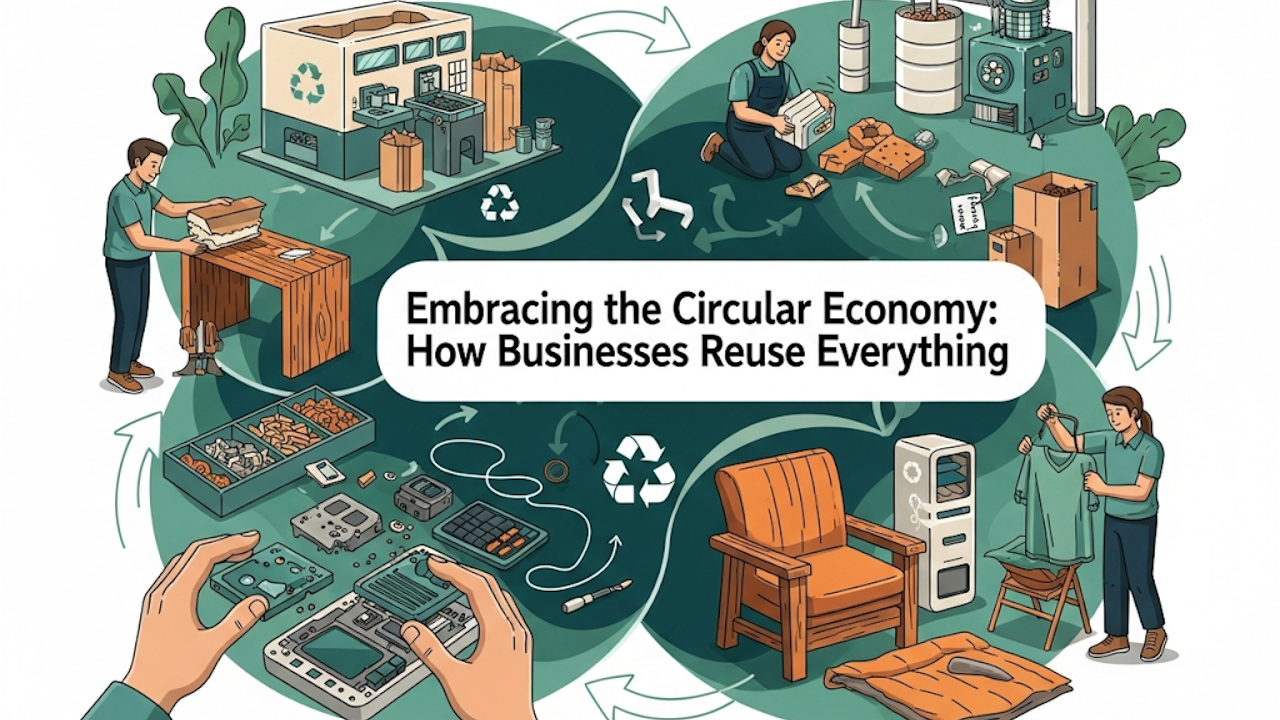
The traditional linear economy follows a straightforward path of take, make, and dispose. Companies extract raw materials, manufacture products, sell them to consumers, and then those items often end up in landfills after a short useful life. This model has fueled global growth for decades, but it has also created massive environmental problems, including resource depletion, pollution, and climate change. In contrast, the circular economy reimagines this process. It designs systems where waste is minimized or eliminated entirely. Products and materials stay in use for as long as possible through strategies like reuse, repair, refurbishment, remanufacturing, and high-quality recycling. The goal is to create closed loops that mimic natural ecosystems, where one process’s output becomes another’s input.
Businesses that embrace the circular economy do not just talk about sustainability. They build it into their core operations, often reusing everything from packaging to entire products. These companies demonstrate that profitability and environmental responsibility can align. By extending product lifecycles and recovering materials, they cut costs on virgin resources, reduce waste disposal fees, and meet growing consumer demand for ethical options. Regulatory pressures, such as extended producer responsibility laws in Europe, further encourage this shift. Yet the real drivers are innovation and long-term resilience. In a resource-constrained world, reusing everything is not just smart. It is essential for survival. This article explores the principles behind the circular economy and profiles pioneering businesses across industries that have committed to reusing nearly every element of their operations.
At its heart, the circular economy rests on three core principles. First, design out waste and pollution from the outset by choosing materials and processes that avoid harmful byproducts. Second, keep products and materials in use through durable design, repair services, resale, and remanufacturing. Third, regenerate natural systems by returning nutrients to the soil or using renewable energy. These ideas, popularized by organizations like the Ellen MacArthur Foundation, move beyond the old reduce-reuse-recycle mantra to create systemic change. Companies that succeed here treat waste as a design flaw rather than an inevitable outcome. They invest in take-back programs, modular product architectures, and partnerships that turn one firm’s leftovers into another’s raw materials. The result is often lower emissions, reduced water use, and new revenue streams from refurbished goods.
Fashion has long been one of the most wasteful industries, with fast production cycles and low recycling rates. Yet several brands have flipped the script by designing clothes that can be worn, repaired, resold, and recycled indefinitely. Patagonia stands out as a leader. The outdoor apparel company encourages customers to repair items through its Worn Wear program, which offers free repairs or guides for self-mending. Shoppers can also buy used Patagonia gear or trade in their old pieces for credit. When garments reach the end of their life, Patagonia recycles them into new fabrics. The brand prioritizes recycled and organic materials, aiming for more than 90 percent of its fabrics to come from such sources. This approach keeps textiles out of landfills and reduces the need for virgin cotton or petroleum-based synthetics. Patagonia’s model proves that high-quality, long-lasting products create loyalty while minimizing environmental harm.
Another fashion innovator, Mud Jeans, takes circularity even further with its Lease A Jeans program, launched in 2013. Customers pay a monthly fee to wear a pair of jeans rather than owning them outright. After a year or when the jeans wear out, they return the pair for free repairs during the lease or full recycling. Mud Jeans accepts returns from any brand, as long as the denim contains no more than 4 percent synthetic fibers. The company removes hardware like rivets and zippers, shreds the fabric, cleans it, and spins it into new yarn. The resulting denim incorporates up to 55 percent post-consumer recycled cotton, with plans to reach 100 percent recycled content soon. Non-recycled portions use certified organic cotton. This closed-loop system slashes water use by 87 percent and carbon dioxide emissions by 89 percent compared to conventional denim. Mud Jeans publicly shares life-cycle assessments to maintain transparency and pushes the industry toward conscious consumption. By treating jeans as a service rather than a disposable product, the company reuses almost every fiber and component.
Adidas has pursued similar goals in footwear. Its UltraBoost DNA Loop shoes use a single material, thermoplastic polyurethane, assembled without glue through heat-based processes. Once customers finish with the shoes, they return them to the company. The material is then recovered and reused in new products without downcycling or loss of quality. This design eliminates waste at every stage and keeps the entire shoe in the loop. Complementing this, Nike’s Reuse-A-Shoe program has recycled more than 148 million pounds of old trainers into Nike Grind material for surfaces like playgrounds and tracks. The company also accepts donations of footwear and apparel for either resale or recycling, further closing the loop.
In the home goods sector, IKEA has scaled circular practices across its massive retail network. The Swedish furniture giant operates buy-back programs where customers return unwanted items for store vouchers. Returned pieces receive a second life through as-is sections or dedicated second-hand stores, such as the one in Eskilstuna, Sweden. IKEA also distributes millions of free spare parts annually to help customers repair existing furniture rather than replace it. In 2024 alone, the company provided over 25 million assembly parts to 2.2 million customers. These efforts extend product lifespans and divert waste from landfills. IKEA further invests in recycling infrastructure and tests furniture leasing models. By designing for disassembly and using recycled materials in new products, the company aims to reuse or recycle nearly everything it sells.
Electronics present unique challenges because of rapid obsolescence and complex material mixes. Yet companies like Fairphone and Apple show how reuse can work even here. Fairphone designs modular smartphones with replaceable components, making repairs simple and affordable. Customers can swap out screens, batteries, or cameras without discarding the whole device. This approach keeps phones in use longer and reduces e-waste. Apple takes recovery to an industrial level. Its Daisy robot disassembles up to 1.2 million iPhones per year, recovering materials like gold, tungsten, and rare earth elements for reuse in new devices. Complementary robots like Taz and Dave target specific components. These systems allow Apple to close loops on high-value materials while minimizing mining demands. Google complements such efforts by remanufacturing servers and reselling retired components, achieving high landfill diversion rates in its data centers.
Philips, through its Signify lighting division, pioneered the concept of lighting as a service. Instead of selling bulbs or fixtures outright, the company retains ownership and sells illumination by the hour or square meter. At the end of a contract, Philips reclaims the hardware, refurbishes components, and reuses them in new installations. This model extends to medical equipment, where the firm refurbishes imaging devices and achieves 50 to 90 percent material reuse. Such strategies turn one-time sales into ongoing relationships and ensure that valuable parts circulate indefinitely.
Manufacturing offers some of the most impressive examples of industrial-scale reuse. Interface, the carpet tile pioneer, adopted a mission decades ago to eliminate negative environmental impact by 2020. The company collects used carpet tiles from clients, separates the yarns and backing, and remanufactures them into new products. This closed-loop process recaptures nearly all materials and has saved millions of pounds of virgin resources. On a broader scale, the Kalundborg Symbiosis in Denmark demonstrates how entire industrial ecosystems can reuse everything. Since the 1960s, companies including Novo Nordisk, Novozymes, and an energy plant have exchanged waste streams. One firm’s wastewater becomes another’s cooling water. Surplus steam heats homes and factories. Biomass from biotech processes generates biogas for refining. Gypsum from power production feeds construction materials. Today, 16 partners share more than 25 resource flows, turning what would be waste into valuable inputs and slashing collective emissions and costs.
Automotive and heavy equipment manufacturers have embraced remanufacturing. Renault operates circular strategies across vehicle lifecycles, from design to end-of-life dismantling. The company reuses or recycles parts and materials at scale. Toyota runs a circular factory program in Europe that processes thousands of end-of-life vehicles annually, giving new life to over 100,000 components each year at its UK site. Caterpillar and similar firms rebuild engines and machinery to like-new standards, often using 80 percent or more reused parts. These programs reduce raw material extraction and lower greenhouse gas emissions compared to building from scratch.
Packaging represents another frontier. TerraCycle partners with brands to recycle items traditionally considered unrecyclable, such as chip bags or toothbrushes. Its Loop platform delivers groceries in durable, reusable containers that customers return for cleaning and refilling. Brands like those in Burger King’s trials use deposit-based reusable burger boxes and drink cups that cycle through zero-waste cleaning systems. Thousand Fell applies similar logic to shoes, offering recycling credits through partnerships that keep materials in use. These initiatives shift from single-use plastics to perpetual loops.
The benefits of these models extend beyond the environment. Circular businesses often enjoy cost savings from recovered materials and stronger customer relationships through service-oriented offerings. They also future-proof against supply chain disruptions and regulatory changes. Yet challenges remain. Scaling take-back systems requires robust logistics and consumer participation. Designing for circularity from the start demands upfront investment and cross-industry collaboration. Global supply chains can complicate traceability, and some materials lose quality after repeated cycles. Public policy plays a crucial role here, with initiatives like the European Union’s Circular Economy Act aiming to standardize secondary material markets and boost reuse targets.
Looking ahead, technology will accelerate progress. Artificial intelligence can optimize sorting and predict maintenance needs. Digital product passports will track materials throughout their journeys. Advances in chemical recycling will handle mixed plastics more effectively. Consumer awareness continues to grow, favoring brands that deliver transparency and longevity. Businesses that reuse everything position themselves as leaders in a low-carbon, resource-efficient future.
The circular economy is not a distant ideal. It is already thriving in companies that treat every scrap, component, and product as a valuable asset. From Patagonia’s repaired jackets to Mud Jeans’ recycled denim, IKEA’s refurbished sofas to Apple’s recovered metals, these organizations prove that reusing everything creates economic value while safeguarding the planet. As more firms adopt these practices, the linear model will fade, replaced by loops that sustain both business and life on Earth. The transition demands creativity, collaboration, and commitment, but the rewards, a cleaner world and resilient economies, make the effort worthwhile. Consumers, policymakers, and entrepreneurs all have roles to play in supporting these pioneers and building a truly circular world.