

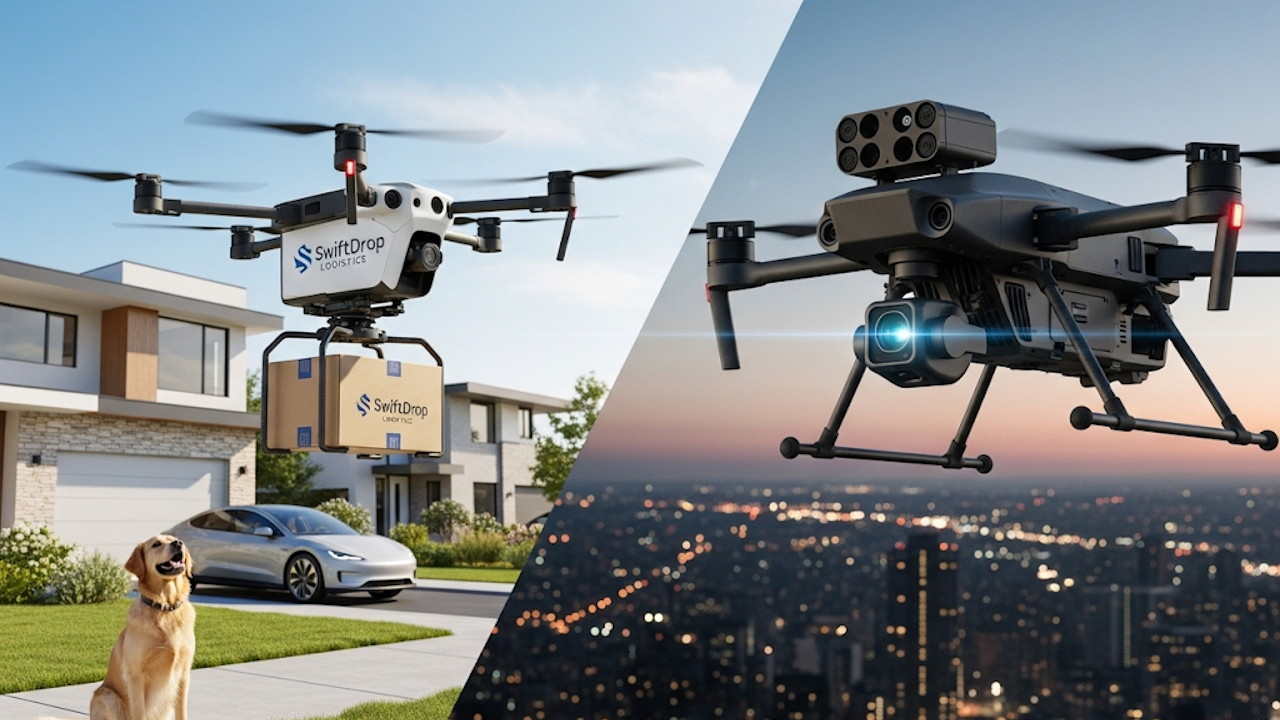
Autonomous drones represent one of the most transformative technologies of the 21st century. These unmanned aerial vehicles operate with minimal or no human intervention, relying on advanced artificial intelligence, sensors, and sophisticated algorithms to navigate, make decisions, and complete tasks. What began as experimental military projects has evolved into a versatile tool spanning commercial delivery services and high-stakes surveillance operations. This article explores the development, current applications, technical foundations, benefits, challenges, and future outlook of autonomous drones.
The concept of unmanned flight dates back to the early 20th century, with radio-controlled aircraft used in World War I and II for target practice and reconnaissance. True autonomy emerged later with improvements in computing power and sensor technology. In the 1990s and early 2000s, military programs like the Predator drone introduced remote operation, but full autonomy required breakthroughs in machine learning and real-time data processing. By the 2010s, companies such as Amazon, Google Wing, and DJI pushed civilian applications, while defense contractors refined systems for persistent intelligence gathering.
Today, autonomous drones integrate multiple technologies to function independently. Global Navigation Satellite Systems like GPS provide positioning, but in urban canyons or jammed environments, drones switch to visual inertial odometry, lidar, radar, and ultrasonic sensors. Onboard computers run pathfinding algorithms based on A-star or rapidly exploring random trees to avoid obstacles. Artificial intelligence models, often trained on vast datasets, enable object recognition, predictive behavior analysis, and adaptive decision making. Battery technology and electric propulsion have extended flight times, while swarm intelligence allows groups of drones to coordinate like flocking birds.
Delivery applications highlight the commercial potential of this technology. Amazon Prime Air, announced in 2013, envisioned 30-minute deliveries using small multirotor drones. Although regulatory hurdles delayed widespread rollout, trials in select regions demonstrated feasibility. A drone leaves a fulfillment center, flies a pre-approved corridor at low altitude, drops a package via winch or parachute at a designated spot, and returns. Wing, a subsidiary of Alphabet, has conducted thousands of deliveries in Australia and the United States, delivering everything from medicines to coffee. Medical delivery proves especially valuable in remote or congested areas. In Rwanda and Ghana, Zipline drones transport blood, vaccines, and emergency supplies to rural clinics, reducing delivery times from hours to minutes and saving lives during critical shortages.
E-commerce giants see autonomous delivery as a solution to last-mile challenges. Traditional trucking and van fleets struggle with traffic, driver shortages, and rising fuel costs. Drones bypass ground congestion entirely. A typical delivery drone carries up to five kilograms over distances of 10 to 20 kilometers. Advanced models incorporate weather-resistant designs, automatic return-to-home functions when batteries run low, and redundant communication links. Integration with ground robots or lockers further streamlines the process. Customers receive notifications with live tracking, and the drone hovers briefly before releasing the payload.
Beyond retail, autonomous drones support agriculture, infrastructure inspection, and disaster response. Farmers deploy them to monitor crop health through multispectral cameras that detect water stress or disease before visible symptoms appear. Energy companies inspect power lines and wind turbines for damage without sending crews into hazardous areas. After natural disasters such as earthquakes or floods, drones rapidly map affected zones, identify survivors, and deliver aid. These applications demonstrate how autonomy scales efficiency across industries.
Surveillance represents another major domain where autonomous drones excel. Law enforcement agencies use them for crowd monitoring, search and rescue, and crime scene documentation. Equipped with high-resolution cameras, thermal imaging, and microphones, drones provide real-time aerial views that ground officers cannot match. In disaster zones, they locate trapped individuals through heat signatures or structural analysis. Border patrol services deploy longer-endurance fixed-wing drones to cover vast territories, detecting illegal crossings or smuggling activity with minimal human oversight.
Military and defense applications push the boundaries of autonomous surveillance. Systems like the MQ-9 Reaper evolved from remotely piloted to increasingly autonomous platforms capable of loitering over targets for extended periods. Modern variants incorporate AI for target identification, reducing operator workload. Swarm technology allows dozens of small drones to overwhelm defenses, share data, and adapt formations in real time. These capabilities reshape modern warfare by providing persistent intelligence, surveillance, and reconnaissance without risking pilots.
Civilian surveillance also raises important questions. Cities experiment with drone fleets for traffic management and public safety. Police departments in several countries test automated patrol drones that respond to 911 calls or monitor high-crime areas. Privacy advocates express concern over constant aerial observation and data collection. Clear regulations are essential to balance security benefits with individual rights. Many jurisdictions now require warrants for targeted surveillance, data retention limits, and transparent usage policies.
The technical challenges of autonomy remain significant. Reliable operation in complex environments demands robust artificial intelligence that can handle uncertainty. A drone must distinguish between a plastic bag blowing in the wind and a bird, or navigate around construction cranes that were not on previous maps. Edge computing processes data locally to minimize latency, while 5G and satellite links provide backup connectivity. Cybersecurity poses another risk; hackers could attempt to hijack control signals or spoof GPS. Manufacturers implement encrypted communications, anomaly detection, and fail-safe mechanisms that force landing in safe zones.
Energy management limits current capabilities. Most small delivery drones fly for 20 to 40 minutes before recharging. Hybrid systems combining electric motors with internal combustion engines or hydrogen fuel cells promise longer endurance. For surveillance missions requiring hours or days aloft, solar-powered high-altitude pseudo-satellites offer intriguing possibilities. These aircraft operate in the stratosphere, functioning like stationary satellites but with the flexibility to reposition.
Regulatory frameworks evolve alongside the technology. The Federal Aviation Administration in the United States and the European Union Aviation Safety Agency have established rules for beyond-visual-line-of-sight operations, remote identification, and airspace integration. Drones must broadcast their identity and location, much like aircraft transponders. Approval processes for fully autonomous flights involve safety assessments, redundancy requirements, and risk analyses. International harmonization remains incomplete, complicating cross-border operations.
Economic impacts are substantial. The global drone market is projected to grow rapidly, with delivery and surveillance segments leading expansion. Job creation occurs in manufacturing, software development, maintenance, and data analysis. However, displacement of traditional delivery workers and pilots requires workforce transition strategies. Insurance companies develop new policies covering autonomous operations, factoring in reduced human error but introducing algorithmic liability questions.
Ethical considerations accompany these advancements. Autonomous weapon systems spark debate about lethal decision-making without human oversight. Even non-lethal surveillance drones collect massive amounts of personal data, raising questions about consent and potential misuse. Developers and policymakers advocate for ethical guidelines, including transparency in AI decision processes and prohibitions on certain applications. Public trust depends on demonstrating responsible deployment.
Looking ahead, several trends point to greater integration of autonomous drones into daily life. Urban air mobility concepts envision drone taxis and cargo networks sharing airspace with traditional aircraft through advanced traffic management systems. Artificial intelligence will improve through larger models and better simulation environments, leading to safer and more capable systems. Material science advances will produce lighter, stronger frames and more efficient batteries. Quantum sensors may enhance navigation in GPS-denied environments.
Integration with other emerging technologies amplifies potential. The Internet of Things allows drones to communicate with smart city infrastructure, adjusting routes based on traffic lights or construction updates. Blockchain could secure delivery logs and surveillance footage against tampering. Augmented reality interfaces will help operators supervise multiple drones simultaneously when needed.
Challenges persist in public acceptance. Some communities worry about noise pollution, visual intrusion, or safety risks from malfunctioning aircraft. Educational campaigns and demonstration projects help address these concerns by showcasing benefits in concrete terms. Transparent data policies and community oversight boards can build confidence.
In conclusion, autonomous drones have progressed from niche military tools to essential assets in delivery, surveillance, and numerous other fields. Their ability to operate independently transforms logistics, public safety, and environmental monitoring. Continued innovation in artificial intelligence, energy systems, and regulatory frameworks will determine how fully society harnesses this technology. Balancing innovation with safety, privacy, and ethical standards remains the central task for developers, governments, and citizens alike. As capabilities expand, autonomous drones promise to reshape how goods move, how spaces are monitored, and how humans interact with the skies above. The coming decades will reveal whether these machines become seamless extensions of modern infrastructure or sources of new societal tensions. Responsible development and inclusive governance offer the best path toward realizing their positive potential while mitigating risks.