

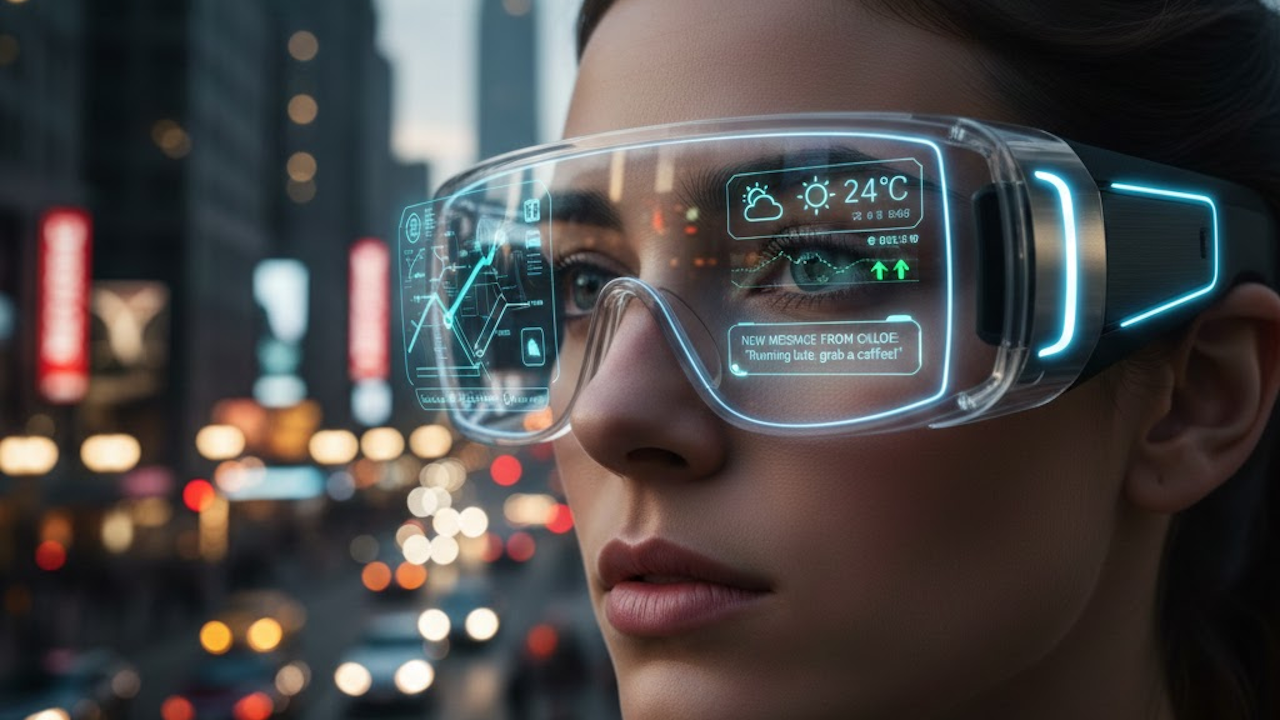
Augmented reality glasses, often called AR glasses or smart glasses, represent one of the most promising frontiers in personal computing. These devices overlay digital information, images, and interactive elements directly onto the user’s view of the real world. Unlike virtual reality headsets that immerse users in entirely simulated environments, AR glasses enhance everyday reality, allowing people to navigate, work, learn, and connect while staying present in their physical surroundings.
As of 2026, AR glasses have moved beyond early prototypes and niche enterprise tools into a growing consumer market. Shipments of AR and VR devices combined with display-less smart glasses continue to rise rapidly, driven by lighter designs, better displays, and integration with artificial intelligence. This article explores the evolution, technology, current offerings, applications, challenges, and future potential of AR glasses.
A Brief History of AR Glasses
The concept of augmented reality dates back decades, with early experiments in heads-up displays for military pilots. Consumer interest surged in the 2010s. Google Glass, launched in 2013, was one of the first widely publicized attempts at consumer AR eyewear. It featured a small display in the upper right of the wearer’s field of view, a camera, and voice controls. While innovative, it faced criticism for its bulky design, privacy concerns related to the camera, and limited battery life. Google pivoted the product toward enterprise use before eventually shelving the consumer version.
Other early efforts included Microsoft’s HoloLens in 2016, which brought more advanced spatial mapping and gesture controls but remained heavy and expensive, targeting professional applications. Magic Leap’s One in 2018 used diffractive waveguide optics but struggled with high costs and underwhelming real-world performance for consumers. Snap’s Spectacles introduced camera-equipped glasses for social sharing, evolving over generations toward fuller AR capabilities.
The mid-2020s marked a turning point. Meta’s collaboration with Ray-Ban produced stylish smart glasses that achieved mainstream success, initially focusing on cameras and audio before adding small displays. Chinese manufacturers like XREAL, RayNeo, Rokid, and Viture accelerated innovation with affordable, lightweight models featuring Micro-OLED displays. By 2025 and 2026, the market saw explosive growth, with shipments increasing significantly and AI integration becoming standard.
How AR Glasses Work
At their core, AR glasses combine several key technologies to blend virtual content with the real world seamlessly.
The process begins with sensors. Cameras, IMUs (inertial measurement units), and sometimes depth sensors or LiDAR scan the environment and track the user’s head, hands, and gaze. This data feeds into processors that run simultaneous localization and mapping (SLAM) algorithms to understand the user’s position and the surrounding space.
Next comes the display system. Micro-displays such as Micro-OLED or emerging Micro-LED generate the virtual image. Light from these displays travels through optics, typically waveguides, to reach the user’s eyes. Waveguides are thin pieces of glass or plastic that use total internal reflection to guide light across the lens. Diffractive or geometric structures then couple the light out toward the eye, creating the illusion of virtual objects floating in the real world.
Birdbath optics offer an alternative, using mirrors to reflect and magnify the image, but they often result in darker or bulkier lenses. Waveguides enable slimmer, more transparent designs that better resemble ordinary eyewear. Brightness, field of view (FOV), and transparency remain critical metrics. Current models achieve 40 to 70 degrees FOV, with brightness levels up to 1600 nits for better outdoor visibility.
Power management is crucial. Many devices rely on onboard batteries supplemented by processing in external pucks or connected phones. Eye tracking, hand gestures, voice commands, and touch controls provide intuitive input methods. AI enhances functionality by enabling real-time object recognition, translation, and contextual assistance.
Current Landscape of AR Glasses in 2026
The market in 2026 offers options across price points and capabilities.
Meta’s Ray-Ban smart glasses lead in consumer adoption. The latest generations include models with small monocular displays for notifications, navigation, and captions, while maintaining fashionable designs. They excel in audio, cameras, and AI features like real-time translation, with strong sales figures.
Rokid’s AI Glasses stand out for their lightweight design at just 49 grams, making them among the most comfortable full-function AR options. Priced accessibly, they include binocular displays, cameras, and AI capabilities.
XREAL and RayNeo offer strong value in the display-focused segment. Models like the XREAL xbx a01+ and RayNeo Air series provide large virtual screens for media consumption and productivity at prices around 300 dollars, with high brightness and good ergonomics. Viture’s Beast and similar devices target entertainment with impressive color and refresh rates.
Enterprise-oriented options from companies like Microsoft (HoloLens successors) and Vuzix emphasize durability, wider FOV, and integration with industrial software. Snap’s newer Spectacles push creative AR tools. Upcoming releases from Google and Samsung on the Android XR platform promise broader ecosystem support.
Prices range from under 300 dollars for entry-level display glasses to over 2000 dollars for advanced prototypes or enterprise units. Weights have dropped below 70 grams for many consumer models, approaching ordinary eyewear.
Applications Transforming Daily Life and Work
AR glasses shine across diverse use cases.
In everyday consumer scenarios, they provide hands-free navigation with directional arrows overlaid on streets. Real-time translation displays subtitles for conversations or signs in foreign languages. AI assistants can identify objects, offer information about landmarks, or assist with shopping by comparing prices and reviews visually. For entertainment, users enjoy giant virtual screens for movies, games, or multitasking, turning commutes or travel into immersive experiences.
Productivity benefits are substantial. Professionals can access documents, emails, or video calls without pulling out a phone or laptop. Remote experts can guide field technicians with overlaid instructions and annotations. In manufacturing and logistics, workers receive step-by-step assembly guidance or pick-by-vision systems that highlight items, reducing errors and training time.
Healthcare applications include surgical navigation, patient data overlays, and training simulations. Education gains interactive 3D models for subjects like anatomy or history. Creative fields use AR for design visualization, digital art, and collaborative reviews.
The integration of generative AI amplifies these capabilities, allowing natural language queries about the environment and proactive contextual suggestions.
Challenges and Limitations
Despite progress, hurdles remain.
Battery life often limits continuous use to a few hours for display-heavy tasks. Heat management and weight distribution affect comfort during extended wear. Display brightness struggles in direct sunlight for many models, and field of view is narrower than natural human vision.
Privacy concerns persist due to cameras and always-on sensors. Social acceptance requires designs that avoid the “cyborg” look of early prototypes. Cost, while decreasing, still barriers widespread adoption. Technical issues like latency, alignment drift, and limited processing power in fully untethered form factors need resolution.
Regulatory questions around data collection and safety in various environments add complexity.
The Future Outlook
Looking ahead, AR glasses are poised for broader mainstream integration. Advances in Micro-LED displays promise higher brightness, efficiency, and color accuracy with lower power use. Improved waveguides and metasurfaces will enable wider FOV in slimmer profiles. On-device AI and better batteries or energy harvesting could support all-day use.
Major players like Apple are expected to enter with dedicated AR glasses, potentially in late 2027 or beyond, building on Vision Pro learnings. Google and Samsung’s Android XR efforts will expand the developer ecosystem. By the end of the decade, AR glasses could evolve into primary computing devices for many, supplementing or partially replacing smartphones in daily tasks.
Market forecasts suggest strong growth, with consumer and enterprise segments expanding rapidly. True all-day wearable AR with seamless spatial computing may arrive within a few years, fundamentally changing how people interact with information and each other.
Conclusion
AR glasses offer a compelling vision of the future: one where technology fades into the background, enhancing rather than distracting from the world around us. From humble beginnings with Google Glass to today’s lightweight, AI-powered models, the journey reflects rapid innovation in optics, computing, and human-computer interaction.
While challenges in comfort, privacy, and performance remain, the trajectory is clear. These new lenses do not just let us see the world differently; they enable us to engage with it more intelligently, productively, and creatively. As the technology matures and becomes more accessible, AR glasses have the potential to redefine everyday life in ways we are only beginning to imagine. The next chapter in personal technology is unfolding right before our eyes.